
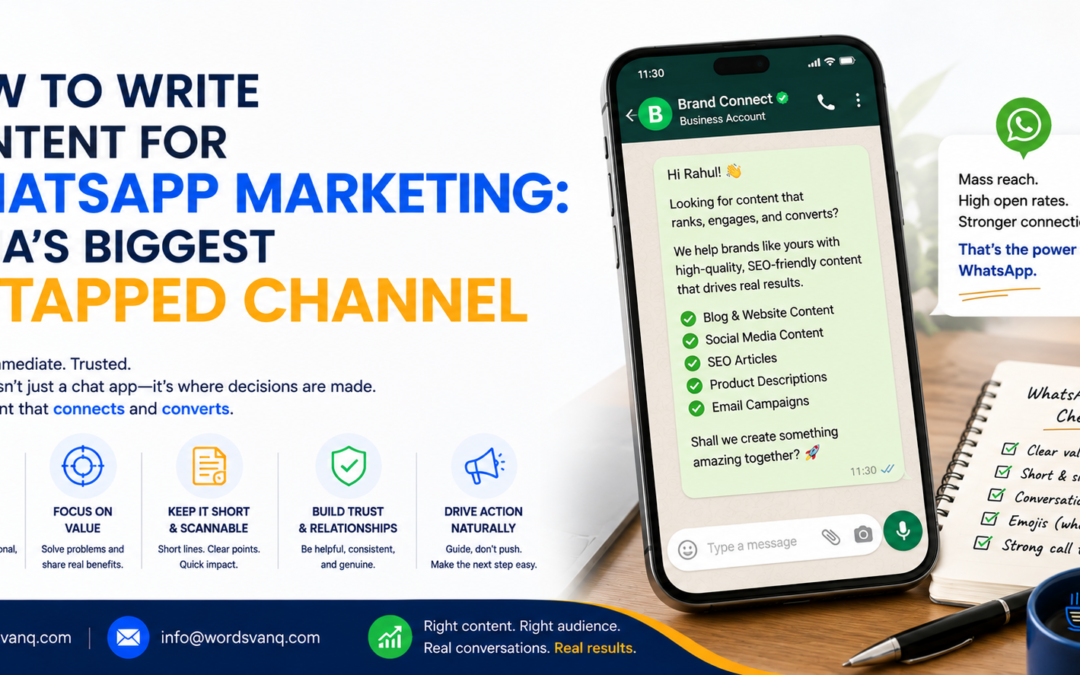
India has 500M+ WhatsApp users, the world’s largest base.
WhatsApp messages get a 98% open rate vs. 21% for email.
WhatsApp Business has 50M+ business users in India.
Indian consumers prefer WhatsApp for brand communication.
KEY TAKEAWAYS
✓ WhatsApp has a 98% message open rate in India, making it the highest-reach marketing channel available to any Indian business.
✓ WhatsApp content writing is fundamentally different from email or social media; it must feel personal, conversational, and genuinely valuable.
✓ The first line of any WhatsApp message is the most important; it appears in the notification preview and determines whether the message gets opened or ignored.
✓ WhatsApp Business API allows segmented broadcasts, automated sequences, and interactive buttons, but the content quality determines their effectiveness.
✓ The golden rule of WhatsApp marketing: never send anything you would not be comfortable receiving from a brand yourself.
✓ WordsVanq creates WhatsApp message content, broadcast sequences, and multi-channel content strategies for Indian businesses.
Your email newsletter has a 22% open rate on a good day. Your Facebook post reaches 3% of your followers. Your Google ad Two percent of the people who see your Google ad click on it. by 2% of the people who see it. And then there is WhatsApp, where 98% of messages get opened, most within three minutes of delivery, by the 500 million Indian users who check the app an average of 25 times per day.
WhatsApp is not just India’s most popular messaging app. It is the primary communication channel for the majority of Indian consumers, used for everything from family conversations to business negotiations, from customer service to product discovery. And yet most Indian businesses treat WhatsApp as an afterthought, sending spammy broadcast messages that get ignored or blocked, or using it only for customer service queries.
The Indian businesses that are growing fastest in 2026 understand something their competitors have not yet grasped: WhatsApp is a content channel, not just a messaging channel. The content you send on WhatsApp, how it is written, structured, timed, and targeted, determines whether it builds customer relationships and drives sales or gets blocked and reported as spam. This guide gives you the complete framework for writing WhatsApp marketing content that This guide provides a comprehensive framework for crafting WhatsApp marketing content that Indian customers read, click, and act upon. by Indian customers. And for businesses that need professional content writing services to handle multiple channels at scale, WordsVanq is ready to help.
Why WhatsApp Is India’s Most Powerful and Most Misunderstood Marketing Channel
India has more WhatsApp users than any other country in the world. According to Meta’s own data, there are over 500 million WhatsApp users in India, more than the entire population of the European Union. The app is used across all income levels, all age groups, and all geographies, from metro cities to the most remote rural villages. In many parts of India, WhatsApp is not just the most popular messaging app; it is the internet.
For Indian businesses, this creates an unparalleled marketing opportunity. No other channel gives you direct, personal access to your customers in a space they check dozens of times per day. No other channel has a 98% open rate. No other channel allows you to send rich media, images, PDFs, videos, and voice notes in a conversational context that feels personal rather than promotional.
Why Most Indian Businesses Are Getting WhatsApp Wrong
Despite this extraordinary potential, most Indian businesses use WhatsApp marketing in ways that actively damage their brand. The most common mistakes:
- Mass-blasting promotional messages to unverified contact lists with no personalization or permission
- Copying their email newsletter content into WhatsApp without adapting for the channel’s conversational format
- Sending too frequently, bombarding customers with daily promotional messages that feel intrusive
- No clear value offer: sending messages that serve the business (promotions, announcements) without genuinely serving the customer
- Ignoring replies, using WhatsApp as a one-way broadcast channel rather than a two-way conversation
The businesses that get WhatsApp right understand that this channel demands a fundamentally different content approach from email, social media, or advertising. It demands conversational, personalized, genuinely valuable content that respects the intimacy of the space.
WhatsApp Content vs Email Content vs Social Media Content: The Key Differences
Before writing a single word of WhatsApp content, you need to understand how this channel differs from the other content channels you already use. Getting the channel tone wrong is the fastest way to earn a block.
| Dimension | Social Media | ||
|---|---|---|---|
| Tone | Professional, formal, or semi-formal | Brand voice, often aspirational | Conversational, personal, direct |
| Length | 200 to 1,000+ words | 50 to 300 characters typical | 50 to 300 characters, brevity essential |
| Format | HTML with images, headers, buttons | Rich visual with captions | Text + one image or document—keep simple. |
| Frequency | Weekly or fortnightly is standard. | Daily posting is normal. | 2 to 4 times per month maximum for broadcasts |
| Open Context | Reader at desk, some dedicated reading time | Scrolling feed, competing for attention | Notification on phone, high attention but time-limited |
| Relationship Feel | One-to-many broadcast | One-to-many broadcast | One-to-one conversation (even in broadcast) |
| Content Goal | Inform, nurture, convert | Engage, build brand, drive traffic | Deliver immediate value, prompt specific action. |
| Failure Mode | Low open rate, unsubscribe | Low engagement, scroll past. | Block, report as spam, permanent relationship damage |
“WhatsApp is the only marketing channel where your customer has to actively let you in. Treat that permission with more respect than any other channel you use.”
The WhatsApp Content Writing Framework: 5 Principles
These five principles underpin every piece of effective WhatsApp marketing content. Apply all five to every message you send.
Principle 1: The First Line Is Everything
On WhatsApp, the first 50 to 60 characters of your message appear in the notification preview before the recipient opens it. This preview is what determines whether they open the message or ignore it. If the first line does not immediately communicate value, the message will not be opened, regardless of how good the rest of it is.
First-line comparison:
✘ Weak: Dear Valued Customer, We are pleased to announce our latest offer on all products this month.
✔ Strong: Rahul, your order is ready. Pick it up by 7 PM today and get free delivery next time.
The weak first line opens with a generic greeting and leads with what the brand wants to say. The strong first line uses the customer’s name, immediately tells them something relevant to them, and creates a reason to open.
Principle 2: Write Like a Human, Not a Brand
WhatsApp lives in the same space as messages from family, friends, and colleagues. A message that reads like a press release or a marketing brochure is immediately jarring and out of place. WhatsApp content should sound like it was written by a real person who knows the recipient.
✘ Weak: We are delighted to present our exclusive range of products at discounted prices for a limited period.
✔ Strong: Quick heads up, we just restocked your favorite face wash. Only 30 units are left, and it usually sells out by Thursday.
Principle 3: One Message, One Action
Every WhatsApp message should have one clear purpose and ask for one specific action. A message that promotes a sale, announces a new product, shares a blog post, and asks for a review is asking the recipient to do four things—and they will do none of them.
Define the single action you want the recipient to take before writing the message. Buy now. Reply yes to confirm. Click the link. Share with one friend. Then write the entire message to drive that one action.
Principle 4: Lead With the Recipient’s Benefit, Not the Brand’s News
The most common WhatsApp content mistake is writing from the brand’s perspective rather than the customer’s. ‘We are launching our new collection’ is brand-first. ”Your wardrobe update just arrived, and you get early access before we open to everyone else’ is customer-first. The information is the same. The perspective is completely different, and the second version is dramatically more compelling.
Principle 5: Always Include a Clear, Easy Next Step
Every WhatsApp message should make it effortless for the recipient to take the desired action. Include a direct link (not ‘visit our ‘website’—the actual URL). Include a phone number to call or a ‘Reply YES’ option. Include a catalog link if you are promoting products. The easier you make the next step, the higher your conversion rate.
Types of WhatsApp Marketing Content That Work in India
Not all WhatsApp content serves the same purpose. Here are the most effective WhatsApp content types for Indian businesses, with guidance on when to use each one:
| Content Type | When to Use | Key Writing Principle | Example Opening |
|---|---|---|---|
| Transactional Updates | Order confirmation, delivery status, appointment reminders | Be specific and actionable; include order numbers, times, and links. | Your order #4521 has been dispatched. Track here: [link] |
| Exclusive Offers | Flash sales, early access, loyalty rewards | Make the exclusivity real, ‘only for WhatsApp subscribers.’ | 24-hour early access for you: 30% off before we go public with this sale. |
| Value-Added Tips | Industry tips, how-to advice, useful information relevant to your product | Give genuine value with no direct promotion, build trust | Quick tip: Apply sunscreen 20 mins before stepping out in the sun. |
| Re-engagement | Inactive customers, abandoned carts, lapsed buyers | Acknowledge the gap, and offer a reason to return. | It has been a while! Here’s something just for you, 20% off your next order. |
| Launch Announcements | New products, new services, new locations | Lead with what is new for the customer, not what is new for the brand. | Something you asked for is finally here, [product]. Limited stock, first access for you. |
| Event Invitations | Webinars, in-store events, launches, demos | Create urgency with limited spots or timing. | Join us live this Saturday at 11 AM; only 50 spots. Reply YES to save your seat. |
| Feedback Requests | Post-purchase, post-service, post-event | Keep it extremely short, one question maximum. | How was your experience with us? Reply 1-5 (1 = poor, 5 = excellent). |
Writing WhatsApp Messages for Different Indian Business Types
WhatsApp content looks different depending on your business type, your customer relationship, and what you are trying to achieve. Here are message examples across the most common Indian business categories, showing the conversational, personalized approach that works.
E-commerce and Retail
Abandoned cart recovery message:
Hi Priya! You left something behind. Your Kanjivaram silk saree in deep burgundy is still in your cart—and we only have 2 pieces left in your size. Complete your order in the next 2 hours, and we will add free gift wrapping: [cart link]. Reply HELP if you need assistance.
Real Estate
New project alert for interested leads:
Hi Amit, Remember the 2 BHK you inquired about in Wakad? We just got a similar unit in the same project—2nd floor, east-facing, possession in December 2026. Price: Rs 68 lakhs. Pre-launch pricing ends this Friday. Want to schedule a site visit this weekend? Reply “YES,” and I will confirm a time.
Healthcare and Clinic
Appointment reminder:
Hi Sunita, This is a reminder that your dental check-up with Dr. Mehta is tomorrow, Thursday, 24th July, at 11:30 AM. Please carry your previous X-rays if you have them. Need to reschedule? Reply RESCHEDULE, and our team will call you within 30 minutes.
Coaching and Education
Free resource offer to prospective students:
Hi Rohan, You attended our JEE webinar last week. Here is the free 30-day study plan we promised: [PDF link] We also have 3 seats left in our July batch starting this Monday. Fee: Rs 18,000 with EMI option. Want more details? Reply NOW and we will call you in 10 minutes.
B2B Services and Agencies
Follow-up after a proposal:
Hi Vikram, Just checking in on the content proposal I sent on Monday. Happy to hop on a 15-minute call to walk you through the approach or answer any questions. We have 2 onboarding slots open for August. Would Thursday or Friday work for a quick call?
Notice the consistent pattern across all examples: a personalized name, specific and relevant content, one clear next step, and a conversational tone that feels like a message from a person who knows you, not a broadcast from a brand that is selling to you.
WhatsApp Business API vs WhatsApp Business App: What You Need to Know
There are two ways Indian businesses use WhatsApp for marketing: the free WhatsApp Business app and the WhatsApp Business API. Understanding the difference helps you choose the right approach and write content for the right format.
| Feature | WhatsApp Business App (Free) | WhatsApp Business API (Paid) |
|---|---|---|
| Who It Is For | Small businesses and solopreneurs | Medium and large businesses, agencies |
| Broadcast Limits | Up to 256 contacts per broadcast | Unlimited (subject to quality rating) |
| Message Templates | Freeform messaging to saved contacts | Pre-approved templates required for broadcast |
| Automation | Basic auto-replies only | Full chatbot and automated sequences possible |
| Segmentation | Manual, limited to contact labels | Advanced, segmented by behavior, purchase history, and tags |
| Interactive Buttons | Not available | Reply buttons and list menus available |
| Analytics | Basic read receipts only | Delivery, open, click, and conversion tracking |
| Best Content For | Personal customer conversations, small broadcasts | Scalable marketing sequences, transactional messages |
For most Indian SMBs starting with WhatsApp marketing, the free WhatsApp Business app is the right starting point. As volume and sophistication grow, the WhatsApp Business API (through partners like Interakt, Wati, Gupshup, or AiSensy) allows full automation, segmentation, and scale.
WhatsApp Content Templates for Indian Businesses
Use these templates as starting points for your own WhatsApp marketing messages. Personalize every template with the recipient’s name and specific relevant details before sending.
Template 1: Flash Sale Announcement
Hi [Name]! [Your Brand] Flash Sale – 6 hours only. [Product/Service]: [Discount]% off, valid until [Time] today only. [Link to offer] Reply STOP to unsubscribe.
Template 2: New Arrival / Launch
Hi [Name], New in: [Product Name]—[one sentence about what makes it special]. [Key detail: price / size / flavor / feature] Order before [Date/Time] and get [benefit: free delivery / gift / discount]. [Direct link]
Template 3: Re-engagement
Hi [Name], we miss you! It has been [X weeks/months] since your last order. As a thank you for being a customer, here is [X]% off your next purchase. Code: [CODE] (valid for 48 hours) [Link] – Shop now
Template 4: Appointment / Event Reminder
Hi [Name], Reminder: [Appointment/Event name] is [tomorrow/on Day, Date] at [Time]. [Location or link if virtual] Need to change the time? Reply RESCHEDULE and we will sort it for you.
Template 5: Referral Program
Hi [Name]! You loved [product/service]; now share that love. Refer a friend and both of you get [benefit]. Just share this link: [Unique referral link] No limit on referrals. Every friend you refer = [benefit] for you.
WhatsApp Marketing Rules and Compliance for Indian Businesses
WhatsApp has strict policies around marketing messages, and violating them can result in your business number being permanently banned. Beyond WhatsApp’s own policies, India’s DPDP (Digital Personal Data Protection) Act 2023 imposes legal obligations on businesses that collect and use personal data, including phone numbers.
■ Always get explicit opt-in consent before adding contacts to your broadcast list.
You must have clear, documented consent from every contact before sending them marketing messages on WhatsApp. ‘ Signing up for WhatsApp updates on your website, a verbal opt-in confirmed via WhatsApp reply, or a form that explicitly includes WhatsApp marketing consent are all acceptable. Buying or scraping phone numbers and adding them to broadcasts is a policy violation that can result in a permanent account ban.
■ Always include an easy opt-out option.
Every marketing message must include a clear way for recipients to stop receiving messages. ‘Reply STOP to unsubscribe’ is the standard approach. Process opt-outs immediately; continuing to message someone who has opted out is a DPDP compliance violation and a fast path to being reported as spam.
■ Never use WhatsApp Business API for messages users have not specifically requested
The WhatsApp Business API requires pre-approved message templates for proactive marketing messages. These templates are reviewed by Meta before approval. Do not attempt to work around this by disguising promotional content as transactional messages; Meta’s review system identifies this and will reject or ban accounts that try.
■ Respect quiet hours
Sending WhatsApp marketing messages between 9 PM and 9 AM is both poor practice and potentially a DPDP compliance issue if it constitutes unwanted intrusion. Indian consumer expectations are that marketing messages arrive during business hours. Scheduling tools on WhatsApp Business API platforms allow precise timing control.
How WordsVanq Creates WhatsApp Marketing Content
At WordsVanq, WhatsApp content writing is part of our broader multi-channel content service for Indian businesses. We understand that WhatsApp requires a completely different writing approach from the blog posts, website copy, and email newsletters that make up most content marketing programs, and we adapt accordingly.
| What Words Vanq Does | How It Improves Your WhatsApp Marketing |
|---|---|
| WhatsApp Content Strategy | We map your WhatsApp content to your customer journey, what to send, when, to whom, and through which stage of the funnel. |
| Message Sequence Writing | We write complete WhatsApp broadcast sequences—welcome series, nurture sequences, re-engagement campaigns, and post-purchase follow-ups. |
| API Template Copywriting | We write WhatsApp Business API-compliant message templates that pass Meta’s approval process on the first submission. |
| Personalization Framework | We build personalization frameworks that go beyond first-name insertion, referencing customer purchase history, preferences, and behavior. |
| A/B Testing Variations | We write two or three variations of key messages for A/B testing to identify which approach performs best. |
| Compliance Review | We review all WhatsApp content for DPDP compliance, opt-out inclusion, and WhatsApp policy adherence. |
| Multi-Channel Integration | We ensure WhatsApp content works in coordination with your email, social media, and website content for a consistent brand voice. |
Conclusion
WhatsApp is the most powerful marketing channel available to Indian businesses right now, and it is the most underused. The businesses that learn to use it well, with conversational content, genuine personalization, and real value in every message, have access to a direct line to their customers that no other channel can match.
The writing principles are not complicated. Write like a person, not a brand. Lead with the recipient’s benefit. Make the first line worth opening. Ask for one clear action. Respect the intimacy of the space. These principles, applied consistently, turn WhatsApp from a spammy broadcast tool into a genuine relationship-building and revenue-driving channel.
If your business needs professional WhatsApp content writing as part of a broader multi-channel content strategy, WordsVanq is ready to help. We write the content. You build the customer relationships.
Ready to turn WhatsApp into a revenue channel? Get professional content from WordsVanq.
Visit: wordsvanq.com/contact-us | Call: +91 9555844324 | Email: info@wordsvanq.com
Frequently Asked Questions
Q: What is WhatsApp marketing content writing?
A: WhatsApp marketing content writing is the craft of writing messages for WhatsApp Business that are personalised, conversational, and designed to drive a specific customer action. It is fundamentally different from email or social media content writing, requiring much shorter messages, a conversational, human tone, a single clear call to action, and an understanding of the intimate, personal nature of the WhatsApp space.
Q: How long should a WhatsApp marketing message be?
A: WhatsApp marketing messages should be as short as possible while still delivering complete value. The ideal length is 50 to 150 words for most marketing messages. The first line (50 to 60 characters) appears in the notification preview and must immediately communicate value. Messages longer than 200 words are rarely read in full on WhatsApp – break any longer content into a short teaser message with a link to the full content on your website or as a document.
Q: What is the best time to send WhatsApp marketing messages in India?
A: Research on WhatsApp open rates in India shows that messages sent between 10 AM and 12 PM and between 7 PM and 9 PM on weekdays have the highest open and response rates. Avoid sending before 9 AM or after 9 PM. For B2B audiences, weekday morning slots (9:30 to 11 AM) work best. For consumer audiences, evenings (7 to 9 PM) typically see the highest engagement.
Q: How is the WhatsApp Business API different from the WhatsApp Business app?
A: The WhatsApp Business app is a free tool for small businesses that allows broadcasts to up to 256 contacts at a time using saved contacts. The WhatsApp Business API is a paid platform (accessed through Meta-approved partners like Interakt, Wati, or Gupshup) that allows unlimited broadcasts to opted-in contacts, automated message sequences, advanced segmentation, interactive buttons, and detailed analytics. The API requires pre-approved message templates for proactive marketing messages.
Q: Can WordsVanq write WhatsApp marketing content for my business?
A: Yes—WordsVanq writes WhatsApp marketing message sequences, broadcast templates, and API-compliant message templates for Indian businesses across all industries. We write WhatsApp content as part of integrated multichannel content strategies that also cover blogs, email newsletters, and social media, ensuring a consistent voice and coordinated messaging across every customer touchpoint.