
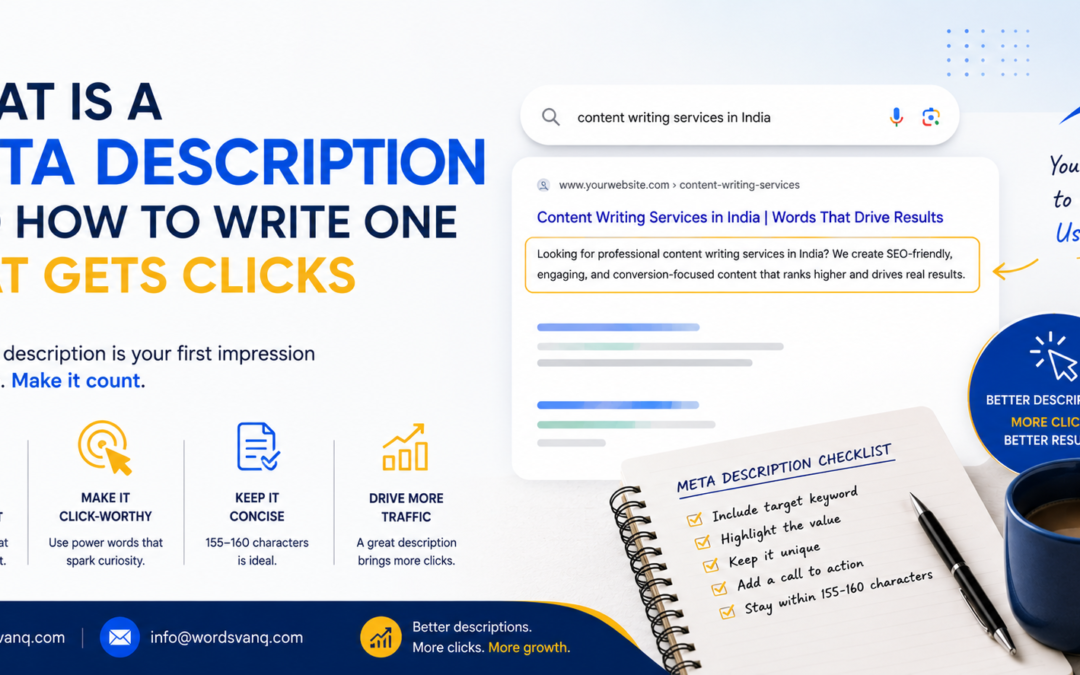
Meta descriptions influence 43% of all click decisions.
Pages with optimized meta descriptions get 5.8% more clicks.
Google rewrites meta descriptions 63% of the time.
Most Indian business pages have missing or weak meta descriptions.
Key Takeaways
- A meta description is the 150–160 character text snippet that appears below your page title in Google search results.
- Meta descriptions do not directly affect Google rankings, but they powerfully affect click-through rate, which indirectly affects rankings.
- Google rewrites approximately 63% of meta descriptions, but writing strong ones still matters because Google uses them when they are better than what it can generate.
- The perfect meta description includes the target keyword, a clear benefit, and a specific call to action, all within 155 characters.
- Missing meta descriptions, descriptions over 160 characters, and duplicate descriptions across pages are the three most common and most damaging meta description mistakes.
- WordsVanq writes SEO-optimized meta descriptions for every page of content we produce for Indian business clients.
You have worked hard to rank your page on Google. Your content is good. Your keywords are right. Your page finally appears on page one. And then nobody clicks on it.
This is one of the most frustrating situations in SEO and one of the most common. A page that ranks but does not get clicked is earning nothing from its ranking. And in most cases, the reason is simple: the meta description is weak, missing, or completely irrelevant to what the searcher actually wants.
Your meta description is the short text that appears below your page title in Google search results. It is the first, and sometimes only, chance you have to persuade a searcher to click your result instead of the five others on the same page. Research by Portent shows that pages with well-written, relevant meta descriptions achieve up to 5.8% higher click-through rates than pages with missing or generic descriptions. That difference compounds directly into traffic, leads, and revenue.
This guide explains exactly what a meta description is, how it affects your Google rankings and click-through rate, and, most importantly, how to write meta descriptions that make searchers choose your result. We include real before-and-after examples, SERP preview simulations, and a step-by-step framework you can apply to every page on your website today. And for businesses that need professional SEO content writing services to handle this at scale, WordsVanq is ready to help.
What Is a Meta Description?
A meta description is a short piece of HTML code, placed in the head section of a webpage, that provides a brief summary of what the page is about. It is the descriptive text that Google (and other search engines) typically display beneath the page title and URL in search results.
Here is what a meta description looks like in the HTML code of a webpage:
<meta name=”description” content=”Learn exactly how to write SEO-optimized meta descriptions that get more clicks on Google. Real examples, templates, and a step-by-step framework for Indian businesses.” />
And here is how it looks in Google search results:
wordsvanq.com > blog > meta-description
What Is a Meta Description and How to Write One That Gets Clicks | WordsVanq
Learn exactly how to write SEO-optimized meta descriptions that get more clicks on Google. Real examples, templates, and a step-by-step framework for Indian businesses.
The meta description does not appear on the page itself; it is invisible to visitors who are already on your page. It exists purely to inform search engines and influence the decision of searchers who are still on the results page, deciding which result to click.
Do Meta Descriptions Affect SEO Rankings?
This is one of the most frequently asked questions about meta descriptions, and the answer requires a clear distinction between direct and indirect effects.
Direct Effect: No
Google has confirmed that meta descriptions are not a direct ranking factor. Google’s algorithm does not use the content of your meta description to determine where your page ranks for a given keyword. You could have a perfect meta description or no meta description at all, and it would not directly change your position in search results.
Indirect Effect: Significant
However, meta descriptions have a powerful indirect effect on your rankings through click-through rate (CTR). Here is how the chain works:
- A well-written meta description earns more clicks from searchers on the results page.
- More clicks from the same ranking position signal to Google that your result is satisfying searcher intent.
- Google interprets this as a quality signal and may improve your ranking position over time.
- A higher-ranking position earns even more clicks, compounding the benefit.
Conversely, a poor or missing meta description reduces your CTR. Even if you rank in position 3, a weak description can cause searchers to skip your result in favor of positions 4 or 5 with more compelling descriptions. Over time, this reduced CTR sends a negative quality signal that can push your ranking down.
“Think of your meta description as a miniature advertisement for your page. Ranking is getting your ad placed. The meta description is the ad copy that determines whether anyone responds to it.”
How Long Should a Meta Description Be?
Meta description length is one of the most commonly misunderstood aspects of on-page SEO. Here is everything you need to know about length in 2026:
| Screen Type | Visible Characters | Recommendation |
|---|---|---|
| Desktop | Approximately 155 to 160 characters | Write up to 155 characters for full desktop display. |
| Mobile | Approximately 120 characters | Front-load your most important content in the first 120 characters. |
| Google Rich Snippets | Variable can be shorter or longer | Structure your description to work well even if Google trims it. |
| Best Practice (2026) | 120 to 155 characters | Aim for this range to display well on both desktop and mobile |
The consequence of going over 155 to 160 characters is that Google truncates your description with an ellipsis (…), cutting off potentially important information. The consequence of going under 50 characters is that your description feels incomplete and fails to fill the available display space, leaving potential benefits unclaimed.
Character Count vs. Word Count
Writers often think in words rather than characters, which can cause confusion. As a rough guide:
- 120 characters is approximately 18 to 22 words.
- 155 characters is approximately 23 to 28 words.
- Always count characters before finalizing your meta description, word count alone is not reliable.
Tip: Use a free online character counter or your SEO plugin’s built-in character counter to verify your meta description length before publishing. Most WordPress SEO plugins (Yoast and Rank Math) show a real-time character count and a green/amber/red indicator as you type.
The Anatomy of a Perfect Meta Description
A high-performing meta description is not just a random sentence about your page. It has a specific structure that combines the right elements in the right order. Here is the anatomy of a perfect meta description:
Element 1: The Target Keyword (Near the Beginning)
Include your primary target keyword as early as possible in the meta description. Google bolds keywords in meta descriptions when they match the searcher’s query, making your result more visually prominent and increasing click-through rate. When the keyword appears near the beginning, it catches the eye immediately.
Element 2: The Key Benefit or Promise
What does this page give the reader? What problem does it solve? What question does it answer? The benefit should be specific and directly relevant to what the searcher is looking for. ‘Learn how to…’ is weak. Learn exactly how to write meta descriptions that get 5% more clicks, with real Indian business examples’ is specific and compelling.
Element 3: A Differentiator or Proof Point (Where Possible)
If you can include something specific that sets your page apart from the other results, a number of examples, a specific framework, a data point, or a unique angle, it significantly increases click-through rate. ’14 real before-and-after examples’ is more compelling than ‘with examples.’
Element 4: A Call to Action
Every meta description should end with a brief call to action that tells the searcher what to do. ‘Read the guide,’ ‘Get a free quote,’ ‘See the examples,’ and ‘Start here.’ The CTA gives the searcher a reason to click now rather than scrolling down to compare other results.
The Formula:
[Target keyword] + [specific benefit] + [differentiator if possible] + [call to action] = under 155 characters
How to Write a Meta Description: Step by Step
Here is the step-by-step process for writing a high-performing meta description for any page on your website:
Step 1: Identify the Primary Keyword for the Page
Your meta description should include the exact keyword your page is targeting, because Google bolds that keyword in the search result when it matches the query. Use the same primary keyword you used in your page title and H1 heading. For a blog post about content writing services in Mumbai, the primary keyword might be ‘content writing services in Mumbai,’ and your meta description should include that phrase naturally.
Step 2: Identify the Searcher’s Core Intent
What is the searcher actually trying to accomplish? Are they looking for information, comparing options, ready to buy, or trying to complete a specific task? The meta description must match this intent precisely. A searcher looking for ‘how to write meta descriptions’ wants a guide with actionable steps. A searcher looking for ‘meta description writing service’ wants to hire someone. The same page should not target both with the same description.
Step 3: Write the Benefit Statement First
Before worrying about length, write out the single most compelling reason a searcher should click your result. What is the specific, tangible benefit they will get? Be specific: not ‘learn about meta descriptions’ but ‘learn exactly how to write meta descriptions that increase your click-through rate by 5% or more. ‘ Then you will edit for length.
Step 4: Add Your Differentiator
If your page has a specific feature that sets it apart, such as real examples, a downloadable template, a checklist, a specific number of tips, or India-specific context, include it. ‘With 12 real before-and-after examples for Indian businesses, tell the searcher something specific about what makes your page worth clicking over the others.
Step 5: Add a Call to Action.
End with a short action phrase. ‘Get the full guide,’ ‘See real examples,’ ‘Start writing better descriptions today,’ and ‘Read now.’ The CTA creates a gentle sense of direction that can significantly improve click-through rate.
Step 6: Count Characters and Edit to 120 to 155.
Paste your draft into a character counter. If it is over 155 characters, identify the least important element and cut or shorten it. If it is under 100 characters, it is too short; add more specific benefits or proof. The target range of 120 to 155 characters gives you full display on desktop and good display on mobile.
Meta Description Examples: Before and After
The fastest way to understand what separates a strong meta description from a weak one is to see the difference side by side. Here are six before-and-after examples across different Indian business types.
| Business Type | Before (Weak) | After (Strong) |
|---|---|---|
| Content Writing Agency | “We provide content writing services for all types of businesses. Contact us to know more.” | “Content writing services in India for SEO-driven growth. 500+ articles delivered, 98% client retention. Get a free content sample today.” |
| Coaching Center in Lucknow | “Best coaching center in Lucknow. Join now for quality education.” | “Coaching center in Lucknow for Class 9-12 & competitive exams. 15 years, 2,000+ selections. Book a free demo class today.” |
| Real Estate Agent in Pune | “We help you buy and sell property in Pune easily.” | “Real estate agent in Pune for 2-3 BHK flats near Hinjewadi & Waka d. RERA-registered, 300+ closed deals. View listings now.” |
| Healthcare Clinic | “Our clinic offers the best healthcare services for you and your family.” | “Multi-speciality clinic in [city] for same-day appointments. 20+ specialists, cashless insurance accepted. Book your slot online.” |
| SaaS Product | “Our software helps businesses manage their work more efficiently.” | “Project management software for small teams. Cut missed deadlines by 40% with automated task tracking. Start your free trial.” |
| E-commerce Product Page | “Buy this product online at the best price. Fast delivery available.” | “Buy [product name] online—4.6★ rated, 2,000+ reviews. Free delivery in 2 days, easy 7-day returns. Shop now.” |
Notice the consistent pattern across all strong examples: they include a specific keyword, a concrete benefit or proof point (a number, a specific location, or a specific feature), and a clear call to action. They answer the searcher’s unspoken question, ‘Why should I click this result specifically?’ before the click is made.
Why Google Rewrites Your Meta Description, And What to Do About It
A study by Portent found that Google rewrites meta descriptions approximately 63% of the time. This surprises many website owners who spend time carefully crafting descriptions, only to find Google is showing something completely different in search results.
Why Does Google Rewrite Meta Descriptions?
Google rewrites your meta description when it believes a different piece of text from your page would better serve the searcher’s specific query. This happens most often when:
- Your meta description does not contain the keywords the user searched for.
- Google finds a passage in your page body that more directly answers the query.
- Your meta description is too short, too long, or contains formatting issues.
- The query is highly specific, and your description is too generic to address it.
What This Means for Your Strategy
The fact that Google rewrites descriptions 63% of the time does not mean you should stop writing them. Here is why:
- When your description is well-written and keyword-relevant, Google uses it rather than rewriting it, giving you control over your result’s appearance.
- Even when Google rewrites the description, having a good meta description in your HTML can influence which portion of your page Google is selected as the replacement
- Descriptions are shown in social media previews and other contexts where Google’s rewriting does not apply; your written description appears there.
- Writing a strong description forces you to think clearly about your page’s core value proposition, a useful discipline regardless of what Google displays.
The best strategy: write a strong, keyword-rich, benefit-focused meta description for every page. Accept that Google may sometimes rewrite it, but trust that your well-written description will be used when it is better than what Google can generate from your page content.
Meta Description Mistakes That Cost You Clicks
These are the most common meta description mistakes we see on Indian business websites, each one directly reducing click-through rates and wasting hard-earned Google rankings:
Missing meta descriptions on key pages
When a page has no meta description, Google generates one automatically by pulling text from the page. This automated description is almost always less compelling than a carefully written one because Google is not trying to persuade the searcher to click—it is just extracting relevant text. Check every important page on your website for missing meta descriptions and add them immediately.
Descriptions over 160 characters
Google truncates long meta descriptions with an ellipsis, cutting off the end of your text. If your call to action or your key differentiator appears at the end of a 200-character description, searchers never see it. Always count characters before publishing and stay within 155.
Duplicate meta descriptions across multiple pages
Having the same meta description on multiple pages tells Google and searchers that these pages have the same content. It reduces your distinctiveness in search results and misses the opportunity to write descriptions that match each page’s specific content and target keyword. Every page needs a unique meta description.
No keyword in the description
When your meta description does not include the searcher’s keyword, Google does not bold anything in your result. The absence of bold text makes your result less visually prominent on the results page, reducing the click-through rate even when your ranking position is good.
Generic descriptions that could apply to any business:
‘We provide quality services with experienced professionals. ‘Contact us today.’ This description could appear on the result for a plumber, a lawyer, a content agency, or a car dealership. It tells the searcher nothing specific about what your page offers and gives them no reason to choose your result.
Keyword stuffing in the description
‘Content writing, content writing services, best content writing in India, content writing agency’ keyword-stuffed descriptions look spammy to searchers, may be ignored by Google, and demonstrate no understanding of what searchers actually want. Use your primary keyword once, naturally, in a sentence that makes genuine sense.
Meta Description Templates for Common Indian Business Page Types
Use these templates as starting points for your own meta descriptions. Replace the bracketed placeholders with your specific details; the more specific you are, the better your description will perform.
| Page Type | Meta Description Template |
|---|---|
| Homepage | [Primary keyword] for [target audience] in [city/India]. We deliver [key benefit] with [proof point]. [CTA]. |
| Service Page | Professional [service name] in [city]. [Specific benefit with number or proof]. [Differentiator]. [CTA]. |
| Blog Post | Learn exactly how to [solve problem] with this complete guide. Includes [number] real examples, a [checklist/template], and a step-by-step framework. [CTA]. |
| Location Page | Looking for [service] in [specific area/city]? [Key benefit]. [Number of clients/years of experience]. [CTA]. |
| Product Page | [Product name] — [key feature that solves buyer’s problem]. [Proof point: rating, number of reviews, or delivery detail]. [CTA]. |
| About Us Page | [Company name] is [brief description] serving [target market] since [year]. [Key differentiator]. Meet the team behind [company name]. [CTA]. |
| Contact Page | Get in touch with [company name] — [location or service area]. We respond to all inquiries within [timeframe]. [CTA]. |
| Case Study | How [client type] achieved [specific result] using [your service/product] in [timeframe]. Read the full case study. [CTA]. |
How WordsVanq Handles Meta Descriptions for Every Client
At WordsVanq, meta descriptions are not an afterthought; they are a built-in part of every content piece we produce. Every blog post, service page, and landing page we write includes a fully crafted, character-counted, keyword-optimized meta description delivered with the content and clearly marked in our metadata block at the top of each piece.
| What WordsVanq Does | How It Helps Your Click-Through Rate |
|---|---|
| Primary Keyword Research Per Page | We ensure the correct primary keyword is included in the meta description for every piece of content, matched to your target search terms. |
| Benefit-Led Description Writing | We write descriptions that lead with the specific benefit the reader gets, not generic summaries that could apply to any business. |
| Character Count Verification | Every description is counted to 120-155 characters before delivery. No truncation in search results, and no wasted space either. |
| Unique Descriptions for Every Page | Every page gets its own unique, tailored meta description, no duplicates across your content, ever. |
| CTA Integration | Every description ends with a context-appropriate call to action that creates a reason to click now rather than later. |
| Metadata Block in Every Deliverable | Meta title, meta description, URL slug, and tags are all included at the top of every piece we deliver, ready for your publishing team to use as-is. |
Conclusion
A meta description is a small piece of text, 120 to 155 characters long. But it has an outsized impact on one of the most important metrics in SEO: how many people actually click your result after seeing it on Google.
The formula is not complicated. Include your target keyword. State a specific, compelling benefit. Add a proof point or differentiator where you can. End with a clear call to action. Stay within 155 characters. Do this for every page on your website, and your click-through rates will improve measurably over the following weeks and months.
If you need professional, SEO-optimized content with well-crafted meta descriptions for every page, written by experienced human writers who understand what Indian audiences click on, WordsVanq is ready to help. We write the content. We write the meta descriptions. You publish and watch the traffic grow.
Want SEO content with expert meta descriptions for every page? Talk to WordsVanq today.
Visit: wordsvanq.com/contact-us | Call: +91 9555844324 | Email: info@wordsvanq.com
Frequently Asked Questions
Q: What is a meta description in SEO?
A: A meta description is a short HTML element, typically 120 to 155 characters, that summarizes what a webpage is about. It appears as the descriptive text beneath the page title and URL in Google search results. While meta descriptions are not a direct Google ranking factor, they significantly influence click-through rate, which indirectly affects rankings over time.
Q: How long should a meta description be in 2026?
A: The recommended length for meta descriptions in 2026 is 120 to 155 characters. This range ensures full display on desktop screens (which show up to 160 characters) while keeping the most important content visible on mobile screens (which show approximately 120 characters). Always count characters, not words, when checking your meta description length.
Q: Does Google always use the meta description I write?
A: Research by Portent found that Google rewrites meta descriptions approximately 63% of the time, selecting a passage from the page body that it considers more relevant to the specific search query. However, writing a strong, keyword-rich, benefit-focused meta description is still important, Google uses your written description when it is better than what it can generate, and your description appears in contexts beyond Google search (social media previews, other search engines, etc.).
Q: Should every page on my website have a unique meta description?
A: Yes. Every page should have its own unique meta description that accurately reflects that specific page’s content and targets that page’s primary keyword. Duplicate meta descriptions across multiple pages send a weak quality signal to Google and miss the opportunity to write click-optimizing text for each page’s specific audience and intent.
Q: Can WordsVanq write meta descriptions for my existing website pages?
A: Yes—Words Vanq can audit your existing website pages for missing, duplicate, or underperforming meta descriptions and rewrite them to our proven formula. We also include a character-counted, keyword-optimized meta description with every new piece of content we produce. Contact us to discuss a meta description audit and rewrite for your website.