
KEY TAKEAWAYS
- Schema markup is code that helps Google understand your content and display it more richly in search results.
- Rich results (star ratings, FAQs, prices, events) earn 20 to 30% more clicks than standard search results.
- Only 17% of websites currently use schema markup, making it a significant competitive advantage for early adopters.
- JSON-LD is the recommended format for schema markup and can be added without changing your visible page content.
- The most important schema types for Indian businesses are LocalBusiness, FAQPage, Article, Product, and Review.
- Schema markup also improves your chances of being cited by Google AI Overviews, ChatGPT Search, and Perplexity.
- WordsVanq creates content structured for schema implementation and advises on the right markup for every page.
You have spent time and money getting your website to rank on Google. You have written blogs, built backlinks, and optimized your meta titles. But there is one powerful SEO tool that most Indian businesses have never touched, and it is silently costing them clicks, visibility, and customers every single day.
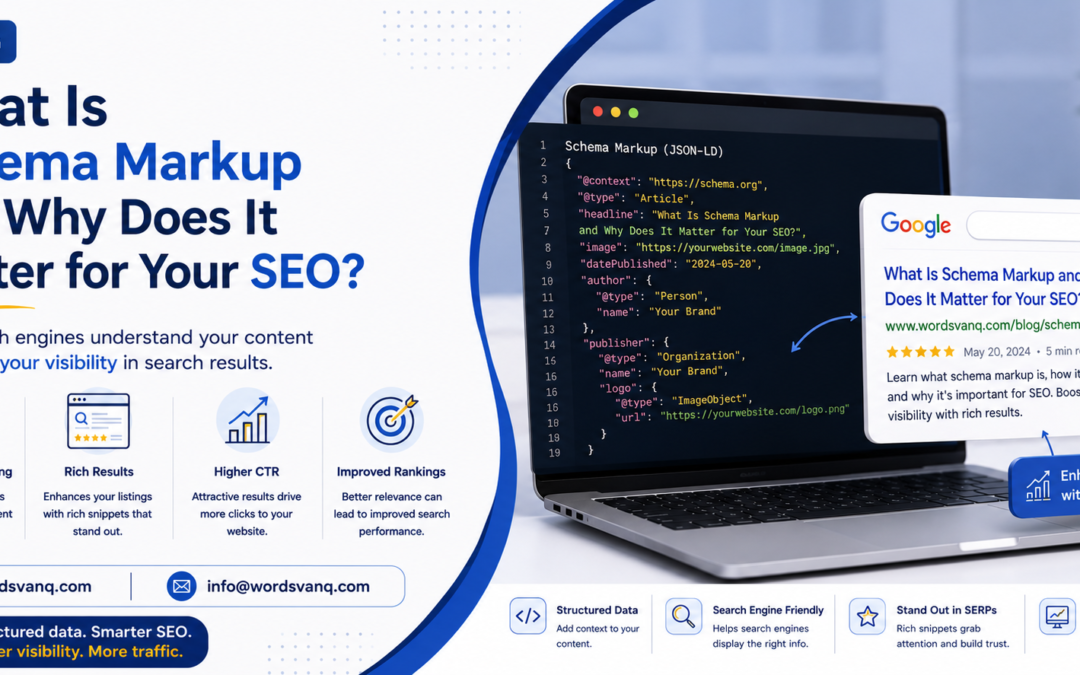
That tool is schema markup. Also called structured data, schema markup is a small piece of code you add to your web pages that helps Google understand your content far more precisely. And when Google understands your content better, it can display it more richly in search results with star ratings, FAQs, prices, event dates, and more appearing directly on the results page.
These enriched search results, called ‘rich results’ or ‘rich snippets,’ earn significantly more clicks than standard blue-link results. Pages with schema markup earn 20 to 30% more click-through rate on average. And with Google AI Overviews now citing pages more frequently when structured data is present, schema markup has never been more valuable.
In this guide, we will explain exactly what schema markup is, how it works, which types matter most for Indian businesses, and how to implement it, even if you are not a developer. We will also explain how WordsVanq builds schema-ready content that helps your website earn richer, more prominent Google results.
What Is Schema Markup? A Plain-English Explanation
Let us start with the simplest possible explanation.
When you write a blog post or create a service page, you can read it and understand it immediately. You know whether it is an article, a product listing, a business profile, or an FAQ. You can see the author’s name, the publication date, the star rating, and the price.
Google can read your words too, but it has to guess at a lot of the context. Is this page about a business, or is it just mentioning one? Is the number on this page a price, a phone number, or a year? Is the content a review of a product or just an opinion piece?
Schema markup removes all the guesswork. It is a standardized vocabulary of tags maintained by Schema.org, a collaboration between Google, Microsoft, Yahoo, and Yandex that lets you label your content explicitly. You are essentially saying to Google: this number is a price, this date is when this event happens, this person is the author, and these five stars represent a customer review rating.
When Google understands this context clearly, it can display your content in much richer, more visually prominent ways in search results, giving your listing a significant appearance advantage over competitors who have not implemented schema.
A Simple Real-World Example
Imagine two restaurants in Jaipur, both ranking on page one of Google for ‘best restaurant in Malviya Nagar, Jaipur. Restaurant A has standard schema markup with star ratings and review count. Restaurant B has no schema.
In the search results, Restaurant A’s listing shows the name, address, a 4.8-star rating, 312 reviews, opening hours, and a price range indicator. Restaurant B’s listing shows just a title, URL, and meta description.
Which result do you think gets clicked more? Restaurant A, every time. That is the power of schema markup in practice.
How Schema Markup Works Technically
You do not need to be a developer to understand how schema markup works, but a basic understanding of the mechanics helps you make better decisions about implementing it on your website.
The Three Formats: JSON-LD, Microdata, and RDFa
Google recommends JSON-LD as the preferred format for schema markup, and it is by far the easiest to implement. Here is a brief overview of all three formats:
| Format | What It Is | Recommended? |
| JSON-LD | A block of JavaScript code placed in the page’s head or body section. Does not require changes to your visible HTML. | Yes, Google’s recommended format |
| Microdata | Schema attributes added directly into your existing HTML tags (e.g., itemprop, itemscope). Requires editing your visible HTML code. | Acceptable but more complex |
| RDFa | Similar to microdata, attributes are embedded directly in HTML. Mainly used for specific use cases like government documents. | Not recommended for most websites |
The main advantage of JSON-LD is that you can add it to any page without touching your visible content or HTML structure. You simply paste a block of code into the page, typically in the head section, and Google reads it independently of the rest of the page. This makes JSON-LD much easier to add, test, update, and remove than the alternatives.
What JSON-LD Schema Markup Looks Like
Here is a simple example of what JSON-LD schema markup looks like for a local business in India.
This is the kind of code that goes into the head section of your website:
<script type=”application/ld+json”> { “@context” “https://schema.org”, “@type
“Local Business”. “name” “WordsVanq Content Writing Agency”. “description”: “Professional content writing services in India”, “url”: “https://wordsvanq.com”. “addressLocality”: “Delhi”, “addressRegion”: “Delhi”, “addressCountry”: “IN” } aggregateRating”: { “@type”: “AggregateRating”, “ratingValue”: “4.9”, “reviewCount”:
telephone: +91-9555844324″, “address”: (“@type”: “PostalAddress”.
“128” } } </script>
When Google crawls this page, it reads this code and immediately understands: this is a local business; here is its name and contact information; it has 128 reviews with an average rating of 4.9 out of 5. This is exactly the information Google needs to show a rich result for this business.
The Most Important Schema Types for Indian Businesses
Schema.org defines hundreds of schema types covering everything from academic papers to video games. But for the vast majority of Indian businesses, a focused set of 8 to 10 schema types covers everything you need. Here are the most important ones:
1. Local Business Schema
Best for: Every business with a physical location or local service area
The LocalBusiness schema is the single most important schema type for Indian businesses with a physical presence. It tells Google your business name, address, phone number, opening hours, price range, and service area, all the information Google needs to show your business in local search results and Google Maps.
For businesses in specific categories, use a more specific subtype: “Restaurant” for food businesses, “Medical Clinic” for healthcare, “Legal Service” for law firms, and “Educational Organization” for schools and coaching centers.
Key properties to include: name, address, phone, opening hours, geocoordinates, service area, price range, and aggregate rating.
2. FAQPage Schema
Best for: Blog posts, service pages, and any page with question-and-answer content
FAQPage schema is one of the highest-impact schema types for content-heavy pages. When implemented correctly, Google can display your FAQ questions and answers directly in search results, giving your page significantly more visual real estate and earning clicks without users even needing to visit your site.
More importantly for 2026, FAQPage schema is one of the most frequently cited data sources by Google AI overviews. Pages with FAQPage schema are more likely to have their content extracted and used in AI-generated answers.
Key properties to include: Question text, answer text (paired for each FAQ item)
3. Article and BlogPosting Schema
Best for: Every blog post and news article on your website
Article schema (or its subtype BlogPosting) tells Google that this page is a written article with a specific author, publication date, modified date, and headline. This improves how Google displays your articles in search results and in Google News and is an important E-E-A-T signal because it associates content with a named, credible author.
For Indian content writing agencies and marketing businesses, article schema on every blog post is a basic requirement for competitive SEO.
Key properties to include: headline, author name and URL, publisher, datePublished, dateModified, image, description
4. Product and Offer Schema
Best for: E-commerce businesses, product listings, and any page selling a specific item
Product schema enables Google to display your product’s price, availability, and star rating directly in search results, creating rich product snippets that dramatically outperform standard results for shopping-intent searches. For Jaipur jewelry businesses, Kanpur leather exporters, or any Indian e-commerce seller, product schema is essential for competitive visibility.
Key properties to include are product name, description, image, SKU, price, currency, availability, and aggregate rating.
5. Review and AggregateRating Schema
Best for: Any business collecting customer reviews – restaurants, hotels, clinics, and agencies
Star ratings displayed in search results are among the most powerful click-through rate drivers available. Pages with visible star ratings earn significantly more clicks than the same page without ratings. The review schema and aggregateRating schema enable Google to display these stars, but only when the reviews are genuine and collected on your own website (not pulled from Google, Zomato, or other third-party platforms).
Key properties to include: Rating value, review count, reviewer name, review body, date of review
6. How-to Schema
Best for: Step-by-step guide and tutorial content
The HowTo schema tells Google that your page contains a step-by-step guide. Google can then display the steps directly in search results as a rich result, with each step listed visibly. For content writing agencies, digital marketing firms, and educational businesses that publish how-to content regularly, HowTo schema significantly improves the visibility of that content.
Key properties to include: Name (title), description, and steps (each with name, text, and optionally image)
7. Event Schema
Best for: Businesses promoting events, workshops, webinars, or conferences
Event schema enables Google to show your event in a dedicated events rich result, with the event name, date, location, and ticket availability displayed prominently. For educational institutions, corporate event companies, hospitality venues, and startup communities in Indian cities, event schema is an underused tool for driving event registrations.
Key properties to include: Event name, start date, end date, location, organizer, description, URL, offers (ticket price)
8. BreadcrumbList Schema
Best for: Every website with multiple levels of navigation
The BreadcrumbList schema tells Google how your pages are organized within your website’s hierarchy. Google can then display the breadcrumb path (e.g., Home > Blog > SEO > Schema Markup) directly in the search result URL line. This improves click-through rate by helping users understand where the page sits within your site and is particularly valuable for e-commerce and content-rich websites with deep navigation structures.
Key properties to include: Item list (each breadcrumb level with name and URL)
How Schema Markup Helps Your SEO in 2026
Beyond the click-through rate improvements from rich results, schema markup contributes to your SEO in several deeper ways that are increasingly important in 2026’s search landscape.
A. Schema Markup and Google AI Overviews
Research from Al Labs Audit found that pages with structured data are significantly more likely to be cited by Google AI overviews than pages without it. The reason is logical: when Google’s AI systems need to extract specific facts from a page, a price, a rating, a step in a process, or an answer to a question—schema markup makes that extraction precise and reliable. Pages without schema require the AI to guess at context. Pages with schema provide it explicitly.
This means schema markup is now not just an SEO tactic; it is a core requirement for AI search visibility. The FAQPage schema in particular is heavily used by Google AI Overviews to extract question-and-answer pairs for inclusion in AI-generated responses.
B. Schema Markup and Voice Search
Voice search on Google Assistant, Siri, and Alexa relies heavily on structured data to answer spoken questions. When someone asks, ‘Hey Google, what are the opening hours of WordsVanq?’ or ‘How do I write an SEO blog post?’ the AI assistant pulls its answer from pages with schema markup far more reliably than from unstructured text.
As voice search continues to grow in India, particularly in Hindi and regional languages, businesses with LocalBusiness, FAQPage, and HowTo schema have a significant advantage in capturing voice search answers.
C. Schema Markup and E-E-A-T
Schema markup contributes to Google’s E-E-A-T (Experience, Expertise, Authoritativeness, Trustworthiness) assessment of your content in several ways. Article schema with a named, credible author associates content with a real person who can be evaluated for expertise. A review schema with genuine customer ratings builds trustworthiness signals; a local business schema with a verified address and contact information supports authoritativeness for local queries.
None of these schema types independently guarantee better rankings, but collectively they reinforce the quality signals that Google’s algorithms use to evaluate your content and your business.
D. The Competitive Advantage of Low Adoption
Here is one of the most compelling arguments for implementing schema markup right now: only about 17% of websites currently use it. In Indian markets, the adoption rate is even lower. This means that implementing even basic schema markup puts your business ahead of the vast majority of local competitors in terms of search appearance quality.
The businesses that implement schema markup now while adoption is still low will build a significant, durable advantage in search visibility that will be increasingly hard for competitors to overcome as search engines continue to rely more heavily on structured data.
5. How to Implement Schema Markup on Your Website
The good news is that you do not need to be a developer to implement schema markup on your website. There are several approaches depending on your website platform and technical comfort level.
Option 1: Use Google’s Structured Data Markup Helper
Google’s Structured Data Markup Helper is a free, beginner-friendly tool that lets you highlight elements on any webpage and automatically generates the corresponding JSON-LD code. You simply paste your page URL, select the schema type you want to add, and highlight the relevant content on the page (like your business name, address, or FAQ items), and the tool generates the code for you.
This is the recommended starting point for any Indian business owner or marketing manager who wants to implement schema without developer involvement.
Option 2: WordPress Schema Plugins
If your website runs on WordPress, which the majority of Indian business websites do, schema markup can be added through plugins without touching any code. The most recommended plugins are:
- Yoast SEO – automatically adds article, webpage, and organization schema to all pages. The premium version adds more schema types.
- Rank Math SEO – offers extensive schema support, including Local Business, FAQPage, HowTo, Product, and more. Often recommended over Yoast for schema specifically.
- Schema Pro – a dedicated schema plugin with support for over 35 schema types. Ideal for businesses that need granular control over their structured data.
Option 3: Manual JSON-LD Implementation
For developers or technically confident users, schema markup can be added manually by pasting JSON-LD code directly into the head section of your page’s HTML. This gives you the most precise control over your structured data but requires basic familiarity with HTML editing.
For most Indian SMBs and startups, a WordPress plugin like Rank Math handles 80% of schema needs with no coding required. For e-commerce businesses or those needing highly specific schema, manual JSON-LD implementation or a developer’s help delivers the most accurate results.
How to Test Your Schema Markup
After implementing schema markup, always test it using Google’s Rich Results Test. Simply paste your page URL or the JSON-LD code, and the tool tells you whether your schema is valid, which rich results it is eligible for, and any errors that need fixing.
You can also use Google Search Console to monitor your rich results performance over time, including impressions, clicks, and any schema errors Google detects on your pages.
Schema Markup Mistakes to Avoid
Schema markup is powerful when done correctly, but there are common mistakes that can prevent it from working or even result in a Google penalty. Here are the most important ones to avoid:
Marking up content that is not visible on the page
Schema markup must reflect content that is actually visible to users on the page. You cannot add schema for a 5-star rating if no reviews are displayed on the page, or mark up a price that does not appear anywhere in the visible content. Google calls this “misleading markup” and can penalize pages that use it.
Using fake or inflated review ratings
Only genuine, independently submitted reviews should be included in the Review and AggregateRating schema. Fabricating review counts or ratings is a Google quality guideline violation that can result in manual penalties and loss of rich results eligibility.
Adding schema to the wrong page type
FAQPage schema should only be added to pages that genuinely contain a list of questions and answers. Product schema should only appear on actual product pages. Applying schema types to pages where they do not match the content is a quality violation.
Forgetting to update schema when page content changes
If you update your prices, opening hours, event dates, or FAQ answers, you must update your schema markup to match. Outdated schema that contradicts visible page content creates confusion for both Google and users.
Not testing after implementation
Always validate your schema using Google’s Rich Results Test after adding or updating it. Invalid JSON-LD syntax, even a missing comma or bracket, prevents the schema from working entirely. Testing takes two minutes and ensures your implementation is error-free.
Schema Markup Priority Guide for Indian Businesses
Not every business needs every schema type. Here is a practical priority guide for the most common Indian business types, showing which schema to implement first for maximum impact.
| Business Type | Priority 1 | Priority 2 | Priority 3 | Priority 4 |
| Local Service Business | Local Business | FAQ Page | Review | Article (blog) |
| Restaurant and Hospitality | Local Business/Restaurant | Review | Event | FAQ Page |
| E-commerce and Retail | Product + Offer | BreadcrumbList | AggregateRating | FAQ Page |
| Healthcare and Clinic | MedicalClinic | FAQ Page | Review | Article |
| Educational Institute | Educational Org | Event | FAQ Page | Course |
| Real Estate | Local Business | FAQ Page | Article (blog) | Review |
| IT and Software Company | Organization | Article | FAQ Page | Product (SaaS) |
| Content and Marketing Agency | Organization | Article | FAQ Page + How To | Review |
| Jewellery and Product Export | Product + Offer | Organization | AggregateRating | BreadcrumbList |
| Coaching Centre | Educational Org | Course | FAQ Page | Event |
Start with Priority 1 for your most important pages. Then work through the remaining priorities over the following weeks. You do not need to implement all schema types at once; a phased approach that starts with the highest-impact types for your specific business is both practical and effective.
How WordsVanq Helps You Get Schema-Ready Content
Schema markup is a technical tool, but it only works when it accurately describes genuinely useful, well-structured content. At WordsVang, we create content that is specifically structured to support and maximize the value of schema markup implementation.
| What WordsVanq Does | How It Supports Schema Markup |
| FAQ Sections on Every Blog and Page | Well-structured FAQ sections ready for FAQPage schema implementation |
| Named Author Attribution | Every piece includes a clear, named author—a requirement for Article schema and E-E-A-T |
| HowTo-Structured Guide Content | Step-by-step guide content written in clean, numbered format that maps directly to HowTo schema |
| Clear Headings and Content Organization | Well-structured headings and logical flow make schema implementation more accurate |
| Local and Geo-Specific Content | Location-specific content aligns precisely with LocalBusiness schema requirements |
| Schema Implementation Guidance | Advise clients on which schema types to prioritize for each page type and provide implementation guides |
| Content That Earns Reviews | Genuinely helpful, expert content encourages user reviews—providing authentic review schema data |
“Schema markup without great content is an empty shell. Great content without schema markup is a missed opportunity. WordsVanq delivers the content that makes schema work.”
Conclusion
Schema markup is one of the most underused and highest-impact SEO tools available to Indian businesses right now. With only 17% of websites currently using it, implementing schema markup puts your business in the minority that earns richer, more prominent search results at a time when standing out on a crowded Google results page has never been more important.
In 2026, the benefits of schema markup go well beyond click-through rates. Structured data improves your visibility in all overviews, strengthens your voice search presence, reinforces your E-E-A-T signals, and gives Google the precise context it needs to understand and recommend your content.
The combination of high-quality, human-written content and well-implemented schema markup is one of the most powerful SEO strategies available. Content gives Google something worth ranking. Schema markup makes sure Google understands and displays it in the best possible way.
If your business is ready to improve its search visibility through better content and smarter SEO implementation, WordsVang is here to help. Get in touch today for a free consultation.
Want content that is structured for rich results and AI citations? Talk to WordsVanq.
Call: +91 9555844324 | Email: info@wordsvanq.com
Frequently Asked Questions
Q: What is schema markup in simple terms?
A: Schema markup is a piece of code added to your website that helps search engines like Google understand your content more precisely. It labels elements like your business name, address, prices, ratings, and FAQ answers so Google can display them in richer, more prominent ways in search results, such as star ratings, FAQ dropdowns, and event details.
Q: Does schema markup directly improve my Google rankings?
A: Schema markup does not directly change your ranking position; Google has confirmed this. But it improves how your listing appears in search results, which significantly increases your click-through rate. More clicks from the same position mean more traffic, and over time, higher engagement signals can indirectly support better rankings.
Q: Which is the best schema format to use: JSON-LD, Microdata, or RDFa?
A: Google recommends JSON-LD as the preferred format for all structured data. It is the easiest to implement, test, and update because it sits separately from your visible HTML content. For most Indian businesses using WordPress, a plugin like Rank Math handles JSON-LD schema automatically.
Q: How do I know if my schema markup is working?
A: Use Google’s Rich Results Test to validate your schema immediately after implementation. You can paste either your page URL or the JSON-LD code directly. The tool shows you which rich results your page is eligible for and flags any errors. You can also monitor rich result performance in Google Search Console under the Enhancements section.
Q: Does schema markup help with ChatGPT and Perplexity citations?
A: Yes. Research shows that pages with structured data, especially FAQPage, Article, and HowTo schema, are more likely to be cited by Google AI Overviews, ChatGPT Search, and Perplexity. Structured data helps AI systems extract specific facts, answers, and steps from your pages with greater precision and confidence.
Q: Can WordsVanq help me implement schema markup?
A: Yes, WordsVanq creates content that is structured and formatted to support schema markup implementation. We also advise clients on which schema types to prioritize for each page type and provide guidance on implementation tools and plugins. Contact us to discuss your specific needs.