
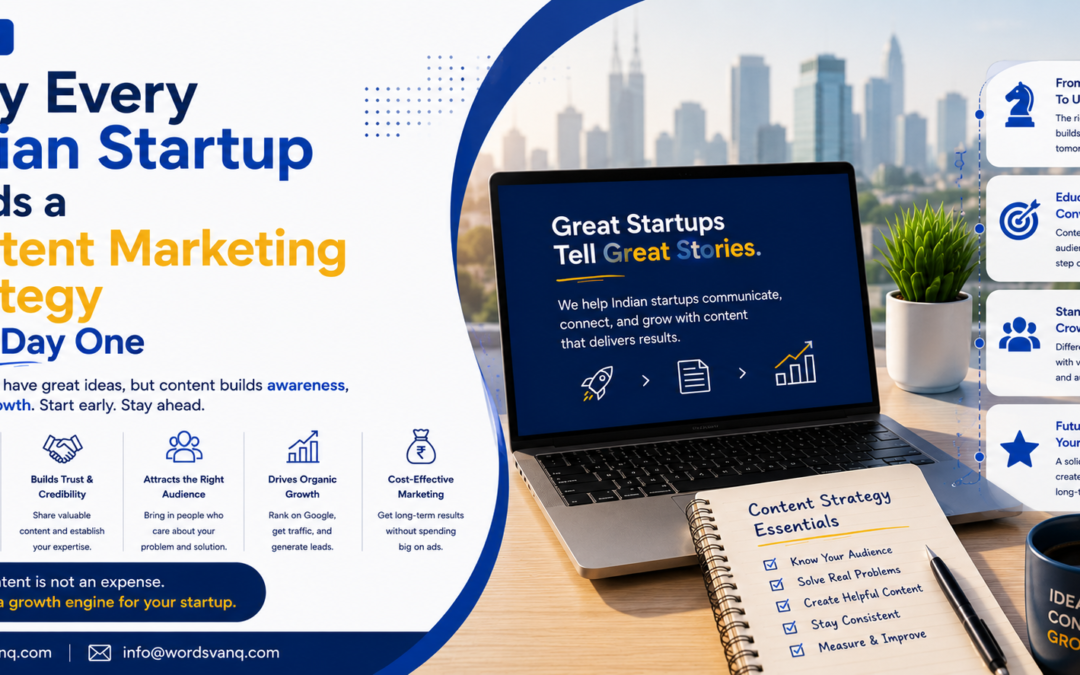
KEY TAKEAWAYS
- Indian startups that invest in content marketing from day one grow 3x faster than those that delay.
- Content marketing costs 62% less per lead than traditional advertising, critical for budget-constrained startups.
- Early content builds domain authority that compounds over time, a competitive moat that is very hard to replicate later.
- Content marketing builds brand trust with Indian investors, customers, and talent simultaneously.
- A startup’s content strategy should start simple: one blog per week, consistent social media, and a well-written website.
- Waiting until you have more time, money, or a “perfect product” to start content marketing is one of the costliest startup mistakes.
- WordsVanq helps Indian startups build and execute content strategies that generate leads, build authority, and support fundraising.
Most Indian startups make the same mistake. They spend months building their product, launch it into the market, and then wonder why nobody is finding them. They pour money into paid ads to generate quick traffic, but the moment the ad budget runs out, the traffic disappears. They watch competitors with less impressive products rank higher on Google and attract more customers, and they cannot figure out why.
The answer is almost always the same. Those competitors started investing in content marketing early. And the startups that are struggling started too late.
India is now home to over 1.4 lakh DPIIT-recognized startups, making it the world’s third-largest startup ecosystem. According to NASSCOM, India produces more startups every year than almost any country on earth. In this environment, having a great product is necessary but no longer sufficient. The startups that grow are the ones that can be found, trusted, and chosen over dozens of equally competent competitors.
Content marketing is how that happens. In this guide, we will explain exactly why every Indian startup needs a content marketing strategy from day one, not after raising a Series A, not once the product is perfect, and not when marketing budgets are bigger. From day one. And how WordsVang helps Indian startups build content strategies that grow with them.
The Indian Startup Reality: Why Visibility Is Now a Survival Issue
India’s startup ecosystem has exploded in scale over the past decade. With over 1.4 lakh DPIIT-recognized startups and thousands more operating without formal recognition, the competition for customer attention, investor interest, and talent acquisition has never been more intense.
Consider what this means practically. If you launch a SaaS product for HR teams in India, you are not competing against a handful of obvious players anymore. You are competing against dozens of established domestic products, international tools with Indian sales teams, and new startups entering the same space every few months. If your target customer searches ‘HR software for Indian SMBs’ on Google, your product needs to appear and appear credibly, or it simply does not exist in that customer’s consideration set.
The startups winning in India’s crowded market have recognized something important: the product gets you in the game, but content marketing is what gets you found, considered, and chosen.
The Search Behavior of India’s Startup Customers
Whether your startup targets enterprise decision-makers in Gurugram, SMB owners in Tier 2 cities, or individual consumers across India, your customers share one behavior: they research extensively online before making decisions. They read comparison blogs. They look for reviews. They check whether the company has credible, informative content before trusting it with their data, their money, or their business processes.
A startup with an excellent product but an empty blog, a sparse website, and no Google presence loses deals every day to competitors with average products but strong content. HubSpot research consistently shows that companies actively using content marketing generate three times more leads per rupee spent than those relying primarily on outbound or paid channels.
Why Starting From Day One Gives You an Unfair Advantage
The single most powerful argument for starting content marketing from day one is compounding. Content marketing does not deliver instant results; it delivers compounding results. And the earlier you start, the more powerful that compounding becomes.
Domain Authority Takes Time to Build
Google’s ranking algorithm gives significant weight to domain authority, a measure of how trusted and established your website is based on its age, content quality, and backlink profile. A website that has been publishing quality content for two years has a significant ranking advantage over a new website that starts publishing today, regardless of content quality.
This means that every month you delay starting your content strategy is a month of domain authority that a competitor who started earlier is building ahead of you. The gap compounds over time. A startup that begins publishing quality content from day one will have a meaningful, durable search visibility advantage over a competitor that waits 18 months to start.
Content Builds Your Brand While You Build Your Product
The pre-launch and early-stage period is actually the ideal time to build your content presence, because you have something competitors further along do not have: the story of building something new. Founder blogs, behind-the-scenes content, problem-space education, and industry insight pieces all build brand awareness and trust before you have a product ready to sell.
Many of India’s most successful startups, Zerodha, Razorpay, and Licious, built significant content audiences before they needed them for customer acquisition. By the time their products were fully developed, they already had an audience that trusted them and was ready to buy.
“The best time to plant a content marketing tree was when you started your company. The second best time is right now.” – Adapted from a well-known proverb that every startup founder should take seriously.
Early Content Attracts Investors and Talent Too
Content marketing benefits Indian startups beyond customer acquisition. Investors increasingly research startups’ online presence before taking meetings. A startup with a well-written blog demonstrating deep domain expertise, a clear point of view on the industry, and evidence of thought leadership is significantly more fundable than one that is invisible online.
Similarly, talented professionals researching potential employers read company blogs, founder articles, and social media content to assess company culture, ambition, and credibility. Content marketing is simultaneously a customer acquisition channel, an investor relations tool, and an employer branding asset, all for the same investment.
The Real Cost Advantage: Content vs. Paid Acquisition
Most Indian startups begin their customer acquisition journey with paid advertising, Google Ads, Facebook Ads, LinkedIn Ads, or influencer partnerships. These channels can deliver fast results and are a legitimate part of a balanced growth strategy. But they have fundamental economic limitations that content marketing does not.
| Factor | Paid Advertising | Content Marketing |
| Cost Per Lead | High and rising, Indian CPCs increase every year as more advertisers compete | 62% lower on average, and falls further as domain authority grows |
| Traffic Duration | Stops the day you pause spending | Compounds for months and years after publishing |
| Scalability | Costs scale linearly; 2x traffic requires 2x budget | Non-linear, more content amplifies existing content’s value |
| Trust Signals | Ads are recognised as ads; the trust ceiling is low | Organic content builds genuine credibility and expertise |
| Investor Perception | A high paid CAC (Customer Acquisition Cost) concerns investors | Low organic CAC through content impresses investors |
| Brand Building | Minimal, ads are transactional | Strong, quality content builds lasting brand equity |
| AI Search Visibility | Zero presence in ChatGPT and Perplexity answers | Well-structured content gets cited by AI search platforms |
| Long-Term ROI | Poor, cost never decreases | Excellent, each piece adds permanent value to your domain |
For budget-constrained early-stage startups, which describes virtually every Indian startup in its first two years, the economics of content marketing versus paid acquisition are not even close. Content marketing delivers more durable, more trust-building, and more investor-friendly results per rupee invested than any paid channel.
This does not mean paid advertising has no place in a startup’s strategy. It means that content marketing should be the foundation, and paid channels should amplify what content has already built, not substitute for it.
What Content Marketing Actually Does for an Indian Startup
Content marketing is not just blogging. For an Indian startup, a well-executed content strategy serves multiple critical business functions simultaneously.
It Educates the Market You Are Creating.
Many Indian startups are solving problems that their target customers do not yet fully understand they have. A SaaS tool for automated GST compliance, an AI platform for supply chain optimization, and a D2C health brand built around gut microbiome science—these all require market education before customer acquisition. Content marketing is how you build that education at scale. Blog posts, explainer videos, email newsletters, and social media content help potential customers understand the problem, appreciate the solution, and arrive at your product already convinced of the need.
It builds category authority before you have scale.
In India’s startup market, category authority, being recognized as the leading voice in your specific problem space, is one of the most valuable assets a startup can build. It is the reason journalists call you for quotes, why investors seek you out rather than waiting to be pitched, and why customers trust you over competitors with more features. Category authority is built through consistent, expert content. The startup that publishes the most insightful analysis of the Indian HR tech landscape will own the mental real estate in that category, regardless of whether it has the most customers.
It Creates Durable SEO Assets That Reduce CAC Over Time
Every high-quality blog post, service page, and case study your startup publishes is a permanent asset on your domain. As these assets accumulate and earn backlinks, your website’s overall search visibility improves, meaning every subsequent piece of content ranks faster and performs better. This is the compounding effect of content marketing: the more you invest, the more efficiently each new piece works. Startups that build strong content libraries in their first two years often find their customer acquisition Costs drop significantly by year three as organic search becomes their primary traffic source.
It Supports the Entire Customer Journey
Content marketing is not just for top-of-funnel awareness. A well-designed content strategy creates assets for every stage of the customer journey: educational blogs for awareness, comparison content and case studies for consideration, detailed product content and FAQs for decision, and onboarding guides and success stories for retention. Each piece of content serves a specific purpose in moving a potential customer from stranger to loyal user.
It builds trust with a skeptical Indian market.
Indian consumers and business buyers are among the most research-intensive in the world. They read multiple sources, compare options carefully, and make decisions slowly, particularly for higher-value products and services. A startup with a rich library of genuinely helpful content builds trust with this audience at every touchpoint of the research journey. By the time a potential customer reaches your sales team or sign-up page, they have already encountered your expertise multiple times and feel they know your brand.
The Day One Content Strategy: What to Start With
Many startup founders are convinced that they will start content marketing ‘once things settle down.’ The reality is that things never settle down. If you wait for the perfect moment, you will wait forever.
The good news is that a startup content marketing strategy does not need to be complex to be effective. Here is what a practical day one content strategy looks like:
Start With Your Website Copy
Your website is your most important piece of content. Before anything else, invest in clear, well-written, persuasive website copy that explains what problem you solve, who you solve it for, why your solution is better than alternatives, and what the visitor should do next. This is the foundation everything else builds on. Many Indian startup websites are full of technical jargon, vague claims, and confusing navigation that sends potential customers away confused. Good website copywriting is the highest-ROI content investment any startup can make.
Publish One Quality Blog Post Per Week
One genuinely useful, well-researched, SEO-optimized blog post per week is enough to build meaningful search visibility over 6 to 12 months. The key word is “genuinely useful”—not thin, not AI-generated, not a list of obvious tips. Each post should answer a specific question your target customer is actually searching for, with enough depth and original insight that it stands apart from everything else on the topic.
Use keyword research tools like Google Keyword Planner, Ahrefs, or Semrush to identify the exact questions your target customers are searching for. Then write the best answer to that question that exists on the internet. Do not try to compete on volume; compete on quality.
Build a LinkedIn Presence From Day One
For B2B startups in India, LinkedIn is the single most important content platform. Founder posts, company updates, industry insights, and thought leadership content on LinkedIn reach decision-makers directly, without any advertising spend. A founder who posts consistently and insightfully on LinkedIn can build a following of thousands of relevant decision-makers within 12 months, creating a warm audience for the startup’s product before any outbound sales effort begins.
Start an Email List Immediately
An email list is one of the most valuable assets a startup can own, because unlike social media followers, an email list is yours. No algorithm change can reduce your reach to zero. Start collecting emails from day one through a simple lead magnet (a useful template, a guide, or a checklist relevant to your target customer) and send a weekly or biweekly newsletter with genuine value.
Create Content for Each Stage of the Funnel
As your startup grows, your content strategy should evolve to serve every stage of the customer journey. Here is a practical framework:
| Funnel Stage | Customer State | Content Types to Create |
| Awareness | Does not know your brand yet | SEO blogs, social media posts, founder LinkedIn content, podcast appearances |
| Consideration | Researching solutions to their problem | Comparison blogs, case studies, product explainers, webinars, email newsletters |
| Decision | Evaluating your product specifically | Detailed product pages, customer testimonials, ROI calculators, FAQ content |
| Retention | Existing customer | Onboarding guides, success stories, product update blogs, community content |
| Advocacy | Happy customer ready to refer | Case studies featuring them, referral programme content, community forums |
Content Marketing for Different Types of Indian Startups
Content marketing strategy looks different depending on your startup type, target market, and stage. Here is how to approach it across the most common Indian startup categories:
| Startup Type | Primary Content Goal | Top Content Formats | Key Platform |
| B2B SaaS | Generate qualified demo requests | Technical blogs, case studies, whitepapers, comparison content | LinkedIn, SEO, email |
| D2C Consumer Brand | Build brand awareness and first purchase | Product stories, ingredient education, founder content, UGC | Instagram, SEO, email |
| Fintech | Build trust with skeptical money-conscious buyers | Explainer blogs, calculators, regulatory guides, customer stories | SEO, YouTube, email |
| Edtech | Generate course enrolments and free trials | Outcome stories, syllabus previews, career guides, demo content | SEO, YouTube, LinkedIn |
| Healthtech | Build clinical credibility and patient trust | Doctor-authored blogs, symptom guides, research summaries | SEO, email, LinkedIn |
| Marketplace | Attract both supply and demand sides | Separate content tracks for buyers and sellers, success stories | SEO, social media |
| Deep Tech / AI | Educate the market and attract enterprise clients | Technical thought leadership, research papers, use case studies | LinkedIn, SEO, industry publications |
| Logistics / Ops | Attract enterprise B2B clients | Industry reports, cost savings case studies, integration guides | LinkedIn, email, SEO |
The common thread across every startup type is this: start with the content that directly addresses your ideal customer’s most pressing question, and publish it consistently enough to build trust and search visibility over time. The format, platform, and tone may differ, but the principle of genuine helpfulness and consistency applies universally.
The Mistakes Indian Startups Make With Content Marketing
Even startups that recognize the importance of content marketing frequently make these costly mistakes that prevent them from seeing results.
■Treating content as a one-time project rather than an ongoing program
Many Indian startup founders commission a content strategy, publish a few blog posts, see no immediate results, and conclude that content marketing does not work. Content marketing is not a campaign; it is a program. The results are not visible in the first month or even the third. They compound over 6, 12, and 24 months of consistent publishing. Treating it as a one-time effort and expecting immediate ROI is the single most common reason Indian startups give up on content before it has had a chance to work.
■Writing for search engines instead of readers
The temptation to stuff articles with keywords and cover every related term in a single piece is understandable, but counterproductive. Google’s algorithms have become sophisticated enough to detect content written for ranking rather than reading, and they penalize it accordingly. Write primarily for your reader. Use keywords naturally. The SEO will follow.
■Publishing AI-generated content without human editorial oversight
With AI writing tools now readily available, many Indian startups use them to produce high volumes of content cheaply. The problem is that AI-generated content without human expertise and editorial judgment produces generic, often inaccurate, brand-inconsistent output that fails to build trust with sophisticated readers and is increasingly penalized by Google’s quality algorithms. For a startup trying to build credibility, generic AI content is worse than no content at all.
■No clear content goal or audience definition
Content without a clear goal is just words. Before publishing anything, every piece of content should have a defined purpose: attract a specific type of visitor, answer a specific question, support a specific sales conversation, or build authority in a specific topic area. Content with no clear goal delivers results that are equally unclear.
■Underinvesting in distribution
Many startups produce good content but publish it and do nothing else. They expect the content to find its own audience. It will not, especially not in the early months before domain authority is established. Every piece of content needs active distribution: share it on LinkedIn, send it to your email list, submit it to relevant communities and forums, and reach out to publications that might republish or reference it. Content without distribution is like a great product with no sales team.
Building Your First Content Calendar: A Practical Framework
A content calendar is not a complicated spreadsheet. It is simply a plan that tells you what to publish, when to publish it, and why. Here is a simple first content calendar framework for an early-stage Indian startup:
| Week | Blog Post Topic | LinkedIn Post | Email Newsletter |
| Week 1 | What problem you solve and why it matters (awareness) | Founder story, why you started this | Welcome email: who you are and what subscribers get |
| Week 2 | The market problem in depth, data and insights | Industry stat with your commentary | Industry insight article or curated resources |
| Week 3 | How your solution works: plain English explainer | Behind-the-scenes product build | Product update or feature spotlight |
| Week 4 | Customer success story or early case study | Customer quote or testimonial | Case study or early traction update |
| Week 5 | Comparison of approaches to the problem (unbiased) | Common misconception in your space | Comparison guide or buyer checklist |
| Week 6 | FAQ: every question your sales calls answer | Answering a common objection directly | FAQ or Q&A with founder |
This is a six-week rolling framework that covers awareness, education, proof, and objection handling in a logical sequence. After six weeks, the cycle can repeat with fresh topics in each category. Over 12 months, this approach produces 52 blog posts, 52 LinkedIn updates, and 52 email newsletters, a substantial content library that builds domain authority, social following, and subscriber relationships simultaneously.
■Batch your content creation. Write two weeks of content in one sitting rather than one piece at a time. This reduces context-switching costs and ensures you always have content ready to publish, even in hectic weeks.
How WordsVanq Helps Indian Startups With Content Marketing
At WordsVang, we have worked with startups across every stage and sector, from pre-launch founders building their content presence from zero to Series A companies scaling their content operations to match their growth. We understand the unique challenges of startup content marketing: limited resources, evolving messaging, competitive markets, and the need to serve investors, customers, and talent with the same content assets.
| What WordsVanq Offers | How It Helps Your Startup |
| Content Strategy Development | Builds a complete content strategy aligned with your startup’s growth stage, target audience |
| SEO Blog Writing | Weekly or fortnightly blog posts that rank on Google, educate your market, and build domain authority |
| Website Copywriting | Clear, compelling, conversion-optimised copy for your homepage, product pages, and about page |
| Founder and Thought Leadership Content | LinkedIn articles and industry pieces that build your personal brand and establish credibility |
| Case Study Writing | Data-driven case studies that turn customer success into sales tools and investor proof points |
| Email Newsletter Writing | Weekly or fortnightly newsletters that build and maintain a warm audience of potential customers |
| Content Calendar Planning | A structured, realistic publishing plan that keeps your content consistent without overwhelming |
| 100% Human-Written Content | No AI shortcuts — every piece written by a trained, experienced writer who understands your industry |
| Scalable Plans | Start with 2 blogs a month and scale to 20 as your startup grows, flexes with your content needs |
“The startups that win in India’s market are not always the ones with the best product. They are the ones that can be found, trusted, and chosen. Content marketing is how you make that happen from day one.”
Conclusion
India’s startup ecosystem is one of the most exciting and most competitive on earth. With over 1.4 lakh recognized startups and thousands more launching every year, the difference between startups that grow and startups that stall is increasingly determined not by product quality alone, but by visibility, credibility, and trust.
Content marketing builds all three consistently, durably, and at a cost that makes economic sense even for the most budget-constrained early-stage startup. The startups that start from day one build compounding advantages in search visibility, brand authority, and audience trust that become increasingly difficult for later-starting competitors to overcome.
The only question is whether to start now or wait. And as every founder who waited too long will tell you, there is never a perfect moment to start. The best moment was day one. The second-best moment is today.
If your startup is ready to build a content marketing strategy that grows with you, WordsVang is ready to help. We understand startups, we understand Indian markets, and we write content that works.
Ready to build your startup’s content marketing strategy? Get a free consultation.
Call: +91 9555844324 | Email: info@wordsvanq.com
Frequently Asked Questions
Q: When should an Indian startup start content marketing?
A: From day one – or as close to it as possible. The earlier you start building your content library and domain authority, the greater the compounding advantage you build over competitors who start later. Pre-launch content that educates your target market about the problem you solve is particularly valuable because it builds an audience before you have a product to sell them.
Q: How much should an Indian startup budget for content marketing?
A: Early-stage startups should allocate between 15 and 25% of their marketing budget to content marketing. In absolute terms, even a budget of Rs 15,000 to Rs 30,000 per month can fund 2 to 4 quality blog posts—enough to start building meaningful search visibility. As the startup grows and content proves its ROI, this budget can scale accordingly.
Q: How long before content marketing shows results for a startup?
A: Most Indian startups start seeing meaningful organic traffic improvements from content marketing within 4 to 6 months of consistent, quality publishing. Domain authority improvements and significant search visibility gains typically take 9 to 12 months. The timeline varies based on competitive intensity in your specific keyword space and the quality and consistency of your publishing.
Q: Should a startup hire an in-house content writer or work with an agency?
A: For most early-stage startups, working with a content writing agency is more cost-effective and flexible than hiring in-house. A good agency brings keyword research, SEO strategy, writing expertise, and editorial quality control that would require multiple hires to replicate. As the startup scales and content volume grows, a hybrid model, an agency for strategy and senior content and in-house for execution, often makes the most sense.
Q: What is the most important piece of content a startup should create first?
A: Website copy – specifically the homepage and key product or service pages. This is the content every potential customer, investor, and partner will encounter first. Clear, persuasive, benefit-led website copy that explains your value proposition immediately is the highest-return content investment any startup can make. Once the website is strong, a consistent blog and LinkedIn presence are the next priorities.