
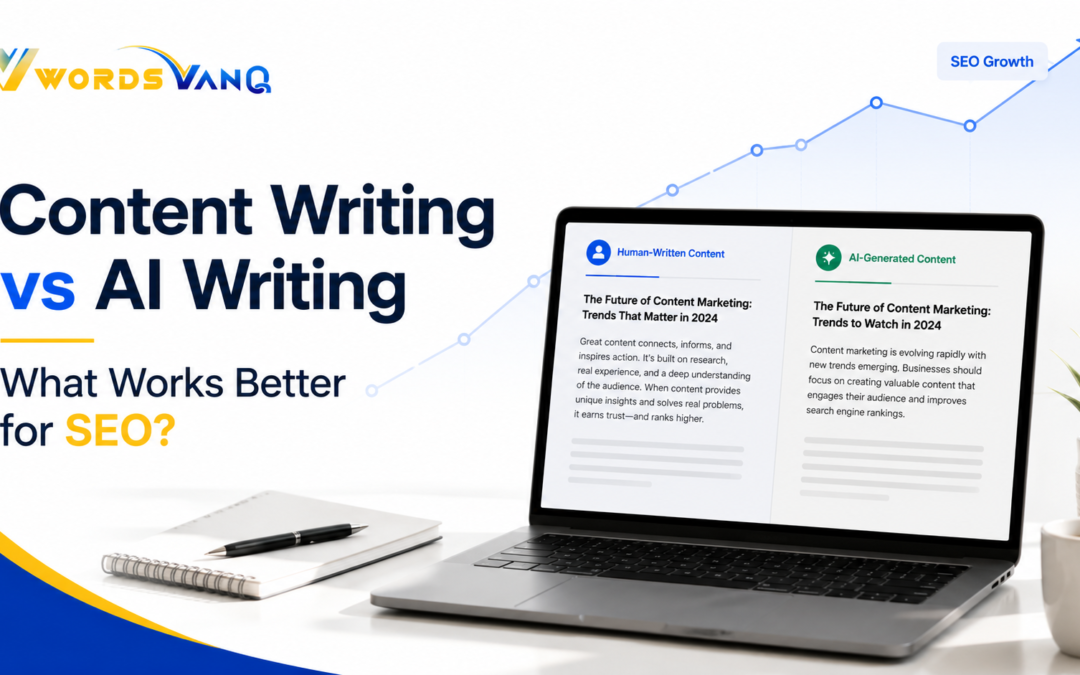
KEY TAKEAWAYS
- AI writing tools can produce content fast, but they often lack depth, accuracy, and originality.
- Google’s helpful content update specifically targets thin, AI-generated content that lacks real value.
- Human content writers bring research, creativity, and strategic SEO thinking to every piece.
- The best approach for most Indian businesses is a combination of a human-led strategy with AI assistance.
- A professional content writing agency in India ensures your content is optimized, original, and effective.
- WordsVanq creates content that is written for real people and built to rank on Google.
AI writing tools are everywhere right now. ChatGPT, Jasper, Copy.ai, Writesonic businesses are using them to create content faster than ever before. And it makes sense. Who would not want a 1,000-word blog post written in five minutes?
But here is the question that every business owner and marketing manager in India is asking: Does AI-written content actually rank on Google? Or do you still need a professional human writer to get results?
This is not a simple yes-or-no answer. The truth is more nuanced. In this blog, we will compare content writing vs AI writing from every important angle: quality, SEO performance, cost, trust, and long-term results. By the end, you will know exactly what works better for your business.
1. What Is Human Content Writing?
Human content writing is the process of creating written material, such as blogs, articles, website copy, social media posts, and more, by a real, trained writer. A professional content writer does far more than just put words on a page.
Here is what a skilled human writer actually does for every piece of content:
- Keyword research: They identify the right keywords your audience is searching for and weave them naturally into the content.
- Audience understanding: They write in a tone and style that matches your specific target audience, whether that is a student, a CEO, a homemaker, or a small business owner.
- Original thinking: Human writers bring unique insights, examples, opinions, and angles that are genuinely fresh and not found elsewhere on the internet.
- Storytelling: They structure content in a way that flows naturally, keeps the reader engaged, and builds toward a clear conclusion or call to action.
- Fact-checking: A good writer verifies statistics, claims, and references before publishing, protecting your brand’s credibility.
- Brand voice: Over time, human writers learn and maintain your unique brand tone, something that makes your content immediately recognizable.
“Good writing is not just about grammar. It is about understanding what the reader needs and delivering it in a way that feels natural and trustworthy.”
Professional content writing services in India, like those offered by WordsVanq, are built on this kind of human expertise. Every blog post goes through research, writing, editing, and SEO optimization before it is delivered. The result is content that genuinely helps your audience and earns the trust of search engines.
2. What Is AI Content Writing?
AI writing tools use large language models, essentially very advanced prediction systems, to generate text based on prompts you give them. You type in a topic or a few keywords, and the AI produces a full article within seconds.
Popular AI writing tools include:
- ChatGPT (OpenAI) — used for general writing and drafting
- Jasper AI — marketed specifically for marketing content
- Copy.ai — focused on short-form marketing copy
- Writesonic is used for blogs, ads, and social media.
- Google Gemini—integrated with Google’s ecosystem
What AI Writing Tools Do Well
There are genuine advantages to using AI writing tools, and it would be unfair to ignore them:
- Speed: An AI tool can produce a 1,000-word draft in under two minutes. For businesses that need high content volumes, this is appealing.
- Cost: AI tools can reduce the per-word cost of content creation significantly, especially for simple, repetitive content.
- Structure: AI tools are reasonably good at creating structured outlines and presenting information in a logical order.
- Starting point: For writers who need a first draft or want to overcome a blank page, AI output can be a useful starting point.
Where AI Writing Falls Short
But the limitations of AI writing are significant, and they matter greatly for SEO and brand credibility:
- Factual errors: AI tools frequently get facts wrong. They ‘hallucinate,’ producing plausible-sounding but incorrect statistics, names, and claims. This can seriously damage your brand’s reputation.
- No real expertise: AI has no lived experience, no industry expertise, and no genuine understanding of your audience. Its content often feels generic and surface-level.
- Repetition and filler: AI-generated content tends to pad articles with filler sentences that add length without adding value, something Google’s algorithms are getting better at detecting.
- Lacks originality: AI writing is based on patterns from existing content on the internet. It cannot create a truly original perspective, which is what earns backlinks and audience loyalty.
- No brand voice: Without heavy customization and editing, AI content often sounds the same regardless of the brand: neutral, bland, and forgettable.
- Ethical and legal risks: Questions around copyright, plagiarism, and content ownership with AI-generated text are still evolving, and the risks are real.
3. SEO Face-Off: Human Content vs AI Content
This is the most important section for any business that wants to rank on Google. Let us go through the key SEO factors one by one and see how human writing and AI writing compare.
A. Google’s Helpful Content Update: A Game Changer
In 2022, Google launched its Helpful Content Update. Then it updated it again in 2023 and 2024. The core message from Google was clear: content written primarily for search engines, rather than for people, will be penalized.
Google’s own documentation says it wants to see content that demonstrates ‘firsthand expertise and depth of knowledge.’ AI tools, by definition, cannot demonstrate first-hand expertise. They can only remix what already exists.
Websites that relied heavily on AI-generated content saw noticeable traffic drops after these updates. Websites with original, expert human content were either unaffected or saw improvements.
B. E-E-A-T: Experience, Expertise, Authoritativeness, Trustworthiness
Google uses a quality framework called E-E-A-T to evaluate content. The four pillars are Experience, Expertise, Authoritativeness, and Trustworthiness.
| E-E-A-T Factor | Human Writing | AI Writing |
| Experience | Real examples, case studies, personal insight | None. AI has real-world experience. |
| Expertise | Industry knowledge, research, depth | Surface-level, based on patterns |
| Authoritativeness | Named authors, credentials, citations | Anonymous, no verifiable authority |
| Trustworthiness | Fact-checked, cited sources, honest | Prone to hallucinations and errors |
As you can see, human writing wins across all four E-E-A-T factors. This is not a small difference; it is the foundation on which Google decides which websites to trust and which to push to the back pages.
C. Keyword Usage and Semantic SEO
Modern SEO is not just about using one keyword over and over. It is about semantic SEO, covering a topic so thoroughly that Google recognizes your page as a true authority on the subject.
Human content writers understand this. They naturally include related terms, questions people actually ask, and topic variations that help Google understand the full context of your content.
AI tools, on the other hand, often overuse the primary keyword and miss the semantic depth that Google rewards. The result is content that looks keyword-stuffed to Google’s algorithms – the opposite of helpful.
D. Readability, Dwell Time, and Bounce Rate
How long a visitor stays on your page, called “dwell time,” is one of Google’s most important ranking signals. If someone clicks your article and leaves within 15 seconds, Google notes that your content did not satisfy the user.
Human writers create content that is genuinely interesting and useful. They vary sentence length, tell stories, use relatable examples, and build toward a satisfying conclusion. This keeps readers engaged and on the page longer.
AI content, while readable, tends to feel mechanical. It lacks personality and the natural flow that comes from human writing. Readers often sense this and leave early, hurting your dwell time and rankings.
E. Backlinks and Shareability
Backlinks, other websites linking to your content, are one of the strongest ranking factors in Google’s algorithm. But websites only link to content they find genuinely valuable, unique, or insightful.
AI-generated content rarely earns backlinks. It offers nothing new. It is a remix of information that already exists on the internet.
Original human content, a detailed research piece, a unique case study, an expert opinion, and a genuinely helpful how-to guide earn backlinks naturally. Over time, this builds your website’s domain authority and makes every page on your site easier to rank.
4. The Cost Question: Is AI Really Cheaper?
On the surface, AI tools seem like a massive cost saving. A subscription to an AI writing tool costs a few thousand rupees a month, and it can produce hundreds of articles. Compared to hiring a professional writer or agency, the numbers look attractive.
But let us look at the full picture.
| Cost Factor | AI Writing | Human Content Writing |
| Per-article cost | Very low | Moderate to high |
| Editing required | Heavy, often 50-70% rewrite needed | Light is mostly ready to publish. |
| Fact-checking time | High AI errors need manual checks. | Low writers research before writing. |
| SEO results | Weak lower rankings, less traffic | Strong higher rankings, more traffic |
| Backlinks earned | Rarely | Regularly with quality content |
| Brand trust built | Low | High |
| Long-term ROI | Poor | Excellent |
When you factor in the time spent editing AI output, the risk of publishing factual errors, the weak SEO results, and the lack of brand trust, AI writing often costs more in real terms than professional human content writing services.
A content writing agency in India like WordsVanq delivers content that is ready to publish, SEO-optimized, and built to bring you traffic for months and years. That is a far better return on investment.
5. Can AI and Human Writing Work Together?
Here is where the answer gets interesting. The real question is not ‘AI or human?’ It is, “How do we use each one wisely?” ‘
The smartest content strategies in 2025 use AI as a tool under human supervision, not as a replacement for human expertise. Here is how a professional content writing agency like WordsVanq approaches this:
| Stage | Who Does It | What Happens |
| Topic Research | Human + AI | The writer uses AI tools to surface trending questions and then applies strategic judgment. |
| Keyword Strategy | Human | An SEO writer researches and selects the best keywords for your specific goals. |
| First Draft | Human (AI assist) | Writers may use AI to brainstorm but write the core content themselves. |
| Depth & Expertise | Human | Real examples, original insights, and brand-specific context added |
| Editing & SEO | Human | The writer optimizes headings, internal links, meta tags, and readability. |
| Fact-Checking | Human | All claims verified before publishing |
| Final Review | Human | Tone, brand voice, and quality check by a senior editor |
This hybrid model gives you the best of both worlds: the speed and scale of AI-assisted research with the quality, depth, and SEO performance of human writing. It is how serious content teams operate today.
6. What Indian Businesses Need to Know
For businesses in India, whether you are a startup in Bangalore, an e-commerce brand in Mumbai, or a healthcare provider in Delhi, the content landscape has specific challenges and opportunities.
The Indian SEO market is more competitive than ever.
With millions of Indian businesses building their online presence, Google search results for popular Indian keywords are intensely competitive. In this environment, thin or generic AI content simply will not cut it. You need content that is genuinely better than what your competitors are publishing.
Indian Audiences Need Contextual Content
Indian readers have unique expectations. They appreciate content that acknowledges local market conditions, uses relevant examples from the Indian context, and speaks to their specific challenges, whether that is GST for a business owner or monsoon home care tips for a lifestyle brand.
AI tools write for a global average. They do not understand that your customer in Pune has different priorities than your customer in Chandigarh. Human writers who know the Indian market can craft this kind of contextual, relevant content.
Trust is built through expertise.
Indian consumers do extensive research before making purchasing decisions, especially for high-value products and services. A well-written, informative blog post that genuinely answers their questions builds far more trust than a shallow AI-generated article.
This trust is what converts visitors into leads and leads into customers. It is also what makes them come back to your website and recommend it to others.
7. The Verdict: What Works Better for SEO?
“For long-term SEO success, human content writing wins every single time. AI is a useful assistant, not a replacement.”
Here is our honest, direct verdict based on everything we have covered:
| Scenario | Best Choice |
| You want to rank on Google long-term. | Human content writing |
| You need high-volume product descriptions. | AI + human editing |
| You are building brand authority. | Human content writing |
| You need fast social media captions. | AI is acceptable |
| You want backlinks and shareability. | Human content writing |
| You need technical or industry content. | Human content writing |
| You want to save costs on bulk drafts. | AI first draft + human edit |
| You want to build trust with customers. | Human content writing |
The bottom line is clear. If your goal is to rank on Google, build brand trust, earn backlinks, and grow your business through content, then professional human content writing is the answer. AI tools can play a supporting role, but they should never lead your content strategy.
Why WordsVanq Is the Right Partner for Your Content
At WordsVanq, we understand the content landscape deeply. We know what Google rewards, what Indian audiences respond to, and how to create content that drives real business results.
| What We Offer | What It Means for Your Business |
| 100% Human-Written Content | Original, credible content that Google trusts and rewards |
| SEO-First Approach | Every piece is built to rank keywords, structure, and links. |
| Industry-Specific Writers | Deep knowledge of your sector, not generic filler |
| Research-Backed Writing | Accurate, trustworthy content that builds your brand authority |
| Pan-India Coverage | We serve cities across India: Pune, Mumbai, Bangalore, Delhi & more. |
| Transparent Process | Clear briefs, timely delivery, and open communication |
| Scalable Plans | Whether you need 2 blogs or 200, we scale with your needs. |
Conclusion
The debate between content writing and AI writing will keep evolving as technology improves. But right now, in 2025, the answer is clear: for businesses that want to rank on Google, build trust, and grow sustainably, human content writing wins.
AI writing tools are impressive, but they are not a shortcut to SEO success. Google is smarter than ever at identifying content that is genuinely helpful versus content that is merely filling space. And your readers can tell the difference too.
The smartest investment you can make for your business right now is in high-quality, human-written, SEO-optimized content. And the easiest way to do that is to work with a professional content writing agency in India that understands your goals.
That is exactly what WordsVanq is here for.
Stop settling for average content. Get WordsVanq working for you.
Call: +91 9555844324 | Email: info@wordsvanq.com
Frequently Asked Questions (FAQ)
Q: Is AI-generated content penalized by Google?
A: Google does not automatically penalize all AI-generated content. However, Google’s Helpful Content guidelines clearly penalize content that is low-quality, unhelpful, or created primarily for search engines rather than people. A lot of AI-generated content falls into this category. Human-written content, when done correctly, is far more likely to meet Google’s quality standards.
Q: Can I use AI tools and still rank on Google?
A: Yes, but only if the AI output is heavily edited, fact-checked, and enriched by a human expert before publishing. Raw AI content is rarely good enough to rank competitively on its own. The best approach is human-led content with AI as a supporting tool, not the other way around.
Q: How much does professional content writing cost in India?
A: Costs vary depending on the type of content, word count, and industry. At WordsVanq, we offer flexible and transparent pricing to suit businesses of all sizes, from startups to large enterprises. Contact us for a custom quote based on your specific needs.
Q: How is WordsVanq different from AI writing tools?
A: WordsVanq provides 100% human-written content by trained, industry-specific writers. Every piece is research-backed, SEO-optimized, and written to match your brand voice. Unlike AI tools, our content is original, credible, and built to rank, not just to fill pages.
Q: What types of businesses does WordsVanq serve?
A: We serve businesses across all industries in India, including e-commerce, healthcare, real estate, education, finance, technology, travel, and more. We have city-specific expertise in Pune, Mumbai, Bangalore, Delhi, Hyderabad, Chennai, and Chandigarh, with pan-India and global reach.