
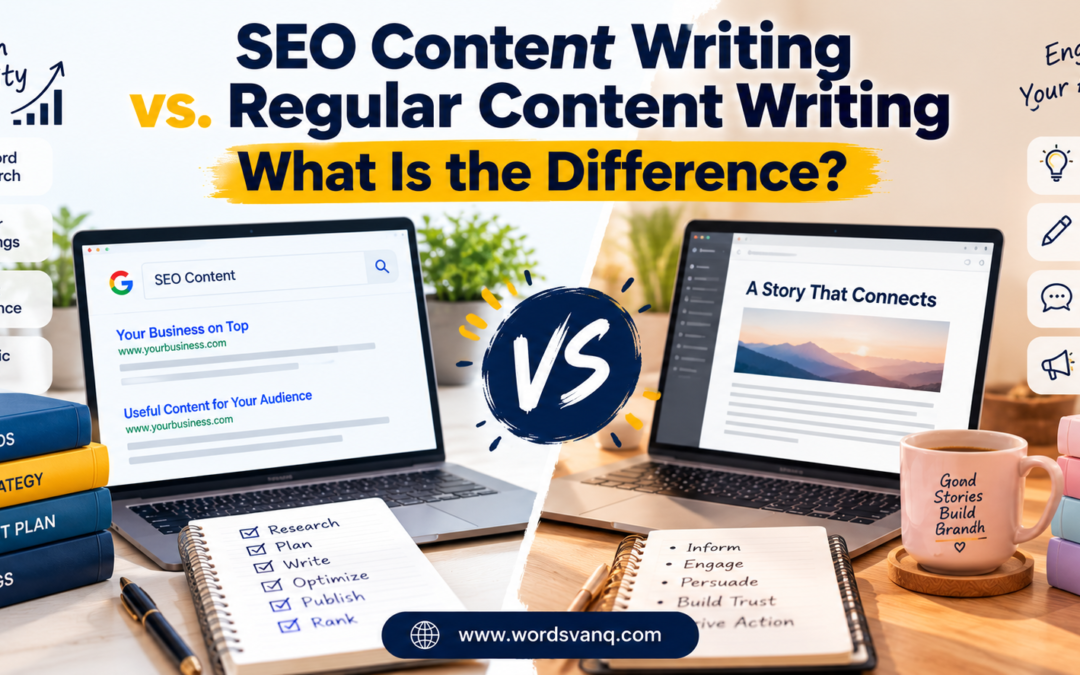
Content plays an important role in how businesses communicate with customers, explain their services, and build trust. However, not all content serves the same purpose. Some content focuses on informing or engaging readers, while other content also aims to improve visibility in search engine results.
Understanding the difference between SEO content writing and regular content writing helps businesses choose the right approach for their websites, blogs, and marketing campaigns.
Both approaches have value. The right choice depends on your audience, business goals, distribution channels, and the results you want to achieve.
What Is SEO Content Writing?
SEO content writing involves creating useful, relevant content that helps readers find answers while making it easier for search engines to understand the page.
SEO stands for search engine optimization. It involves improving a website’s visibility in organic search results without paying for individual clicks.
SEO-focused content considers what people search for, why they search for it, and what information they expect to find. Writers use that understanding to create content that answers questions clearly and supports the website’s broader goals.
Common examples of SEO content include:
• Blog posts targeting relevant search queries.
• Website service pages.
• Informational guides and tutorials.
• Industry-specific articles.
• Product and category descriptions.
• Frequently asked questions and resource pages.
For example, a business offering accounting services might publish an article about tax filing requirements for small businesses. The article can answer a genuine customer question while introducing readers to the company’s relevant services.
A well-planned SEO content strategy also connects related articles and service pages. Explore our guide to content types that drive website traffic for more ideas on developing useful web content.
What Is Regular Content Writing?
Regular content writing focuses on communicating a message, informing an audience, telling a story, or encouraging a particular action. It does not always target organic search traffic as its primary objective.
This type of writing can support brand awareness, customer relationships, internal communication, advertising, and social media engagement.
Examples include
• Social media captions.
• Email newsletters.
• Internal company announcements.
• Brand stories.
• Event invitations.
• Promotional campaign copy.
• Thought leadership posts written for a specific audience.
For instance, a company might send an email announcing a new product feature to existing customers. The email needs a clear message and an appropriate call to action, but it does not necessarily need to target a Google search query.
Regular content can still appear in search results or support a wider SEO strategy. The key difference lies in the content’s primary purpose, not in whether the writer uses keywords.
SEO Content Writing vs. Regular Content Writing: Key Differences
Although both approaches require strong writing, they differ in how writers plan, structure, and measure the content.
| Factor | SEO Content Writing | Regular Content Writing |
|---|---|---|
| Primary objective | Improve relevant organic search visibility and help users find answers | Inform, engage, persuade, or communicate with a defined audience |
| Topic selection | Keyword research, search intent, and audience questions | Campaign goals, brand messaging, audience interests, or editorial plans |
| Structure | Descriptive headings, logical sections, and formats suited to the query | Structure suited to the format and communication goal |
| Keyword use | Relevant search terms used naturally | May use keywords, but search targeting is not always a priority |
| Distribution | Often designed for organic discovery through search engines | May rely on email, social media, campaigns, or direct communication |
| Measurement | Organic impressions, clicks, rankings, and conversions | Engagement, opens, responses, shares, and campaign outcomes |
These differences are not absolute rules. Effective content strategies often combine both approaches to support a business’s overall marketing objectives.
1. Keyword Research Plays a Bigger Role in SEO Content
One of the main differences between SEO content writing and regular content writing is how writers select topics and phrases.
SEO writers research the words and questions people use when searching for information, products, or services. They then assess the intent behind those searches.
For example, someone searching for “what is technical writing” likely wants an explanation. Someone searching for “technical writing services” may be comparing providers.
The content should reflect that difference. Keyword research can help writers identify relevant topics, customer questions, related terms, website content gaps, and opportunities to connect informational articles with service pages.
However, keyword research should guide the content rather than dictate every sentence. Repeating the same phrase unnaturally can make an article difficult to read.
2. Search Intent Influences Content Structure
Search intent refers to the reason behind a user’s query. A person may want to learn something, compare options, find a specific website, or make a purchase.
SEO content writing considers this intent before deciding what information a page should include. An article targeting “how to write website content” should provide practical steps and examples. A page targeting “website content writing services” should explain the service, its benefits, its process, and how a potential customer can inquire.
A mismatch between content and search intent can make a page less useful, even when it includes the target keyword.
Writers should also organize information so readers can find answers quickly. Our guide on writing content that ranks in Google Featured Snippets explains why direct answers and clear content structure matter.
3. SEO Content Requires a Deliberate Internal Linking Strategy
Internal links connect one page of a website to another page on the same website. They help readers discover related information and help search engines understand how pages relate to one another.
SEO-focused articles often link to relevant service pages, supporting guides, and related blog posts. For example, a blog explaining website copywriting could link to a website content writing service page.
The links should provide genuine value. Avoid adding links simply to increase their number, and use descriptive anchor text that tells readers what they will find.
Regular content may also use links, especially in emails, social posts, and campaign materials. However, SEO content planning usually treats internal linking as part of the wider website structure.
4. Both Approaches Need Strong Writing and Original Value
SEO does not replace good writing. A page can target a relevant keyword and still fail to help readers if the information is vague, repetitive, inaccurate, or poorly organized.
Likewise, regular content needs a clear purpose and a message that suits its audience.
Regardless of the format, effective content should:
• Answer the reader’s main question.
• Use clear and natural language.
• Present information in a logical order.
• Support claims with reliable information.
• Reflect the brand’s voice and expertise.
• Give the reader a useful next step when appropriate.
Writers should also avoid publishing content that merely repeats information available everywhere else. Useful examples, original insights, practical instructions, and genuine subject knowledge make content more valuable.
5. How Do You Measure the Results?
The right measurement approach depends on the content’s purpose.
For SEO content, businesses may monitor organic search impressions, clicks, relevant website traffic, keyword visibility, inquiries, and conversions. Google Search Console and website analytics tools can help evaluate performance.
For regular content, useful metrics may include email open rates, click-through rates, social engagement, replies, downloads, or campaign conversions.
Some metrics overlap. The important point is to measure results against the objective defined before publication.
Do not judge every article solely by its immediate traffic. Some content supports customers during research, builds trust, or helps them compare options before they contact a business.
6. When Should Your Business Use SEO Content Writing?
SEO content writing is particularly useful when your business wants to attract people who are actively searching for relevant information, products, or services.
Consider prioritizing SEO-focused content when you want to:
• Increase relevant organic traffic.
• Improve the visibility of important service pages.
• Answer recurring customer questions.
• Build authority around your industry or specialist topics.
• Support long-term organic lead generation.
• Connect informational content with commercial pages.
For example, a software company might publish tutorials, product comparisons, and implementation guides. These resources can help potential customers understand the problem, evaluate possible solutions, and discover the company’s offering.
The content strategy should reflect realistic business priorities, available resources, and the competitiveness of the topics you target.
7. When Is Regular Content Writing the Better Choice?
Regular content writing may be the better fit when you need to communicate with a known audience or support a specific campaign.
It is useful for:
• Announcing company news or product updates.
• Sending newsletters to existing customers.
• Promoting events and limited-time offers.
• Sharing brand stories on social media.
• Communicating internally with employees.
• Creating campaign messages for a defined audience.
For example, a business launching a new service may use email and social media to reach existing customers quickly. It can then publish SEO-focused website content to help people discover and understand the service through organic search over time.
These approaches can work together rather than compete with each other.
8. Can One Piece of Content Serve Both Purposes?
Yes. Businesses can create content that meets audience needs while also supporting organic search visibility.
A practical approach is to define the main audience and objective first, then consider whether search discovery should be part of the plan.
For a blog article, this may involve selecting a relevant topic, researching search intent, organizing information with descriptive headings, and linking to related resources. For an email newsletter, the priority may be a concise message, a relevant subject line, and a clear action.
The objective should determine the format and optimization approach. Do not force every social post, email, or brand message into an SEO article.
How to Choose the Right Content Writing Services
If you plan to outsource content, choose a provider based on your goals rather than the service label alone.
• Your main objective: Do you need organic traffic, stronger website messaging, campaign support, or a combination?
• The required formats: Will you need blogs, website pages, technical articles, emails, or social content?
• Research requirements: Does the work require keyword research, subject-matter interviews, competitor analysis, or technical review?
• Editorial quality: Can the writer adapt to your brand voice and explain complex ideas clearly?
• Measurement: Can you define how the content’s performance will be evaluated?
Pricing varies according to content format, research depth, subject complexity, and turnaround time. Read our guide to content writing rates in India when comparing proposals.
For businesses that need website copy, SEO articles, or ongoing content support, WordsVanq offers content solutions that can be considered as part of a broader content strategy.
Conclusion: Combine SEO Strategy with Strong Writing
The difference between SEO content writing and regular content writing comes down to their primary objectives and the way writers plan for their audiences.
SEO content considers search intent, keyword relevance, content structure, and organic discovery. Regular content focuses on communication goals such as informing, engaging, persuading, or building relationships with a defined audience.
Both approaches depend on clear writing, accurate information, and a strong understanding of the reader. For many businesses, the most effective strategy combines search-focused website content with email, social media, and other communication formats.
Start with your business goals, identify what your audience needs, and choose the content approach that supports those priorities.