
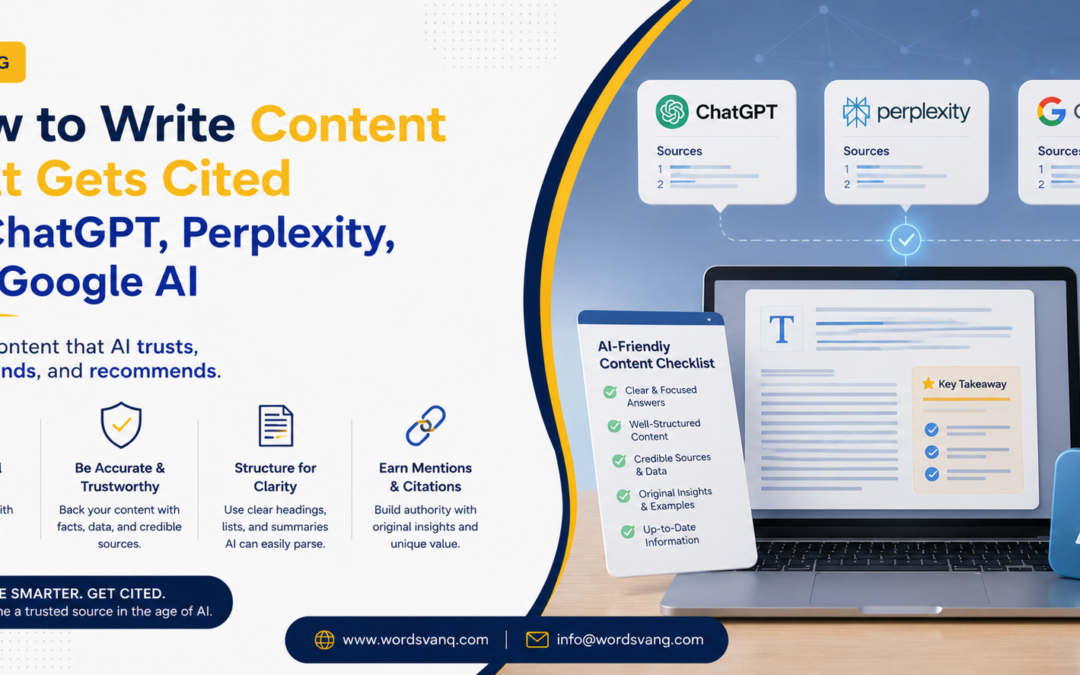
KEY TAKEAWAYS
- AI search platforms now drive over 1 billion referral visits per month; getting cited is a major traffic opportunity.
- ChatGPT, Perplexity, and Google AI Overviews each have different citation logic; you need to optimize for all three differently.
- The three pillars of AI citation are content structure (answer-first format), trust signals (credentials and citations), and technical access (allowing AI crawlers).
- Perplexity prioritizes fresh content published within 30 days; regular publishing is now more important than ever.
- Google AI Overviews pull 97% of citations from the top 20 organic results; traditional SEO still matters.
- 44% of AI citations come from the first 30% of your content; front-loading your best information is critical.
- WordsVanq writes content structured for both traditional SEO and AI citation, giving your business maximum visibility.
Something fundamental has changed about how people find information online. A growing number of your potential customers are no longer typing queries into Google and scrolling through ten blue links. They are asking ChatGPT a question and reading the answer. They are using Perplexity to research a purchase. They are seeing Google AI Overviews summarize a topic before they ever scroll to your website.
This shift is not small. AI search platforms sent over 1.13 billion referral visits to websites in June 2025 alone – a 357% increase year-over-year. ChatGPT now has over 200 million weekly active users. Google AI Overviews appear in roughly 50% of all searches globally. Perplexity has become the default research tool for analysts, students, and technical buyers.
And here is the critical part: when these AI platforms answer a question, they cite a small handful of sources. Pages that get cited earn significantly more traffic, more trust, and more conversions than those that do not. Every other website – regardless of where it ranks on Google – is effectively invisible in that AI-generated answer.
This is the new SEO frontier. It is called Generative Engine Optimization (GEO), and it requires a different approach to content writing than traditional SEO alone. In this guide, we will break down exactly how ChatGPT, Perplexity, and Google AI Overviews decide what to cite and what Indian businesses need to do to earn those citations.
Why AI Search Citations Matter More Than You Think
Before getting into the how, it is worth understanding exactly why AI citations are now a business priority, not just an SEO curiosity.
The Traffic and Conversion Numbers
The data is striking. According to Peec AI’s 2026 benchmark report, every AI citation is worth approximately 47% more qualified traffic than a traditional page-one Google ranking. Companies that appear in AI citations see 3.2x higher conversion rates than those relying solely on traditional search. And pages cited in Google AI Overviews earn 35% more organic clicks than non-cited competitors appearing on the same results page.
Why do AI citations convert so well? Because the user has already received a synthesised answer and is now clicking through to learn more or take action. They arrive with high intent and a degree of trust already established by the AI recommendation. This is a fundamentally different, and more valuable, kind of traffic than a standard organic click
The Flip Side: Zero-Click Risk
Similarweb data shows that searches triggering AI Overviews have an 83% zero-click rate, compared to around 60% for traditional queries. When a Google AI Overview appears, the number one organic position loses 34.5% of its clicks on average.
This means there are now two very different outcomes for any given search. Either your content gets cited in the AI answer, in which case you benefit significantly. Or your content is not cited, in which case you lose traffic to zero-click behaviors. There is very little middle ground. Being in the AI answer is now the goal.
How Each AI Platform Decides What to Cite
The first thing to understand is that ChatGPT, Perplexity, and Google AI Overviews each work differently, and what earns a citation on one platform is not identical to what earns one on another. Here is how each one actually operates.
| Platform | How It Sources Content | Key Citation Signal |
| ChatGPT | Primarily uses training data (knowledge cutoff). Web search is only activated when a query needs recent info. | Domain authority + brand recognition + consistent external mentions |
| Perplexity | Performs a real-time web search for every query. Retrieves and reads candidate pages and synthesises an answer. | Content freshness + structured answers + fast page speed |
| Google AI Overviews | Draws from existing organic search index. 97% of cited sources come from the top 20 organic results. | Existing organic ranking + answer-first structure + schema markup |
| Gemini | Hybrid of Google index and real-time retrieval. Closely linked to Google Search ranking signals | Google organic ranking + brand authority + structured data |
Optimizing for AI search as a single category is like running the same campaign on LinkedIn and TikTok. The underlying mechanics are different, and so is the winning strategy for each.” – Leapd AI Research, 2026
The Three Pillars of AI Citation Optimisation
Despite the differences between platforms, three core pillars determine whether any piece of content gets cited across all major AI search engines. Master these three and you significantly increase your chances of being the source AI platforms reach for.
Pillar 1 – Content Structure: Answer First, Always
Research from Superlines’ analysis of AI citation patterns found that 44.2% of citations come from the first 30% of content on a page. This is one of the most actionable findings in GEO research. AI engines retrieve and score passages from your page, and they heavily favor content that appears early and answers the query directly.
The implication is clear: stop burying your best information halfway through a long introduction. Lead with the answer. Then provide the depth, context, and supporting evidence. This is the opposite of how many blog posts are written, where the writer builds up to a conclusion. AI citation optimization requires flipping that structure entirely.
Every section of your content should open with a 40-60-word self-contained answer to the implied question of that section heading. AI engines extract passages, not full articles. Make every passage independently valuable.
Pillar 2 – Trust Signals: Credentials, Sources, and Consensus
According to research from Profound and SEMrush, AI platforms scan for agreement across multiple independent sources before confidently citing a brand. If your business appears consistently across your own website, industry publications, review platforms, and community discussions, all with similar positioning, AI systems gain confidence in recommending you. This is called the consensus signal.
If you only exist on your own website with no external validation, AI systems treat your claims with skepticism. They have no independent verification, so they recommend competitors who have built broader presence. Trust is not just about what you say on your own pages. It is about what others say about you elsewhere on the internet.
Add verifiable statistics with source links, named author credentials, and citations to credible external sources in every important piece of content. The Princeton GEO study proved that adding statistics and citations each independently boost AI visibility scores.
Pillar 3 – Technical Access: Let AI Crawlers In
According to Shadow’s comprehensive AI citation guide, 10 AI crawler bots exist across 4 major platforms , and each one is independently controllable via your robots.txt file. If you are blocking these crawlers, your content is completely invisible to the corresponding AI engine, regardless of how good it is.
The AI crawlers you need to allow in your robots.txt are:
•OAI-SearchBot and GPTBot – OpenAI (ChatGPT and ChatGPT Search)
•PerplexityBot – Perplexity AI
•ClaudeBot and Anthropic-AI – Anthropic (Claude)
•Google-Extended – Gemini and Google AI Overviews training
•Bingbot – Bing Copilot and ChatGPT Search
•Applebot-Extended – Apple Intelligence
Important: Many websites updated their robots.txt in 2023-24 to block AI crawlers out of concern about training data. If your website did this, you are now invisible to every AI search platform. Check and update your robots.txt as a first priority.
Platform-Specific Strategies: ChatGPT, Perplexity, and Google AI
Now that we have covered the three core pillars, here are the specific tactics for each major AI platform.
Getting Cited by ChatGPT
ChatGPT primarily draws from its training data, which means building authority over a long period is the most important factor. Brand recognition, Wikipedia presence, and consistent mentions across major publications all contribute to ChatGPT’s confidence in citing your business.
For web search citations (when ChatGPT activates real-time search), the criteria shift toward the same signals as Perplexity: recency, authority, and structured content. The key actions for ChatGPT citations are the following:
- Build brand presence across multiple external platforms: industry publications, news mentions, podcast appearances, guest articles, and review sites all create the consensus signal ChatGPT trusts.
- Aim for Wikipedia relevance: ChatGPT heavily favors Wikipedia as a source. If your industry or your business is notable enough to be referenced in a Wikipedia article, that significantly boosts your AI visibility.
- Publish on authoritative external platforms: Articles or guest posts on high-authority Indian publications like Economic Times, YourStory, Inc42, or industry-specific portals build the authority profile ChatGPT values.
- Maintain consistent brand messaging: If your website says one thing and your external mentions say another, AI systems lose confidence. Consistency across all platforms is critical.
Getting Cited by Perplexity
Perplexity is the platform where content freshness matters most. Perplexity cited content published within the last 30 days at an 82% rate in one 2026 analysis. A blog post from six months ago consistently loses to a fresh piece on the same topic. This makes Perplexity the platform where a consistent, high-frequency publishing strategy pays off most directly.
- Publish fresh content regularly: Perplexity’s real-time search architecture means new content can be cited within hours of being indexed. A publishing schedule of 4-8 quality pieces per month significantly improves your perplexity’s visibility.
- Include year signals visibly: Visible year references (“2026” in titles and headings) tell Perplexity that content is current. Update key pieces regularly and make the recency obvious.
- Structure content with direct factual answers: Perplexity extracts and quotes specific passages. Every section should open with a clear, factual, self-contained answer before elaborating.
- Optimize page speed: Perplexity retrieves and reads pages in real-time. Slow-loading pages are deprioritized. Mobile-optimized, fast-loading pages get read and cited more frequently.
- Use schema.org structured data: Schema markup helps Perplexity’s systems understand what your content is about and how it is structured, improving extraction accuracy.
Getting Cited by Google AI Overviews
Google AI Overviews are the most important for Indian businesses because 97% of cited sources come from the top 20 organic results. This means traditional SEO is still the foundation for Google AI citation. If you are not ranking in the top 20 for a query, you will almost certainly not be cited in the AI Overview for that query.
- Rank in the top 20 for your target keywords first: There is no shortcut here. Google AI Overviews pull from the organic index. Traditional SEO, quality content, backlinks, E-E-A-T signals, and page experience remain essential.
- Match search intent precisely: Google AI Overviews favor pages that fully satisfy the query. Content that answers the exact question asked, without requiring the reader to go elsewhere, is more likely to be cited.
- Use clear, extractable heading structures: phrase H2 and H3 headings as questions that users actually ask. This helps Google’s AI systems identify and extract the relevant passage from your page.
- Implement JSON-LD schema markup: FAQ schema, article schema, and HowTo schema all help Google’s AI systems understand your content structure and extract it for AI overviews.
- Earn quality backlinks: Backlinks remain one of the strongest signals for organic ranking, which is the gateway to Google AI Overview citation.
How to Structure Content for AI Citation: A Practical Guide
Knowing the principles is one thing. Knowing how to actually write and structure your content for AI citation is another. Here is a practical, step-by-step framework for structuring every piece of content you publish.
Step 1—Write a direct answer in the opening paragraph.
Your very first paragraph after the title should contain a clear, direct answer to the primary question your content addresses. Keep it to 40-60 words. AI systems extract this passage first and use it to decide whether your page is relevant to the query. Do not waste this space on background or introduction.
Step 2 – Use Question-Format Headings
Phrase your H2 and H3 headings as questions that your audience actually types into search or asks an AI tool. For example, instead of ‘Benefits of Content Writing,’ use ‘Why does content writing improve Google rankings?’ This exact-match framing makes it significantly easier for AI systems to match your section to a specific query and extract the relevant passage.
Step 3 – Front-Load Every Section with Value
Remember that 44% of AI citations come from the first 30% of content. Apply this principle not just to the whole article but also to each individual section. Open every section with a self-contained answer before adding supporting detail, examples, and context. Think of it as a pyramid, the point first, then the base.
Step 4 – Include Verifiable Statistics with Source Links
AI platforms significantly increase their confidence in a source when claims are backed by verifiable statistics with outward citations to credible sources. Include data points from credible studies, industry reports, and authoritative sources, and link to them. This is one of the fastest ways to improve your AI citation rate.
Step 5 – Name Entities Explicitly
AI systems understand content through named entities, specific people, places, organizations, products, and concepts. Mention specific names, locations (including Indian cities and regions), organizations, and products explicitly rather than using vague pronouns or generic terms. This helps AI systems understand the specific context of your content.
Step 6 – Add Schema Markup
Implement JSON-LD schema for Article, FAQPage, HowTo, and LocalBusiness as appropriate to your content. Schema markup is the most direct way to communicate your content’s structure to AI systems. The FAQ schema in particular is heavily used by Google AI Overviews to extract question-and-answer pairs.
Step 7 – Check Your robots.txt and Allow AI Crawlers
Before anything else, verify that your robots.txt is not blocking OAI-SearchBot, GPTBot, PerplexityBot, ClaudeBot, and Google-Extended. If any of these are blocked, no amount of content optimization will earn you citations on the corresponding platform.
Building the Off-Page Signals That AI Platforms Trust
On-page content optimization is only half of the equation. AI platforms, especially ChatGPT, also rely heavily on off-page signals to build confidence in a source. Here is what you need to build beyond your own website.
| Off-Page Signal | What to Do | Which AI It Helps Most |
| External Publication Mentions | Publish guest articles or get featured in Indian industry publications like Economic Times, YourStory, Inc42, or industry-specific portals. | ChatGPT, Gemini |
| Community and Forum Presence | Participate genuinely in relevant communities on Reddit, Quora, LinkedIn, and Indian business forums. | ChatGPT, Perplexity |
| Review Platform Presence | Encourage genuine reviews on Google, G2, Clutch, and Justdial. AI systems read review platforms as trust signals. | All platforms |
| Video Content | Basic tutorial and thought leadership videos on YouTube build the multiplatform presence. AI systems value | ChatGPT, Gemini |
| Backlink Profile | High-quality backlinks from authoritative Indian and international domains remain critical for Google AI Overviews. | Google AI Overviews |
| Social Proof and Mentions | Brand mentions on Twitter/X, LinkedIn, and Instagram, even without links, contribute to the consensus signal. | ChatGPT, Perplexity |
| Consistent Brand Messaging | Ensure your positioning, service descriptions, and key claims are consistent across your website and all external platforms. | All platforms |
The key insight here is that AI citation is not just an on-page SEO task. It requires building what AuthorityTech describes as a broad digital footprint, a consistent presence across multiple independent platforms that AI systems can cross-reference to validate your expertise and trustworthiness.
What This Means for Indian Businesses Specifically
India is a fast-growing AI search market. Indian consumers are adopting ChatGPT and Perplexity rapidly, particularly students, young professionals, and tech-savvy buyers. The window to establish AI citation presence before competitors do is right now.
Hindi and Regional Language Content
One significant opportunity for Indian businesses is vernacular content. Perplexity and Google AI Overviews are expanding their coverage of Hindi, Tamil, Telugu, and other regional language queries. Indian businesses that publish high-quality content in regional languages right now face very little competition for AI citations in those language segments.
Local Query Optimization
Local SEO content, pages targeting specific Indian cities and neighborhoods, is increasingly appearing in AI Overviews for local queries. When a Kanpur business owner asks Perplexity “best content writing agency in Kanpur,” the cited sources are pages with genuine, specific, location-relevant content. Generic national pages do not get cited for these queries.
This is a significant advantage for Indian businesses that invest in location-specific content. A local business with a well-structured, locally relevant page can outcompete larger national players for AI citations on local queries, just as local SEO has always enabled smaller businesses to outrank larger ones for geo-specific searches.
The Indian B2B Opportunity
Indian B2B buyers, particularly in manufacturing, IT, healthcare, and education, are increasingly using Perplexity and ChatGPT to research suppliers and vendors before making contact. For Indian B2B businesses, being cited when a buyer asks ‘best leather goods supplier in Kanpur’ or ‘top IT services company in Noida’ can directly generate qualified leads.
How to Measure Your AI Citation Performance
You cannot optimize what you cannot measure. Here is how to start tracking your AI search visibility.
Manual Query Testing
Regularly test your most important target queries in ChatGPT, Perplexity, and Google with AI Overviews enabled. Note whether your brand or content is mentioned, how it is characterized, and which competitors appear when you do not. Do this weekly for your top 10 to 15 priority queries.
Track Referral Traffic in GA4
Set up a custom channel group in Google Analytics 4 to track AI referral traffic. Add source conditions to match: chatgpt.com, perplexity.ai, claude.ai, gemini.google.com, and copilot.microsoft.com. This gives you a dedicated view of how much traffic AI platforms are already sending you—and whether it is growing.
AI Visibility Tracking Tools
Several tools have emerged specifically for tracking AI citation performance. LLMrefs monitors brand citations across Gemini, ChatGPT, Perplexity, Claude, and Google AI Overviews. AI Labs Audit tracks Perplexity citation performance specifically. These tools make it possible to benchmark your performance against competitors on specific queries.
Google Search Console for AI Overview Signals
Google Search Console does not yet have a dedicated AI Overviews report, but you can identify pages that are likely AI Overview candidates by filtering for queries with high impressions and unusually low click-through rates, a pattern consistent with AI Overview zero-click behavior.
How WordsVanq Helps You Get Cited by AI Search
At WordsVanq, we have built our content writing process to meet the demands of both traditional SEO and the new AI search landscape. Every piece of content we write is structured to earn citations across ChatGPT, Perplexity, and Google AI Overviews, not just to rank on the traditional Google results page.
| What WordsVanq Does | Why It Matters for AI Citation |
| Answer-First Content Structure | We open every section with a clear, extractable answer—exactly what AI systems prioritize when deciding what to cite. |
| Verifiable Statistics and Source Links | Every data claim is backed by a credible source with an outward link – one of the most direct ways to boost AI visibility scores. |
| Named Author and Credential Framework | We help clients establish proper author profiles with verifiable credentials—a critical trust signal for AI platforms. |
| Schema Markup Guidance | We advise on and implement the correct schema markup for your content type—FAQ, article, HowTo, and local business schema. |
| Local and Vernacular Content Expertise | We create location-specific and Hindi-language content that positions Indian businesses for early-mover advantage in AI citations. |
| Consistent Publishing Cadence | We help clients maintain the regular publishing schedule that Perplexity and Google reward with higher citation rates. |
| 100% Human Expertise | AI platforms are trained to cite expert human content. Our 100% human-written approach ensures maximum AI citation potential. |
| Internal Linking and Topical Clusters | Dense internal linking networks—where related content cross-references and builds cumulative topical authority |
Conclusion
The rules of search are changing faster than at any point in the last decade. AI platforms are now a primary discovery channel for millions of consumers and business buyers, including in India. Getting cited by ChatGPT, Perplexity, and Google AI Overviews is not a bonus. For forward-thinking businesses, it is becoming a core part of their digital visibility strategy.
The good news is that the qualities that earn AI citations are the same qualities that make content genuinely excellent: clear answers, verifiable information, real expertise, consistent publishing, and a trusted presence across multiple platforms. This is not a new set of tricks. It is a higher standard of content quality.
If your Indian business is ready to build content that performs in both traditional search and the new AI search landscape, WordsVanq is here to help. We write content that earns citations, builds trust, and drives real business results, now and as the search landscape continues to evolve.
Want your content cited by ChatGPT, Perplexity, and Google AI?
Let WordsVanq help.
Call: +91 9555844324 | Email: info@wordsvanq.com
Frequently Asked Questions
Q: What is GEO, Generative Engine Optimization?
A: GEO stands for Generative Engine Optimization. It is the practice of optimizing your content to be cited and recommended by AI-powered search engines like ChatGPT, Perplexity, Google AI Overviews, and Gemini. It builds on traditional SEO but adds specific requirements around content structure, trust signals, technical crawler access, and off-page consensus signals.
Q: Do I need to choose between SEO and GEO?
A: No – and you should not. Traditional SEO is still the foundation for Google AI Overview citations, since 97% of cited sources come from the top 20 organic results. GEO builds on top of good SEO by adding the specific structural, trust, and technical elements that earn AI citations. The two strategies are complementary, not competing.
Q: How quickly can I start getting cited by Perplexity?
A: Perplexity performs real-time web searches, so new content can be cited within hours of being indexed, if it is well-structured, fresh, and clearly answers the query. This makes Perplexity the AI platform where consistent, high-quality publishing delivers the fastest citation results.
Q: Does publishing in Hindi help with AI citations in India?
A: Yes. Google AI Overviews and Perplexity are expanding Hindi and regional language coverage rapidly. Indian businesses publishing high-quality Hindi content right now face very little competition for AI citations in regional language segments, making it a significant early-mover opportunity.
Q: How do I know if my website is blocking AI crawlers?
A: Check your robots.txt file (accessible at yourdomain.com/robots.txt). Look for disallow rules that mention GPTBot, OAI-SearchBot, PerplexityBot, ClaudeBot, Google Extended, or BingBot. If any of these are blocked, update your robots.txt to allow them so your content becomes visible to AI search platforms.
Q: Can WordsVanq help me optimize existing content for AI citations?
A: Yes – contact us for a content audit and AI citation optimization plan. We review your existing pages, identify the highest-priority opportunities for restructuring, and provide updated content that is built for both traditional SEO and AI search citation performance.