
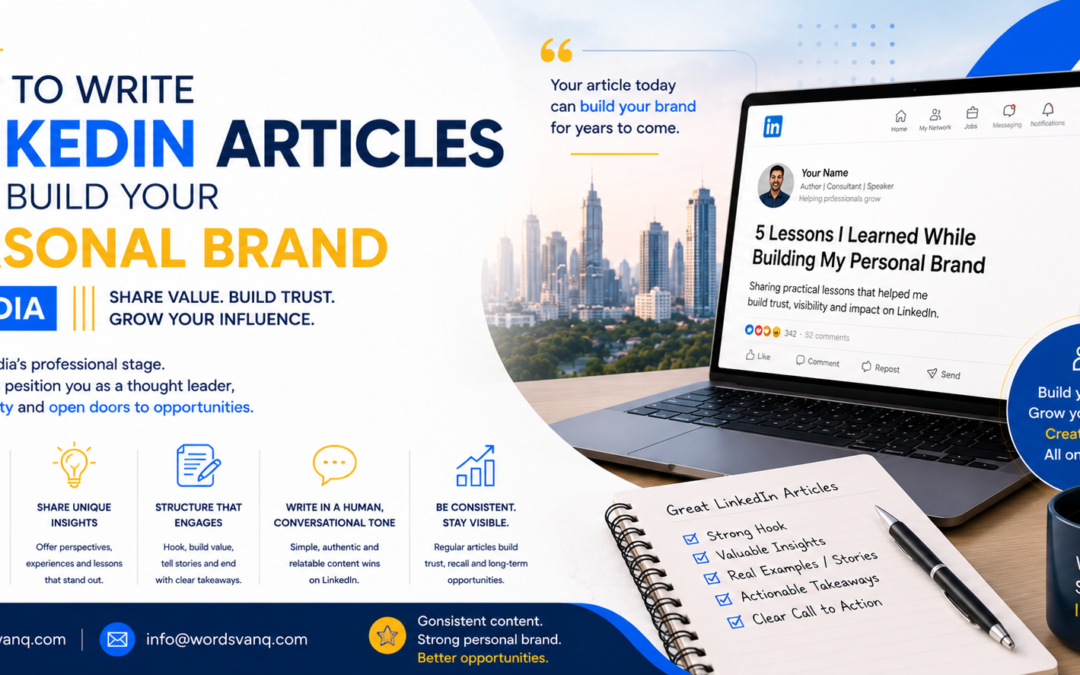
India has 120M+ LinkedIn users, the second largest globally.
LinkedIn articles get 3x more reach than ordinary posts.
Only 1% of LinkedIn users publish long-form articles regularly.
Articles with 1,500-2,000 words get the highest engagement.
KEY TAKEAWAYS
✓ Google indexes articles on LinkedIn, and LinkedIn’s algorithm distributes them, helping you build authority beyond your existing network.
✓ Only 1% of LinkedIn users publish articles, making consistent article publishing one of the most underleveraged personal branding tools in India.
✓ The most effective LinkedIn articles for Indian professionals take a clear position, share specific experiences, and provide actionable insight.
✓ Article hooks – the first two lines visible before “see more” – determine whether anyone reads the rest. Write these first, not last.
✓ LinkedIn articles should be 1,500 to 2,000 words, published consistently (weekly or fortnightly), and promoted actively on the publication.
✓ WordsVanq helps Indian founders, executives, and professionals produce thought leadership articles that build their LinkedIn brand.
India has the second-largest LinkedIn user base in the world, with over 120 million professionals active on the platform. Yet walk through any LinkedIn feed in India, and you will find an ocean of shared news articles, generic motivational quotes, and posts that begin with “Excited to announce.” Every day, millions of Indian professionals scroll past identical content from identical profiles and wonder why nobody is noticing them.
Here is the reality: only 1% of LinkedIn users publish long-form articles. And on a platform where Indian decision-makers, investors, clients, and collaborators are actively looking for credible experts to engage with and work with, that 1% has an extraordinary advantage over the other 99%.
LinkedIn articles, the long-form content format that appears on your profile, get indexed by Google and are distributed across LinkedIn’s algorithm and are the most powerful personal branding tool available to Indian professionals in 2026. This guide explains exactly how to write LinkedIn articles that build genuine authority, attract the right professional connections, and create real business outcomes and how WordsVanq helps Indian professionals and business leaders produce the thought leadership content they need.
Why LinkedIn Articles Are India’s Most Underused Personal Branding Tool
LinkedIn in India is at an inflection point. What began as a jobs and recruitment platform has become the primary digital space where Indian business decisions are made, deals are initiated, partnerships are formed, and professional reputations are built or destroyed.
Indian professionals with strong LinkedIn presences are getting inbound client inquiries, speaking invitations, investment interest, media coverage, and career opportunities that their equally talented but less visible peers are missing entirely. According to LinkedIn’s own data, professionals who publish content on LinkedIn get 6x more profile views and generate significantly more inbound connection requests than those who do not.
Articles vs Posts: Understanding the Difference
Many Indian professionals confuse LinkedIn posts with LinkedIn articles. They are fundamentally different content formats with different distribution mechanics, different longevity, and different uses for personal branding.
| Feature | LinkedIn Posts | LinkedIn Articles |
|---|---|---|
| Format | Short text, up to 3,000 characters | Long-form content, 150 to 125,000 characters |
| Distribution | Primarily to your first-degree connections and followers | To connections, followers, AND indexed by Google for search |
| Longevity | 24 to 72 hours of peak reach before algorithm buries it | Permanently on your profile, indexed by Google, findable for years |
| Discoverability | Limited to existing network primarily | Discoverable by non-connections via Google and LinkedIn search |
| Best For | Opinions, quick insights, announcements, engagement | Deep expertise, thought leadership, evergreen professional content |
| Personal Branding Impact | Medium – builds engagement with existing audience | High – builds searchable authority and attracts new audiences |
For Indian professionals who want to build genuine professional authority, not just engagement with their existing network LinkedIn articles are significantly more powerful than posts. The combination of Google indexing and LinkedIn’s own search makes articles a discoverable, permanent record of your expertise.
What Makes a LinkedIn Article Worth Reading in India
India’s LinkedIn feed is full of noise. Generic leadership advice, reposted international frameworks with an Indian company logo slapped on, and articles that could have been written by anyone about anything. What cuts through this noise is content that is specific, opinionated, and genuinely useful to the Indian professional reading it.
The Three Qualities That Make Indian LinkedIn Articles Stand Out
Quality 1: A Clear, Defensible Point of View
The most widely shared LinkedIn articles in India take a clear position, often a contrarian one. They do not present an “on one hand this, on the other hand that” balance. They make an argument, back it up with evidence and experience, and invite the reader to agree or disagree.
Opening line comparison:
The weak opening states something safe and obvious. The strong opening takes a specific, provocative position backed by a data claim and creates immediate curiosity about what that data shows.
Quality 2: Specific Indian Context and Experience
The most shared LinkedIn articles among Indian professionals are the ones that reflect specifically Indian experiences, Indian market realities, and Indian professional culture. An article about building a startup in Bangalore is more relevant to Indian readers than one about building a startup in Silicon Valley. An article about navigating client expectations in Indian B2B markets resonates more than a translated McKinsey framework.
Your lived experience as an Indian professional building something in India is one of the most valuable things you can share on LinkedIn, and it is the one thing that no international thought leader can replicate.
Quality 3: Actionable Insight, Not Just Observation
The most engaged LinkedIn articles do not just describe a problem or observation. They provide specific, actionable guidance that readers can apply immediately. The test: could someone read this article and do something different tomorrow because of it? If yes, it is actionable. If the article ends with “These are some things to consider,” it is not.
“The Indian professionals building the strongest LinkedIn brands are not the most experienced or the most credentialled. They are the ones who share what they actually know, from what they have actually done, in a voice that is unmistakably their own.”
Choosing the Right Topics for Your LinkedIn Articles
Topic selection is where most Indian LinkedIn article writers go wrong. They write about what they find interesting rather than what their target audience needs from them. The right topics for your LinkedIn articles sit at the intersection of three factors:
- Your genuine expertise – topics where you have real, earned knowledge from direct experience
- Your audience’s real questions – the things your target clients, employers, or collaborators actually want to understand
- Underserved or contrarian angles – perspectives that are not already saturating the LinkedIn feed
Topic Categories That Consistently Perform for Indian Professionals
| Topic Category | Why It Works | Example Article Titles |
|---|---|---|
| Contrarian Takes | High shareability: people share things they strongly agree or disagree with | ‘Why Most Indian Startups Are Wrong About Content Marketing’ / ‘The Myth of…’ |
| Lessons From Failure | Highest engagement category on LinkedIn India: vulnerability + insight | ‘What Losing Our Biggest Client Taught Me About Business Development’ |
| Behind-the-Scenes | Readers want to know how successful people actually work | ‘How We Built a 50-Person Team Without a Single Job Board Post’ / ‘The C…’ |
| Predictions and Trends | Positions you as a forward-thinking voice in your field | ‘What the Google AI Update Means for Indian Digital Marketing in 2026’ |
| Practical How-To | High search value on Google+ demonstrates applied expertise | ‘How to Write a Content Brief That Gets Great Results Every Time’ |
| Indian Market Insights | Unique to Indian professionals, international audiences cannot replicate | ‘Why Indian B2B Sales Cycles Are Longer Than You Think’ / ‘The Real Re…’ |
■ Build a topic bank before you start publishing. Spend 30 minutes generating 20 to 30 potential article titles across these categories. Rate each one on expertise (do you actually know this well?), relevance (does your target audience care?), and differentiation (is this already overexposed on LinkedIn?). Start with the topics that score high on all three.
How to Write a LinkedIn Article That People Actually Read
The structure of a LinkedIn article is more important than most writers realize. Because LinkedIn shows only the first two lines of any post before a “see more” button, and because articles are displayed in a similar preview format in the feed, the opening of your article determines whether anyone reads the rest.
Step 1: Write the Hook First
The hook, the first two to three lines of your article, is the most important thing you write. It should stop the scroll. It should create immediate curiosity, strong emotion, or a compelling question that makes the reader unable to not continue.
The four most effective hook structures for Indian LinkedIn articles:
The Counterintuitive Statement:
■ “The biggest mistake Indian founders make is hiring a sales team too early. Here is what to do instead.”
The Specific Number or Data Point:
■ “We spent Rs 4.2 lakh on Google Ads in Q1 and got 12 leads. Then we switched to content marketing. What happened next changed our whole strategy.”
The Relatable Frustration:
■ “You have been publishing LinkedIn posts for six months. Your follower count has barely moved. Your posts get 4 likes – two of them from your team. Sound familiar?”
The Bold Claim:
■ “I have reviewed over 500 Indian startup websites in the last two years. 80% of them are losing clients before the person even reaches the contact page. Here is why.”
Step 2: Deliver on the Promise of the Hook
Once your hook creates curiosity or emotional engagement, the rest of the article must deliver on whatever the hook promised. If your hook promised data, provide the data in the next paragraph. If your hook promised a story, start the story immediately. Readers who feel the article did not deliver on its opening line will not engage, share, or return.
Step 3: Structure for Easy Scanning
Indian LinkedIn readers, like most digital readers, scan before they commit to reading in full. Structure your article so that someone scanning the headings, the bold text, and the first sentence of each paragraph can understand the article’s core argument without reading every word.
- Use short paragraphs: 2 to 4 sentences maximum
- Use subheadings for every major point or step
- Bold the single most important sentence in each section
- Use numbered or bulleted lists for multiple items; never paragraph them together.
- Leave white space – dense text blocks cause readers to exit
Step 4: Use the STAR-P Framework for Stories
The most engaging LinkedIn articles from Indian professionals combine insight with personal story. The STAR-P framework structures these effectively:
| Letter | Element | What to Write |
|---|---|---|
| S | Situation | Set the context: where you were, what the problem or challenge was |
| T | Task | What you needed to do or decide |
| A | Action | Specifically what you did, the decisions, the steps, the reasoning |
| R | Result | The specific, quantified outcome, what actually happened |
| P | Principle | The lesson extracted, the transferable insight the reader can apply |
Step 5: End With a Question or Clear CTA
Every LinkedIn article should end with something that invites engagement. A question that the article raises naturally (‘What has your experience been with this? ‘ Which approach would you try first?’ drives comments that amplify the article’s reach in LinkedIn’s algorithm. A clear CTA (‘If you found this useful, follow me for weekly insights on content strategy’) drives follower growth. Choose one and end decisively – do not trail off.
LinkedIn Article Length, Format, and Publishing Frequency
These are the most common practical questions Indian professionals ask about LinkedIn articles. Here are the answers based on LinkedIn’s algorithm behavior and analysis of high-performing Indian LinkedIn content.
How Long Should a LinkedIn Article Be?
LinkedIn’s own data shows that articles between 1,500 and 2,000 words receive the most views, shares, and comments. Articles shorter than 1,000 words feel more like extended posts than genuine articles. Articles longer than 3,000 words see completion rates drop significantly.
1,500 to 2,000 words is the sweet spot: long enough to demonstrate genuine depth and expertise, short enough to complete in a single reading session.
How Often Should You Publish LinkedIn Articles?
| Publishing Frequency | What It Achieves | Who It Suits |
|---|---|---|
| Weekly | Maximum algorithm boost and fastest brand building. Requires significant content investment. | Full-time content creators, founders whose primary channel is LinkedIn |
| Fortnightly | Strong brand building with sustainable effort. Best balance for most professionals. | Executives, founders, and senior professionals with busy schedules |
| Monthly | Maintains professional presence. Slower brand building but still meaningful. | Senior leaders for whom LinkedIn is secondary to other priorities |
| Quarterly or less | Insufficient for brand building. Followers forget between publications. | Not recommended if personal branding is a goal |
■ Consistency beats frequency. A professional who publishes one excellent article every two weeks for 12 months will build a significantly stronger LinkedIn brand than one who publishes four articles in January and then disappears. Set a sustainable schedule and protect it.
Should You Add Images to LinkedIn Articles?
Yes, but selectively. A compelling header image significantly improves click-through rate from LinkedIn’s feed preview. Within the article, use images only where they add genuine value, a data chart, a process diagram, or a screenshot. Decorative stock images add no value and slow the reading experience.
Promoting Your LinkedIn Articles After Publishing
Publishing a LinkedIn article without promoting it is like writing a great book and leaving it in an unpublished folder. The article’s initial reach is determined almost entirely by what you do in the first 60 to 90 minutes after publishing.
Share as a LinkedIn Post Immediately After Publishing
Write a standalone LinkedIn post that previews the article, sharing the hook, one key insight, and a link. This post reaches your first-degree connections and triggers the first wave of engagement. The article format itself only appears as a notification to followers; the post is what drives immediate traffic.
Engage With Every Comment in the First Hour
LinkedIn’s algorithm interprets early comments as a strong quality signal and distributes the post to a wider audience. Respond to every comment within the first hour after publishing. Even a brief, genuine response keeps the conversation active and signals to the algorithm that your content is generating engagement.
Tag Relevant People Who Appear in the Article
If your article references a conversation with a mentor, cites a peer’s work, or discusses an industry figure, tag them in your promotional post. People tagged in posts often share them with their own networks, dramatically extending your reach beyond your existing followers.
Share in LinkedIn groups and communities.
Post the article link in relevant LinkedIn groups where your target audience is active. Indian LinkedIn has active communities for marketing professionals, startup founders, HR leaders, and many other professional categories. A genuine, non-promotional post in these groups can generate significant additional reach.
Repurpose Key Insights as Follow-Up Posts
Every 1,500-word article contains multiple standalone insights that can become individual LinkedIn posts in the days and weeks after publication. A single article should ideally generate 3 to 5 follow-up posts, each driving new readers back to the original article.
Personal Branding on LinkedIn: The Long Game for Indian Professionals
LinkedIn personal branding is not a sprint. It is a long-term investment in professional reputation that compounds over time. Here is what the trajectory typically looks like for Indian professionals who commit to consistent LinkedIn article publishing:
| Timeline | What Happens | What to Focus On |
|---|---|---|
| Months 1 to 3 | Small reach, limited engagement. Most articles reach only existing connections. Imposter syndrome is common. | Focus entirely on quality and consistency. Do not optimize for reach yet. |
| Months 4 to 6 | The algorithm begins recognizing consistent publishing. Reach starts expanding beyond the immediate network. First… | Test different hooks, topics, and formats. Identify what resonates with your audience. |
| Months 7 to 12 | Meaningful follower growth. Regular comments from industry peers. First concrete business outcomes: speaking… | Double down on what works. Engage with your growing audience. Build… |
| Year 2+ | Recognizable voice in your industry. AI systems begin citing your articles. Consistent inbound opportunities. | Scale and systematize. Involve a content partner for research and editing. |
The Indian professionals who build the most powerful LinkedIn brands are not necessarily the most senior or most famous. They are the ones who show up consistently, share genuinely useful insights, and treat their LinkedIn audience with the same respect they would give a live audience at a professional event.
Common LinkedIn Article Mistakes Indian Professionals Make
These are the most common mistakes that prevent Indian professionals from building meaningful LinkedIn brands through articles:
■ Writing about what you want to say instead of what your audience wants to read
The most common LinkedIn article mistake is writer-centric content, articles about what you find interesting rather than what your target audience finds valuable. Before writing any article, ask, ‘Who specifically am I writing this for, and what do they gain by reading it?’ If you cannot answer both questions clearly, the topic needs rethinking.
■ Being too safe and too generic to be memorable
Generic articles that could have been written by anyone earn generic engagement. The Indian LinkedIn articles that build brands take clear positions, share specific experiences, and offer perspectives that are recognisably the author’s own. Safe content does not build a brand – it builds a forgettable presence.
■ Disappearing after every article
Many Indian professionals publish an article, get a burst of engagement, and then go quiet for weeks or months before publishing again. LinkedIn’s algorithm penalizes inconsistency heavily. The professional who publishes fortnightly for a year will have dramatically more reach on their 24th article than on their first because the algorithm has learned to trust and distribute their content.
■ Using long, unbroken paragraphs
Dense paragraphs are the fastest way to lose LinkedIn readers. Mobile devices show LinkedIn content in narrow columns where five-sentence paragraphs look like walls of text. Keep every paragraph to 2 to 3 sentences. Use white space aggressively. Make your article feel easy to read before anyone has read a word.
■ No promotional posts to support the article
LinkedIn articles are not widely distributed by the algorithm on their own; they send a notification to your followers but do not appear in the feed the way posts do. Without a supporting promotional post, most of your articles will reach only a fraction of your followers. Every article needs a promotional post published immediately after it.
How WordsVanq Helps Indian Professionals Build Their LinkedIn Brand
At WordsVanq, we work with Indian founders, executives, consultants, and senior professionals who understand the value of LinkedIn thought leadership but do not have the time or the writing confidence to produce consistent, high-quality articles on their own.
Our LinkedIn article writing process is built around your voice, your experience, and your expertise. We do not write generic content; we write articles that sound unmistakably like you because we spend time understanding your perspective, your experiences, and the specific audience you are building for.
| What WordsVanq Does | What It Means for Your LinkedIn Brand |
|---|---|
| Voice and Expertise Discovery | We conduct a detailed briefing to understand your professional background, opinions, experience |
| Topic and Angle Development | We identify the article topics and angles that best serve your professional goals and your target audience |
| Hook and Structure Writing | We write the opening hooks, structure, and narrative flow that make articles impossible to scroll past |
| Research and Data Integration | We research relevant data, Indian market statistics, and credible sources that strengthen your argument |
| Personal Story Integration | We structure your real professional experiences using narrative frameworks that create emotional connections. |
| Promotional Post Writing | Every article comes with a standalone LinkedIn promotional post to drive initial traffic and engagement |
| Consistent Publishing Calendar | We maintain a weekly or fortnightly publishing schedule that builds the compounding brand effect |
| 100% Your Voice | Every article is written to sound like you—reviewed, revised, and refined until it is indistinguishable from your own writing |
Conclusion
LinkedIn articles are the most underutilized personal branding tool available to Indian professionals. In a country with 120 million LinkedIn users and only 1% of them publishing long-form articles, the opportunity to stand out through consistent, high-quality writing is extraordinary.
The professionals building the strongest LinkedIn brands in India are not necessarily the most experienced or the most credentialled. They are the ones who show up consistently, take clear positions, share their genuine experiences, and treat LinkedIn as a professional publishing platform rather than a social feed.
If you are ready to build a LinkedIn presence that attracts clients, opportunities, and professional recognition but need help producing the quality and consistency of content that a strong brand requires, WordsVanq is ready to help. We write the articles. You build the brand.
Ready to build your LinkedIn personal brand with professional articles?
Talk to WordsVanq.
Visit: wordsvanq.com/contact-us | Call: +91 9555844324 | Email: info@wordsvanq.com
Frequently Asked Questions
Q: What is the difference between a LinkedIn article and a LinkedIn post?
A: LinkedIn posts are short-form content (up to 3,000 characters) that appear in your connections’ feeds for 24 to 72 hours before the algorithm deprioritizes them. LinkedIn articles are long-form content (up to 125,000 characters) that are permanently displayed on your profile, indexed by Google for search visibility, and sent as notifications to your followers. Articles build lasting, searchable professional authority in a way that posts cannot.
Q: How long should a LinkedIn article be in India?
A: Research and analysis of high-performing LinkedIn articles consistently shows that 1,500 to 2,000 words is the optimal length. This is long enough to demonstrate genuine depth and expertise, but short enough to complete in a single reading session. Articles shorter than 1,000 words feel lightweight. Articles longer than 3,000 words see reader completion rates drop significantly.
Q: How often should Indian professionals publish LinkedIn articles?
A: For meaningful brand building, a minimum of one article per fortnight is recommended. Weekly publishing accelerates brand growth but requires more content investment. Monthly publishing maintains a professional presence but builds authority more slowly. The most important factor is consistency; a professional who publishes fortnightly for 12 months will build a far stronger brand than one who publishes daily for a month and then disappears.
Q: What topics work best for LinkedIn articles for Indian professionals?
A: The highest-performing topics for Indian LinkedIn articles are contrarian takes on conventional wisdom in your field, behind-the-scenes insights from your professional experience, lessons learned from specific failures or challenges, practical how-to guides based on your direct experience, and Indian-market-specific insights that international creators cannot provide. The common thread is specificity; generic articles about universal topics rarely build strong personal brands.
Q: Can WordsVanq write LinkedIn articles in my voice?
A: Yes, ghostwriting LinkedIn articles for executives, founders, and senior professionals is one of our most popular services for Indian clients. We spend time understanding your background, your opinions, your professional experiences, and your target audience before writing a single word. Every article we deliver is written to sound unmistakably like you – reviewed and refined until you are completely satisfied that it represents your voice and expertise authentically.