
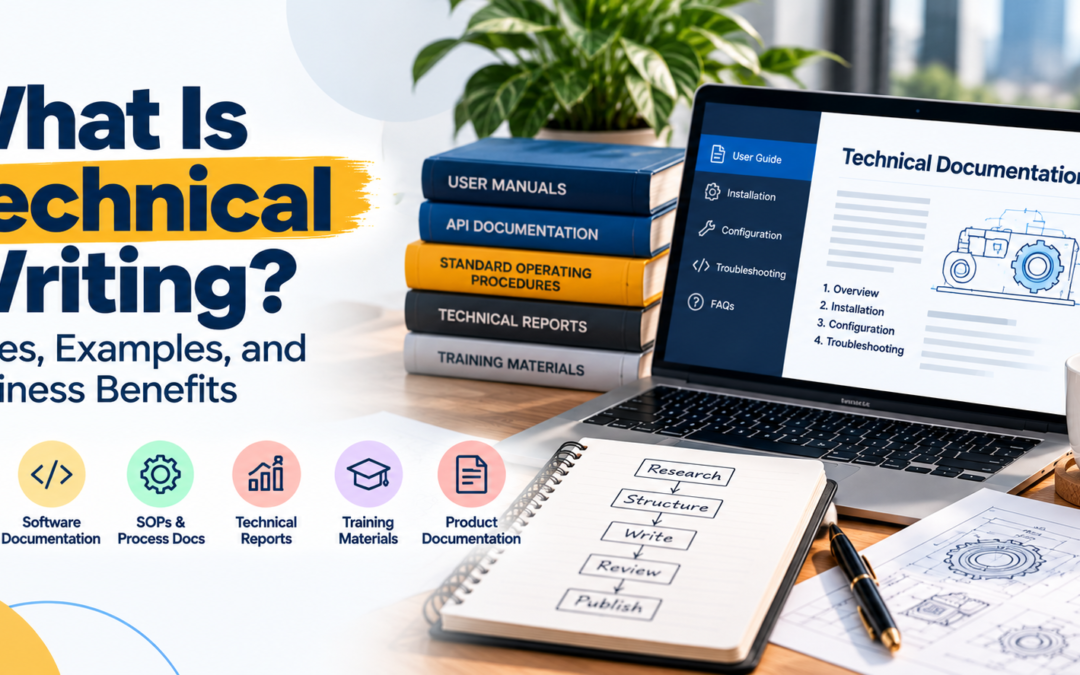
Businesses often work with complex products, specialized processes, and technical information that customers or employees need to understand. However, explaining complicated information in simple, accurate language is not always easy. This is where technical writing becomes valuable.
Technical writing services help businesses communicate technical information through clear, structured, and audience-focused documents. These documents may include product manuals, user guides, standard operating procedures, technical reports, software documentation, and training materials.
Whether you run a technology company, manufacturing business, engineering firm, or software organization, effective technical writing can help people understand your products, follow processes, and use information correctly.
In this guide, we explain what technical writing means, explore its main types, share practical examples, and discuss how businesses can benefit from professional technical writing support.
What Is Technical Writing?
Technical writing is the process of explaining specialized information clearly, in an organized and practical way. It helps readers understand a product, system, process, or technical concept without unnecessary confusion.
Unlike general marketing content, technical documents prioritize accuracy, usability, consistency, and clarity. Writers must understand the subject, identify the intended audience, and present information in a format that readers can use.
For example, a software company may need documentation that explains how users can install an application, configure settings, troubleshoot common errors, and complete specific tasks. A manufacturing company may need operating instructions that help employees use equipment safely and consistently.
Both examples require writers to organise detailed information so that readers can follow it correctly. Professional technical writing services can help businesses turn complex information into useful documentation for customers, employees, partners, and other stakeholders.
What Are the Main Types of Technical Writing?
Technical writing covers several document types. The right format depends on the information you need to communicate, the audience you serve, and the outcome you want to achieve.
1. User Manuals and Instruction Guides
User manuals explain how to operate a product, use a feature, or complete a task. They help readers understand what a product is and how to use it correctly.
Common examples include:
• Product user manuals.
• Installation instructions.
• Equipment operating guides.
• Setup and configuration guides.
• Maintenance instructions.
For example, a company selling industrial equipment may need a manual that explains installation requirements, operating steps, maintenance procedures, and troubleshooting guidance. Well-written manuals can reduce confusion, improve usability, and help customers find answers without contacting support for every basic question.
2. Software and API Documentation
Software documentation explains how an application, platform, system, or software component works. It may serve as an end user, developer, administrator, or internal technical team.
Common examples include:
* Software installation guides.
* Application configuration instructions.
* Application programming interface (API) documentation.
* Developer guides.
* Integration instructions.
* Troubleshooting documentation.
For example, a software-as-a-service (SaaS) company may need API documentation that explains authentication, available endpoints, request parameters, response formats, and error messages. The writer must present information. accurately and organise it so developers can find the details they need. This often requires close collaboration with software engineers and subject-matter experts.
3. Standard Operating Procedures (SOPs)
Standard operating procedures explain how an organization should perform a task or process consistently. Businesses use them to document responsibilities, workflows, quality requirements, and operational steps.
SOPs may cover:
• Employee onboarding.
• Equipment operation.
• Quality control.
• Customer support workflows.
• Data handling procedures.
• Internal approval processes.
For example, a manufacturing business may use an SOP to document inspection steps before a product leaves the production line. Clear procedures help teams follow the same process, reduce avoidable errors, and preserve operational knowledge as responsibilities change.
4. Technical Reports and Research Documents
Technical reports present findings, analysis, test results, or recommendations related to a technical subject. They help readers understand what a team investigated, what it discovered, and what those findings mean.
These documents may include feasibility studies, product testing reports, engineering reports, research summaries, system performance assessments, and technical evaluation documents.
A technical report should distinguish verified findings from assumptions and recommendations. It should also explain methods, limitations, and relevant evidence so readers can assess the conclusions.
5. Training Materials and Educational Documentation
Training documents help people learn how to use a product, follow a process, or develop a technical skill. They are especially useful when a task involves several steps or requires consistent execution.
Examples include employee training manuals, software training guides, learning modules, technical presentations, step-by-step tutorials, and knowledge-base articles.
For instance, a company introducing a new internal software platform may create training materials to help employees complete common tasks and understand the new workflow. Good training documentation uses a logical progression, clear examples, and practical instructions suited to the learner’s experience.
6. Product and Engineering Documentation
Engineering and product documentation records technical specifications, design decisions, requirements, and system details. It supports communication among engineering teams, suppliers, product managers, and other stakeholders.
Examples include product specifications, engineering design documents, system architecture documents, requirements documents, testing procedures, and product release notes.
These documents require precision because readers may rely on them to make design, implementation, procurement, or operational decisions. Technical writers often work with engineers and product specialists to confirm terminology, verify details, and keep documentation aligned with the actual product.
Technical Writing Examples Across Different Industries
Technical writing is not limited to software companies. Many industries depend on accurate documentation to explain processes, products, and specialized information.
| Industry | Example of technical writing | Main purpose |
|---|---|---|
| Software and IT | API documentation and setup guides | Help users and developers work with software |
| Manufacturing | Equipment manuals and SOPs | Support consistent and correct operations |
| Healthcare technology | Device instructions and technical product documents | Explain product use and technical details clearly |
| Engineering | Specifications and test reports | Document requirements, methods, and findings |
| Finance and fintech | System guides and process documentation | Explain workflows and platform functionality |
| Telecommunications | Network configuration guides | Help teams configure and troubleshoot systems |
The format and level of detail depend on the reader. A document for an experienced engineer may use specialized terminology, while a guide for a first-time user should explain concepts and steps more carefully.
How Is Technical Writing Different from Content Writing?
Technical writing and general content writing share important skills, including research, editing, organization, and clear communication. However, they often serve different purposes.
Technical writing usually explains how something works, how to perform a task, or how to interpret specialized information. General content writing may focus on educating an audience, building brand awareness, supporting search visibility, or encouraging a business action.
For example, an API guide explains how developers can connect to a software system. A blog about the benefits of API integrations may help business readers understand why those integrations matter.
Both documents can be valuable, but each requires a different structure and approach. If you want to understand how search-focused content differs from other writing formats, read our guide to SEO content writing vs. regular content writing. For broader ideas on planning website resources, explore content types that drive website traffic.
What Skills Does a Technical Writer Need?
Technical writers need more than strong grammar. They must understand complex information, identify what readers need to know, and present instructions or explanations in a usable format.
* Research and information gathering: Gather information from product specifications, existing documents, and subject-matter experts, and identify gaps before drafting.
* Ability to simplify complex information: Explain specialized concepts without removing essential details.
* Document structure and information design: Use headings, numbered steps, tables, diagrams, warnings, and examples to make documentation easier to navigate.
* Accuracy and attention to detail: Verify terminology, figures, references, and procedures with reliable sources and qualified experts.
* Collaboration with subject-matter experts: Work with developers, engineers, product managers, trainers, compliance teams, and support specialists.
* Editing and documentation maintenance: Review existing documents, update outdated instructions, maintain consistency, and ensure readers can identify the correct version.
Why Do Businesses Need Professional Technical Writing Services?
As businesses develop more complex products and processes, documentation becomes an important part of operations, customer experience, and knowledge management. Professional technical writing services can provide several benefits.
* Make complex information easier to understand: Clear documentation helps customers and employees understand unfamiliar systems, technical concepts, and multi-step processes.
* Improve customer support resources: User guides, troubleshooting articles, and knowledge-base content can help customers resolve common issues independently.
* Support consistent business processes: Documented procedures help employees follow established workflows and train new team members.
* Strengthen product usability: Clear instructions help users understand common tasks and resolve predictable issues.
* Preserve organisational knowledge: Documented processes and decisions help organisations retain information when team members change roles.
• Help teams work more efficiently: Consistent documentation gives teams a shared reference point and reduces repeated explanations.
These benefits depend on documentation quality, accuracy, accessibility, and regular maintenance. Simply producing more documents does not guarantee better outcomes.
How to Choose the Right Technical Writing Company
Selecting a technical writing partner requires careful evaluation, particularly when your documentation involves specialised products, complex systems, or industry-specific requirements.
• Review relevant experience: Ask for examples that match your document type, industry, or technical complexity.
• Check research and verification methods: Understand how the writer gathers information, works with subject-matter experts, checks technical details, and handles gaps in source material.
• Confirm the scope and deliverables: Define which documents you need, who will supply technical information, what formats you require, how revisions will work, and who approves the final version.
• Evaluate structure and usability: Review samples for logical organisation, clear instructions, consistent terminology, and ease of navigation.
• Discuss confidentiality and maintenance: Confirm how the provider will handle confidential material and whether future updates fall within the agreed scope.
• Compare pricing based on complexity: Technical writing costs depend on research requirements, document length, specialist knowledge, source material, review cycles, and deadlines.
For a broader understanding of writing costs, read our guide to content writing rates in India. Technical documentation may require a different pricing approach from general blog writing because of its research and verification needs.
Can AI Tools Replace Technical Writers?
Artificial intelligence (AI) tools can support parts of the documentation process. Writers may use them to organise notes, create an initial outline, improve readability, or identify sections that need further explanation.
However, AI-generated technical content still requires careful review. Tools may misunderstand a product, invent details, omit important limitations, or produce instructions that do not match the actual system.
Businesses should treat AI as a supporting tool rather than a substitute for technical verification. A qualified reviewer should check factual accuracy, terminology, security implications, and procedural details before publication. For complex or safety-sensitive documentation, approval from the relevant subject-matter expert remains especially important.
How to Get Started with a Technical Writing Project
A clear project brief helps a technical writer understand your requirements and estimate the work accurately. Before starting, prepare the following information:
• Project objective: Explain what the documentation should help readers understand or do.
• Target audience: Identify whether readers are customers, developers, engineers, employees, or another group.
• Document requirements: List the manuals, guides, reports, SOPs, or other materials you need.
• Source material: Gather product specifications, existing documents, process notes, diagrams, and relevant references.
materials.
• Review process: Identify the subject-matter experts who will verify technical accuracy.
• Delivery requirements: Specify formats, deadlines, revision expectations, and any maintenance needs.
You do not need every detail finalised before contacting a provider. However, a clear starting brief helps establish expectations and reduces avoidable delays.
Conclusion: Make Technical Information Clear, Accurate, and Useful
Technical writing helps businesses turn complex information into documentation that people can understand and use. From user manuals and software documentation to SOPs and engineering reports, each document should serve a clear purpose and suit its intended audience.
Professional technical writing services can help organisations improve documentation quality, support consistent processes, and make specialised knowledge easier to access. The most effective approach combines subject-matter accuracy, thoughtful structure, clear language, and regular maintenance.