
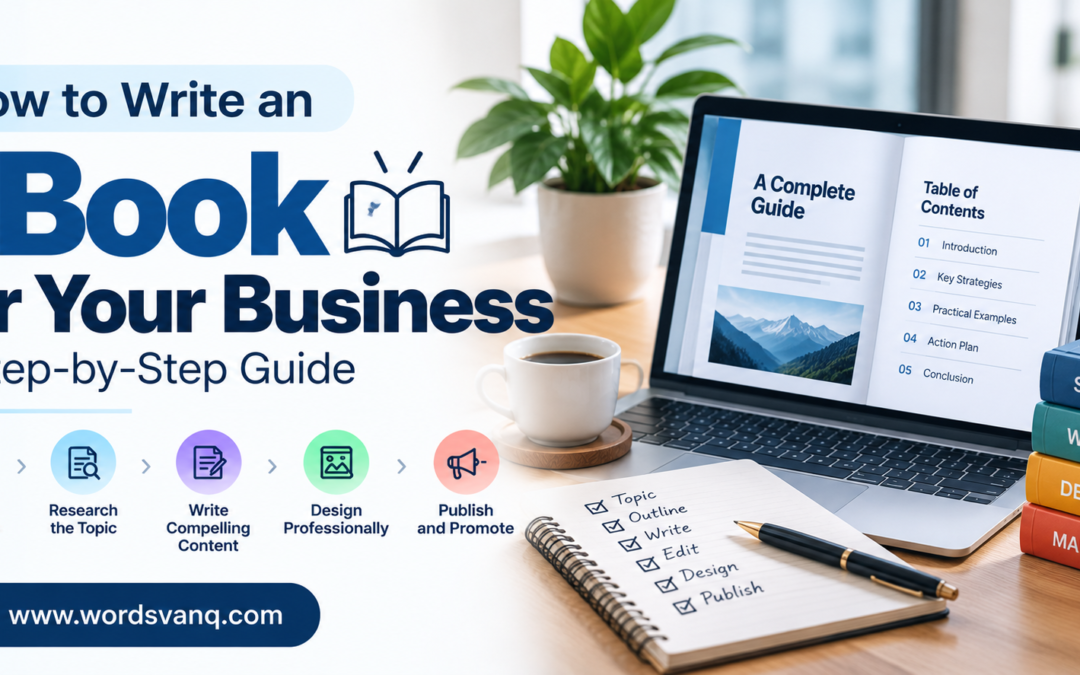
An eBook can help your business share knowledge, build trust, and attract potential customers. It gives you a way to explain your expertise, answer common questions, and provide useful information in one place.
However, creating a successful business eBook takes more than putting a few articles together. You need a clear topic, a well-planned structure, useful information, and a professional presentation.
Whether you want to generate leads, educate customers, or support your marketing campaigns, this guide will show you how to write an eBook for your business, step by step.
If you need help creating high-quality content, a content writing agency can support you with research, writing, editing, and content development.
What Is a Business eBook?
A business eBook is a digital publication that shares useful information about a specific topic related to your industry, products, services, or audience.
Unlike a short blog post, an eBook allows you to explore a subject in greater detail. You can include practical advice, examples, checklists, case studies, and step-by-step instructions.
Businesses use eBooks to generate leads, explain complex services, educate potential customers, and establish their expertise.
For example, a software company could create an eBook about choosing the right software for customer relationship management. A marketing agency could publish a guide to improving search engine visibility. A healthcare business could develop an educational resource that answers common patient questions.
The best topic depends on your audience, your expertise, and the business outcome you want to achieve.
Why Should Your Business Invest in eBook Writing?
A well-written eBook can support several areas of your marketing strategy. It gives your audience something useful while helping your business communicate its expertise.
1. Generate Qualified Leads
You can offer an eBook as a free download in exchange for a visitor’s email address. This helps you build a list of people who have shown interest in your topic.
You can then share relevant resources and service information through email campaigns.
2. Build Trust and Credibility
Readers are more likely to trust a business that explains a topic clearly and provides practical information. An eBook gives you space to demonstrate your knowledge and answer questions that matter to your audience.
3. Explain Complex Topics
Some subjects need more explanation than a regular blog post can provide. An eBook lets you break a complex topic into manageable sections and guide readers through it.
4. Support Your Content Marketing Strategy
You can repurpose an eBook into blog posts, email newsletters, social media posts, infographics, and short videos. This helps you get more value from your research and writing.
For more ideas, explore our guide to 10 types of content that drive the most traffic to your website.
5. Support the Sales Process
Potential customers often research several options before making a decision. An informative eBook can help them understand their challenges, evaluate solutions, and learn how your business can help.
How to Write an eBook for Your Business: 8 Essential Steps
Follow these steps to plan, write, and publish an eBook that serves your audience and supports your business objectives.
Step 1: Define Your Goal and Target Audience
Before you start writing, decide why you want to create an eBook.
Do you want to generate leads, educate existing customers, explain a service, or establish your business as a trusted source of information? Your answer will influence the topic, structure, writing style, and final call to action.
Next, identify your target audience. Consider these questions:
• Who will read the eBook?
• What problems do they want to solve?
• What information do they need before making a decision?
• How familiar are they with your subject?
• What should they do after reading the eBook?
For example, an eBook for business owners who are new to search engine optimization should explain basic concepts in simple language. A guide for experienced marketing managers can explore advanced strategies, performance metrics, and implementation methods.
Practical tip: Write one sentence that explains who the eBook is for and what readers will learn. Use this statement to guide the entire writing process.
Step 2: Choose a Relevant eBook Topic
Your topic should connect your business expertise with your audience’s needs.
Avoid choosing a subject simply because it is popular. Instead, focus on a problem your audience wants to solve.
You can find topic ideas by reviewing customer questions, popular blog posts, search queries, industry reports, and feedback from your sales team.
You should also check whether people search for your chosen topic online. Keyword research helps you understand how your audience describes its problems and what information it expects to find.
Choose a topic that offers enough value for a dedicated eBook without becoming too broad to cover properly.
Step 3: Research the Topic Thoroughly
Research helps you create accurate, useful, and credible content.
Start with reliable sources, such as industry reports, official documentation, research papers, expert interviews, and established publications. Review competing resources to understand what they cover and where your eBook can offer something more useful.
During research, look for:
• Important facts and supporting evidence.
• Common questions and misconceptions.
• Practical examples and case studies.
• Current industry practices.
• Gaps in existing resources.
• Advice readers can apply to their own situations.
Keep a record of your sources so you can verify facts and provide references where necessary.
Your goal is not to collect as much information as possible. It is to select the information that helps readers understand the topic and take the next step.
Step 4: Create a Clear eBook Outline
An outline gives your eBook a logical structure before you begin drafting. It also helps you avoid repeating ideas or missing important information.
A typical business eBook structure may include:
1. Cover page: Introduce the topic with a clear title and subtitle.
2. Introduction: Explain who the eBook is for and what readers will learn.
3. Background: Describe the problem and explain why it matters.
4. Main chapters: Present your advice, methods, examples, and recommendations.
5. Practical resources: Include checklists, templates, or worksheets where relevant.
6. Conclusion: Summarize the main lessons and suggest the next steps.
7. Call to action: Invite readers to explore a relevant resource or contact your business.
The number of chapters depends on the subject and the depth of coverage required. Focus on a smooth reading experience rather than a specific page count.
Step 5: Write the First Draft
Once your outline is ready, start writing each section.
You do not need to make every sentence perfect in the first draft. Focus on explaining your ideas clearly and completing the content before moving to detailed editing.
Keep these writing principles in mind:
Use simple language. Explain technical terms when you first introduce them.
Keep paragraphs focused. Discuss one main idea at a time. Short paragraphs and descriptive subheadings make the eBook easier to read.
Include practical examples. Examples help readers understand how a concept works in a real situation.
Support important claims. Use reliable evidence when you discuss facts, research findings, or industry trends.
Maintain a consistent tone. Your eBook should sound like it comes from the same business, from the introduction to the final page.
Avoid unnecessary repetition. Each chapter should add something new rather than repeat information already covered elsewhere.
If you use artificial intelligence tools during drafting, treat their output as a starting point. Review the facts, verify sources, add your expertise, and edit the content to match your brand voice.
Step 6: Edit and Proofread the Content
Writing the first draft is only part of the process. Editing helps you turn the draft into a clear and useful resource.
Review the content in separate passes.
Check the structure. Make sure the chapters follow a logical order and each section supports the main topic.
Review clarity and readability. Replace complicated sentences with simpler alternatives. Remove unnecessary words and explain unfamiliar terms.
Verify facts and sources. Check statistics, examples, references, product details, and other factual claims.
Proofread the document. Correct spelling, grammar, punctuation, formatting, and consistency issues.
It is also useful to ask someone from your target audience to review the eBook. Their feedback can reveal unclear explanations or missing information that you may overlook.
If you need guidance on improving online content, read our article on how to write content that ranks in Google’s featured snippets.
A professional eBook writing service can also help with research, content development, editing, and proofreading when your internal team lacks the time or specialist skills.
Step 7: Design a Professional eBook Layout
Your eBook should be easy to read and visually consistent with your brand.
Good design does not require complicated graphics on every page. A clean layout often works better because it keeps attention on the content.
Consider these design elements:
* A clear and relevant cover.
* Consistent fonts, colors, and heading styles.
* Readable font sizes and comfortable spacing.
* Short sections with descriptive headings.
* Relevant images, diagrams, tables, and charts.
* Page numbers and a table of contents for longer eBooks.
* Clickable links where the digital format supports them.
* A clear final page with your company details and call to action.
Make sure every visual adds value. A diagram that explains a process is more useful than a decorative image that has little connection to the topic.
Before publishing, check the final file on desktop and mobile devices. Review page breaks, links, image quality, text alignment, and readability.
If your business needs both writing and design, look for an eBook writing company or content writing agency in India that can coordinate these stages.
Step 8: Publish and Promote Your eBook
Once the content and design are ready, decide how readers will access the eBook.
You can publish it as a downloadable resource on your website, offer it through a landing page, share it with email subscribers, or distribute it through relevant marketing channels.
Your promotion plan should match your audience and business goals.
Use a dedicated landing page. Explain what readers will learn and why the resource is useful. If you collect email addresses, keep the form simple and explain how you will use their information.
Promote it through email. Share the eBook with subscribers who may benefit from the topic.
Create supporting blog posts. Publish related articles and link to the eBook where it provides additional value.
Share useful extracts on social media. Turn key lessons, checklists, and examples into posts that encourage readers to explore the full resource.
Use it in sales conversations. Share the eBook with prospects who need more information about a problem your business solves.
Track meaningful results, such as downloads, landing-page conversions, qualified inquiries, and assisted sales. These measures will help you understand whether the eBook supports your business objectives.
Common Mistakes to Avoid When Writing a Business eBook
Even a well-researched eBook can lose its value if it does not meet readers’ expectations. Avoid these common mistakes:
* Choosing a topic that is too broad: Focus on one audience and a clear problem.
* Writing without a plan: Create an outline before drafting chapters.
* Focusing on promotion instead of value: Educate readers before introducing your services.
* Using unsupported claims: Verify facts and cite reliable sources.
* Ignoring readability: Use clear headings, short paragraphs, and simple language.
* Overlooking the design: Check the final document across different devices.
* Publishing without a promotion plan: Decide how you will attract readers before launch.
* Forgetting the next step: Give readers a relevant action to take after finishing the eBook.
Avoiding these mistakes can help you create a resource that readers find useful and your business can use across multiple marketing activities.
Should You Hire an eBook Writing Service?
Writing an eBook in-house can work well when your team has the required knowledge, time, and writing skills. However, some businesses need outside support to manage the entire process.
Professional eBook writing services can help with topic planning, research, outlining, drafting, editing, and content development. Depending on the provider, you may also be able to arrange design and formatting support.
Consider hiring a professional content writing agency if:
* Your team does not have enough time to write a detailed eBook.
* Your topic requires technical research or specialist knowledge.
* You need consistent content for several marketing campaigns.
* You want an experienced writer to organize complex information.
* You need editorial support to maintain a consistent brand voice.
When comparing providers, review their writing samples, research process, editing standards, industry experience, and scope of work. Confirm whether the quoted service includes writing only or also covers editing, design, revisions, and final formatting.
Businesses looking for eBook writing services in India should also compare communication processes, delivery timelines, and experience with their target audience. The right partner should understand your business goals and create content that meets your readers’ needs.
For more information about pricing and service scope, see our guide to content writing rates in India.
Create a Business eBook That Supports Your Marketing Goals
A successful business eBook starts with a clear purpose. Choose a relevant topic, understand your audience, research carefully, and organize the content before writing. Then edit the draft, invest in a readable design, and build a plan to reach the right readers.
You do not need to cover every aspect of an industry in one eBook. Focus on solving a specific problem and giving readers information they can use.
If you need help turning your expertise into a well-structured resource, WordsVanq can support your content development needs. As a content writing agency, WordsVanq helps businesses create useful content that communicates ideas clearly and supports their marketing goals.
Explore WordsVanq’s content writing services to discuss your next eBook project.
Frequently Asked Questions
1. How do I start writing an eBook for my business?
Start by defining your target audience and the problem you want to solve. Choose a relevant topic, research it thoroughly, and create an outline. Then write, edit, design, and publish the eBook.
2. How long should a business eBook be?
There is no fixed word count or page requirement. A short guide may need only a few thousand words, while a detailed technical eBook may require more. Focus on covering the subject properly without adding unnecessary content.
3. How much do eBook writing services cost in India?
The cost depends on the topic’s complexity, research requirements, word count, writer expertise, and the services included. Editing, design, formatting, and specialist research may affect the total price. Request a detailed quotation based on your project scope.
4. Can an eBook help generate business leads?
Yes. Businesses often offer useful eBooks as downloadable resources through landing pages. When readers voluntarily share their contact details to access the content, the business can follow up with relevant information and offers, subject to applicable privacy and consent requirements.
5. What should I look for in an eBook writing company?
Review the company’s writing samples, industry experience, research standards, editing process, timelines, and revision policy. Confirm the deliverables before starting, including whether the service covers design and formatting.
6. Can I turn my existing blog posts into an eBook?
Yes. You can combine related articles into a more complete guide. However, do not simply copy and paste the posts. Reorganize the information, remove repetition, fill content gaps, and add an introduction, transitions, practical resources, and a conclusion.
7. What is the difference between eBook writing and eBook design?
eBook writing focuses on research, structure, and written content. eBook design focuses on the cover, layout, typography, visuals, and overall presentation. Some providers offer both services as part of one package.