
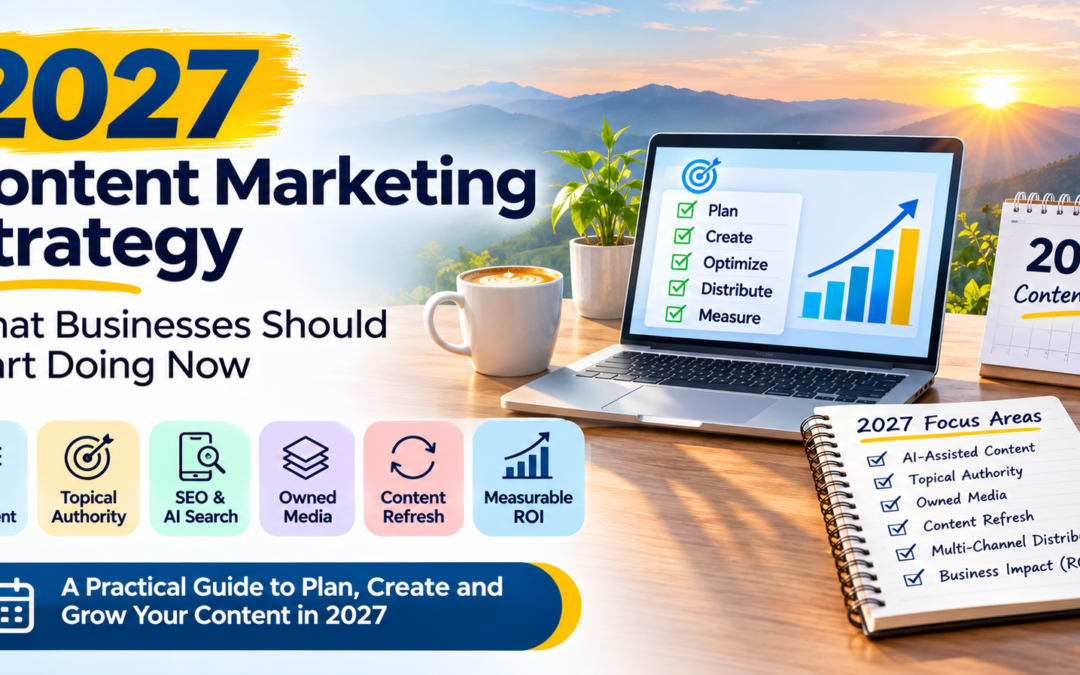
Businesses are entering 2027 with a very different content marketing environment than they faced just a few years ago. Artificial intelligence (AI) can help teams research, draft, repurpose, and distribute content at a speed that was previously difficult to achieve. At the same time, search engines are increasingly providing answers directly in search results and AI-powered platforms are becoming part of the research and buying process.
That does not mean businesses should simply publish more content. In fact, the opposite may be true. The competitive advantage in 2027 will increasingly come from creating useful, original, trustworthy, and strategically distributed content rather than producing large volumes of generic articles.
Recent 2027 research from the Content Marketing Institute shows that B2B marketers are already dealing with this tension. AI is improving speed and efficiency, but marketers continue to identify accuracy, quality control, and brand authenticity as major challenges. The research also shows that owned media is expected to remain a major investment area in 2027.
So what should businesses do now? They should start building their 2027 content marketing strategy before the new year arrives.
What Is a 2027 Content Marketing Strategy?
A 2027 content marketing strategy is a structured plan for creating, optimizing, distributing, and measuring content that supports business objectives throughout 2027.
It should answer questions such as:
• Who are we trying to reach?
• What problems do our customers need to solve?
• Which topics should our brand own?
• What content belongs on our website?
• How will we use AI responsibly?
• How will our content support SEO and AI-powered search?
• Which content should generate leads or sales?
• How will we demonstrate expertise and credibility?
• How often should we update existing content?
• Which channels should distribute our content?
• How will we measure business results?
A strong strategy connects content with the entire customer journey rather than treating blogging as an isolated SEO activity. Google says its AI Overviews and AI Mode continue to use fundamental SEO principles such as crawlability, internal linking, textual content, excellent page experience, and helpful, reliable, people-first content. Businesses therefore do not need a completely separate content strategy for AI search. They need a better overall content strategy.
Why Businesses Should Start Planning Their 2027 Content Strategy Now
Waiting until January 2027 to plan your content calendar creates an unnecessary disadvantage. Content needs time to gain visibility. A new article may require weeks or months to establish organic visibility. A topic cluster may require multiple supporting articles. Industry research, expert interviews, and content updates also take time.
Planning early gives businesses an opportunity to:
* Identify content gaps
* Research valuable topics.
* Build topic clusters
* Create cornerstone content
* Improve existing pages
* Prepare industry-specific content.
* Develop original research
* Build internal links
* Establish author expertise
* Create content distribution workflows
* Test AI-assisted production processes
The goal should be to ensure a thoughtful approach to publishing rather than doing everything immediately. The goal should be to enter 2027 with a content system that can consistently produce useful business outcomes.
1. Move From Content Volume to Content Value
One of the biggest changes businesses should make in 2027 is to stop treating the number of published articles as the primary measure of content marketing success. Publishing 100 generic articles is not automatically better than publishing 25 highly useful resources.
Google’s current guidance for AI-powered search emphasizes unique, valuable, non-commodity content and warns against creating large numbers of pages primarily to manipulate search rankings or generative AI responses.
Businesses should ask, “What can we say that competitors cannot easily copy?”
That could come from:
• First-hand experience
• Original research
• Customer data
• Expert opinions
• Case studies
• Proprietary processes
• Industry examples
• Original statistics
• Product demonstrations
• Detailed comparisons
• Lessons from real projects
Instead of publishing another generic article titled “10 Digital Marketing Tips,” a digital marketing agency could publish “What We Learned From Managing SEO Campaigns for 25 Small Businesses.” The second topic provides a reason to trust the company.
2. Build Around Expertise and Topical Authority
Businesses should stop planning their blog around disconnected keywords. Instead, they should build topic clusters.
Suppose a company provides content marketing services. Rather than publishing unrelated articles about content writing, it could build a content cluster around content marketing.
Pillar topic: Content Marketing Strategy
Supporting topics: What Is Content Marketing?
• How to Create a Content Marketing Strategy
• Content Marketing vs. Traditional Advertising
• Content Marketing for B2B Companies
• Content Marketing for Small Businesses
• How to Measure Content Marketing ROI
• Content Marketing Trends for 2027
• How AI Is Changing Content Marketing
• How to Build a Content Calendar
• How to Repurpose Long-Form Content
These pages can be internally linked to create a stronger information architecture and demonstrate expertise around a subject instead of competing for isolated keywords.
3. Use AI as a Content Assistant, Not a Content Strategy
AI will remain an important part of content marketing in 2027. The important question is where AI adds value and where human expertise is essential.
AI can help with:
* Topic ideation
* Content briefs
* Keyword clustering
* Research organization
* Outline development
* Content repurposing
* Metadata drafts
* FAQ generation
* Content audits
* Summarization
* Distribution workflows
Businesses should not rely on AI to produce large volumes of undifferentiated content without meaningful human review. A better workflow is
Research → Strategy → Human expertise → AI assistance → Human editing → Fact checking → Optimization → Distribution → Measurement.
AI should make a good content operation more efficient. It should not become a substitute for having something valuable to say.
4. Create Content That Demonstrates First-Hand Experience
In 2027, businesses should make their content more specific. Generic statements are easy to produce. Experience is harder to replicate.
Instead of saying “SEO is important for businesses,” a stronger article could explain which SEO problems the business encountered, what changes were implemented, how long the changes took, what improved, what did not work, what the business learned, and what another company should do differently.
This creates evidence of experience. Sales teams have customer objections. Support teams have recurring questions. Founders have industry experience. Product teams understand technical problems. Marketing teams have campaign data. All of these can become valuable content.
5. Optimize Content for Both Search Engines and AI Answers
SEO remains important in 2027, but businesses should broaden the definition of search visibility. People may discover a company through traditional Google results, AI Overviews, Google AI Mode, ChatGPT, Perplexity, YouTube, LinkedIn, Reddit, industry publications, and other discovery platforms.
Content should be easy for both people and machines to understand. That starts with:
* Clear page structure
* Descriptive headings
* Direct answers
* Logical internal links
* Useful supporting information
* Accurate facts
* Author information
* Original insights
* Relevant entities and terminology
* Proper structured data where applicable
* Crawlable pages
* Strong user experience
Businesses should not chase every new AI optimization trick. They should make their existing content better.
6. Focus More on Commercial and Decision-Stage Content
One mistake many businesses make is producing too much top-of-funnel content. An article can generate thousands of impressions without producing a single qualified lead.
Awareness:
• What Is Technical SEO?
• What Is Content Marketing?
• Why Does Website Speed Matter?
Consideration:
• SEO Agency vs. In-House SEO Team
• Content Writing Agency vs. Freelance Writer
• SEO Content Writing vs. Regular Content Writing
Decision:
• Content Writing Services Pricing
• How to Choose a Content Writing Agency
• Content Writing Packages for Small Businesses
• Technical Writing Services for SaaS Companies
Retention and expansion:
• How to Get More Value From Your Existing Content
• How to Create Content Refresh Strategy
• How to Scale Content Across Multiple Markets
This creates a more commercially useful content ecosystem.
7. Make Your Website an Owned Media Asset
Social media can provide reach. Search engines can provide discovery. All platforms can provide new visibility. But your website remains one of the most important assets your business controls.
Businesses should build valuable resources on their own websites instead of depending entirely on third-party platforms.
Useful owned-media assets include:
• Blog articles
• Industry guides
• Research reports
• Case studies
• Whitepapers
• Comparison pages
• Glossaries
• Product education
• Original data
• Customer stories
• FAQs
• Downloadable resources
Owned content can continue generating value long after a social post disappears from a feed.
8. Refresh Existing Content Instead of Always Creating New Content
Content marketing is not only about publishing. It is also about maintaining what you already have.
Review existing articles for outdated statistics, old examples, broken links, missing sections, declining rankings, declining organic traffic, outdated screenshots, old product information, weak internal links, new search questions, and new competitors.
Some older pages may need a small update. Others may need a complete rewrite. Some should be consolidated. Others may no longer deserve to exist. A quarterly content audit can help businesses decide where to spend their resources.
9. Create More Original Research and Data-Driven Content
If everyone can ask AI to write an article about a topic, generic articles become less valuable. Original research becomes more valuable.
Businesses should consider producing:
• Industry surveys
• Customer surveys
• Internal benchmarks
• Annual reports
• Market studies
• Original statistics
• Expert interviews
• Customer trend reports
• Case studies
• Proprietary datasets
For example, a real estate company could publish “2027 Rental Market Trends in Lucknow: What Our Property Data Shows.” A digital agency could publish “SEO Performance Benchmarks for Small Businesses in India: 2027 Report.” These assets can support SEO, digital PR, social media, sales, and brand authority at the same time.
10. Build a Content Distribution System
Publishing an article should not be the end of the process. It should be the beginning.
A single long-form article can become:
• LinkedIn posts
• Short-form videos
• Email newsletters
• Social media carousels
• Sales enablement content
• FAQs
• Website snippets
• Webinar topics
• Podcast discussions
• Industry commentary
One pillar article can become five LinkedIn posts, two short videos, one email newsletter, one carousel, three supporting blog articles, and sales-team talking points. This increases the return on every piece of content and helps businesses maintain consistency without constantly starting from zero.
11. Strengthen Author and Brand Credibility
In 2027, businesses should make it easier for readers and search systems to understand who is behind their content.
Consider adding:
• Author bios
• Relevant professional experience
• Editorial review information
• Expert contributors
• Company About pages
• Case studies
• Customer testimonials
• Industry credentials
• Original research
This is especially important for healthcare, finance, legal, technology, and other areas where accuracy and expertise matter significantly. The goal is not to add credibility signals simply because they are an SEO checklist. The goal is to make your expertise visible.
12. Measure Business Outcomes, Not Just Traffic
Traffic remains useful. But traffic alone does not tell you whether content is working.
Visibility: Organic impressions, rankings, AI search visibility, brand mentions, and search share.
Engagement: Organic clicks, engagement rate, returning visitors, content depth, newsletter subscriptions.
Business impact: Leads, qualified leads, demo requests, contact form submissions, sales opportunities, and revenue influenced by content.
Content efficiency: Cost per content asset, content production time, content refresh rate, and conversion rate by content type.
The most important metric will vary by business. A B2B software company may care about qualified demo requests. A local service business may care about phone calls and inquiries. An e-commerce company may care about assisted revenue. The content strategy should therefore start with business objectives and work backward.
A Practical 2027 Content Marketing Framework
Step 1: Define your business goals. Decide whether content needs to support brand awareness, organic visibility, lead generation, sales, customer education, retention, or authority building.
Step 2: Identify your priority audiences. Define your ideal customers, industry segments, buyer roles, main problems, purchase objections, and search behavior.
Step 3: Build your topic architecture. Identify core topics, supporting topics, commercial topics, comparison topics, industry-specific topics, and customer questions.
Step 4: Create a content production system. Decide who researches, writes, reviews, fact-checks, publishes, and distributes, and where AI can assist.
Step 5: Build a content refresh cycle. Review important content every quarter or according to how quickly the information changes.
Step 6: Measure and improve. Track performance and use the results to decide what to create, update, expand, consolidate, repurpose, or remove.
What Should Businesses Start Doing Before 2027?
1. Audit your existing content. Find pages that are outdated, underperforming, or competing with each
other.
2. Identify your 5 to 10 most important topics. These should directly relate to your products, services, customers, and expertise.
3. Build topic clusters. Create pillar pages and supporting articles instead of publishing disconnected blog posts.
4. Identify content gaps. Compare your website with competitors and look for important questions they answer that you do not.
5. Create commercial content. Build pages around comparisons, pricing, services, use cases, alternatives, and buyer questions.
6. Develop an AI-assisted workflow. Use AI where it improves efficiency, but maintain human oversight for expertise, accuracy, tone, and originality.
7. Start collecting original insights. Turn customer questions, internal data, expert interviews, and case studies into content.
8. Improve your author and brand information. Make your expertise clear to readers and search systems.
9. Create a distribution plan. Decide how every major article will be reused across other channels.
10. Establish content KPIs. Connect content performance to leads, sales, visibility, and other meaningful business outcomes.
2027 Content Marketing Trends Businesses Should Watch
AI-assisted content production: AI will continue to become part of everyday content workflows.
AI-powered search: Search behavior will continue expanding beyond traditional blue-link results.
Original expertise: Businesses will have greater incentive to publish content based on real experience, evidence, and proprietary knowledge.
Owned media: Companies will continue investing in content assets they control rather than relying entirely on rented platforms.
Content governance: As content production becomes faster, businesses will need stronger systems for reviewing, updating, consolidating, and maintaining content.
Multi-channel discovery: Customers may discover brands through search engines, AI platforms, social networks, communities, video platforms, and industry publications.
Quality over quantity: More content will not necessarily produce more visibility. The ability to create genuinely useful content will become more important.
These are forward-looking trends, not guaranteed outcomes. Businesses should monitor actual 2027 developments and adjust their strategy accordingly.
Final Thoughts
A strong 2027 content marketing strategy should not be built around publishing as much content as possible. It should be built around becoming more useful, more visible, and more credible.
Businesses should use AI to improve efficiency without allowing automation to replace expertise. They should build topic authority instead of chasing isolated keywords. They should create content based on real customer problems and first-hand knowledge. They should invest in owned media, refresh valuable content, and distribute important ideas across multiple channels.
Most importantly, businesses should connect content with actual commercial objectives. The companies that start preparing now will have more time to build their content foundations before 2027 begins.
At WordsVang, we help businesses develop and execute content strategies that combine SEO content writing, technical writing, website content, content management, and content-driven SEO. If your business needs a stronger content pipeline for 2027, visit wordsvanq.com or contact WordsVang to discuss your content requirements.
Frequently Asked Questions
What is a content marketing strategy for 2027?
A 2027 content marketing strategy is a structured plan for creating, optimizing, distributing, and measuring content that supports business goals throughout 2027. It should cover audience needs, SEO, AI-assisted workflows, topic authority, content distribution, and performance measurement.
What are the biggest content marketing trends for 2027?
Important trends include AI-assisted content production, AI-powered search, original research, first-hand expertise, topical authority, owned media, content refreshes, multi-channel distribution, and stronger content governance.
Will AI replace content writers in 2027?
AI is likely to become a larger part of content production, but businesses still need human expertise for strategy, original insights, fact checking, editorial judgment, brand voice, and subject-matter accuracy.
Should businesses still invest in SEO content in 2027?
Yes. Google continues to emphasize fundamental SEO practices for its AI-powered search experiences. Businesses should focus on helpful, reliable, people-first content, strong site architecture, internal linking, crawlability, and valuable information.
How often should businesses publish content in 2027?
There is no universal publishing frequency. Businesses should choose a sustainable schedule based on resources, audience, industry, and objectives. Publishing fewer high-quality pieces can be more effective than producing large volumes of generic content.
How can a small business create a 2027 content strategy?
Start with valuable customers and their questions. Identify the services or products you want to sell, build topic clusters around them, create useful website content, develop a sustainable publishing schedule, and measure leads and conversions rather than focusing only on traffic.
Should businesses update old content in 2027?
Yes. Content should be reviewed regularly for outdated information, declining performance, broken links, missing information, and changes in search intent.
What is the difference between content marketing and SEO content?
Content marketing is the broader strategy of using content to attract, educate, engage, and convert an audience. SEO content is content specifically optimized to improve visibility in search engines. A strong 2027 strategy should use SEO as part of a broader content marketing system.
What should businesses do now to prepare for 2027?
Businesses should audit existing content, identify topic clusters, create commercial content, improve author and brand credibility, establish AI-assisted workflows, plan content distribution, and create a regular content refresh process before 2027 begins.