
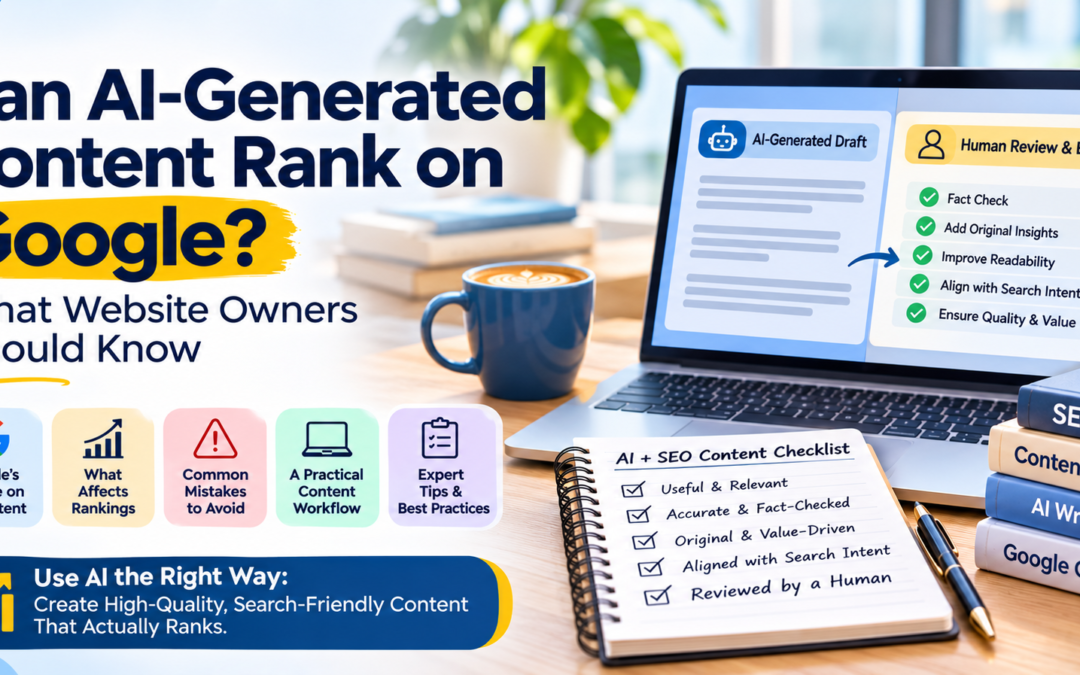
Artificial intelligence (AI) has changed how businesses create website content. Today, website owners can use AI writing tools to draft blog posts, product descriptions, service pages, email campaigns, and social media content in a fraction of the time traditional writing requires.
However, faster content production raises an important question: Can AI-generated content rank on Google?
Some businesses worry that Google will penalize their websites for publishing AI-written articles. Others believe they can generate hundreds of blog posts with AI and quickly improve their organic traffic. Neither assumption gives the complete picture.
Google does not automatically reject content because someone used AI to create it. Instead, its guidance focuses on the usefulness, originality, accuracy, and overall quality of the published content. The problem starts when website owners use automation primarily to manipulate search rankings or publish large volumes of unoriginal pages without adding value.
For businesses, this means AI can support an effective content strategy, but it cannot replace editorial judgement, subject knowledge, research, and quality control.
1. Does Google Allow AI-Generated Content?
Yes. Google allows website owners to publish AI-generated content, provided that it follows its Search Essentials and spam policies. Google has explained that its ranking systems aim to reward high-quality, original content, regardless of how someone produces it. The same principle applies to content created by human writers, AI tools, or a combination of both.
This distinction matters because using AI is not the same as publishing spam. A business might use an AI writing assistant to develop a blog outline, organize research notes, suggest headings, improve sentence structure, draft an initial article, create meta description options, or identify reader questions.
A writer or subject matter expert can then review the draft, verify the information, add original insights, and ensure that the article answers the reader’s actual question. This approach uses AI as a productivity tool rather than treating it as an automatic content publishing system.
The key point: Google does not prohibit AI-generated content. It discourages content created primarily to manipulate search rankings rather than help people.
2. What Does Google Actually Evaluate When Ranking AI Content?
Google does not award rankings simply because a page uses AI or because a human wrote every sentence. Its guidance emphasizes helpful, reliable, people-first content. A website owner should evaluate AI-assisted content against several quality factors.
Originality and information value. An article should offer something useful beyond information readers can find on every competing website. For example, a generic article about the benefits of digital marketing may list visibility, lead generation, brand awareness, and customer engagement. A stronger article can include examples from real projects, practical recommendations, industry-specific applications, common mistakes, and original observations.
Accuracy and factual reliability. AI tools can generate incorrect information, outdated statistics, invented references, and misleading explanations. Writers must verify important claims, particularly in healthcare, finance, legal services, technology, and other subjects where inaccurate information can influence important decisions.
Experience and subject knowledge. Readers often need more than a general explanation. An article about choosing a dental clinic for children, for example, can offer more value when a pediatric dental professional contributes guidance about a child’s first visit, parental concerns, and treatment approaches.
Search intent and completeness. A page should answer the question behind the search query. Someone searching whether AI content can rank on Google likely wants to understand Google’s policy, ranking considerations, potential risks, and practical ways to use AI. A useful article should cover these needs rather than offer a one-line answer.
3. Can AI-Generated Content Rank Without Human Editing?
It can, but publishing an unreviewed AI draft creates avoidable risks. AI tools can produce readable articles with headings, paragraphs, keywords, and FAQs. However, readable content does not automatically qualify as useful content.
An unedited draft may contain generic explanations, factual errors, weak examples, repetitive language, poor search-intent alignment, and a lack of subject expertise.
Imagine an IT company publishing an AI-generated article about cloud migration. The article may explain the basic concept correctly, but potential customers may also want to understand migration challenges, security considerations, downtime, infrastructure requirements, and implementation costs. If the article ignores these concerns, it may offer little value.
Human editing helps identify these gaps. A knowledgeable editor can add technical details, examples, references, and recommendations. Human editing is not a guaranteed ranking factor. It is a quality-control step that helps make content more useful, accurate, and relevant.
4. What Is Scaled Content Abuse, and Why Should Website Owners Avoid It?
One of the biggest risks associated with AI writing is the temptation to publish large volumes of content without proper research or editorial review. Google describes this practice as scaled content abuse.
It refers to generating many pages primarily to manipulate search rankings rather than help users. The policy applies whether someone creates content using AI, human writers, or a combination of methods.
Consider a digital marketing agency that uses AI to create 100 city pages: Content Writing Services in Delhi, Mumbai, Pune, Lucknow, and Jaipur. If every page contains almost identical information and only the city name changes, the website offers little unique value to visitors.
A better approach is to create fewer, more useful pages. Each location page should address relevant local business needs, industries, customer expectations, and service requirements.
Risky practices: publishing hundreds of AI articles without review; rewriting competitor articles without adding value; creating city pages by changing only location names; targeting unrelated trending topics; and publishing content without expert input.
The issue is not the volume of content alone. It is the lack of value behind that volume.
5. AI-Generated Content vs. Human-Written Content: Which Is Better for SEO?
There is no universal rule that human-written content will always outperform AI-generated content or that AI-written content will rank equally well in every situation. Both approaches can produce useful content. Their effectiveness depends on research, expertise, editorial process, and the value they bring to readers.
Production speed: AI is usually faster for initial drafts; human writing time depends on research and scope.
Research: AI can organize information but needs fact-checking; human writers can conduct direct research and interviews.
Original insights: AI may produce predictable ideas; people can contribute firsthand experience and judgment.
Accuracy: both approaches require verification.
Brand voice: AI needs clear instructions and editing; skilled writers can adapt tone and messaging.
SEO performance: both depend on final content quality.
The most practical option for many businesses is a combination of both. AI can help with research organization, outlining, and drafting. Human writers and editors can improve accuracy, add context, strengthen brand voice, and ensure the article meets its purpose.
6. How to Use AI for SEO Content Without Compromising Quality
Businesses do not need to avoid AI writing tools. They need a clear process for using them responsibly.
Step 1: Start with keyword and audience research. Understand what your audience searches for and why. Research primary and secondary keywords, search intent, related questions, competing pages, information gaps, and the audience’s knowledge level. A company targeting technical writing services should know whether its audience needs technical documentation, user manuals, API documentation, software guides, or a writing agency.
Step 2: Create a detailed content brief. Include the target audience, primary and secondary keywords, search intent, main topic and subtopics, required examples, internal linking opportunities, sources that need verification, and the desired call to action. AI can help organize the brief, but an SEO strategist or editor should approve its direction.
Step 3: Use AI to support the writing process. Use AI to develop an outline or initial draft, simplify complex explanations, suggest headings, improve readability, identify repetition, draft FAQs, and suggest internal links. Do not accept every suggestion without review.
Step 4: Add original insights and practical examples. Ask a subject matter expert to review the article or contribute industry examples, project experiences, professional recommendations, customer questions, original research, and practical advice. Never invent client results, case studies, testimonials, or statistics.
Step 5: Fact-check the complete article. Verify statistics, regulations, medical or technical claims, product specifications, dates, policy changes, references, and external links. Review the title, meta description, image alt text, and structured data for accuracy and relevance.
Step 6: Optimize for readers and search engines. Check the title tag, meta description, descriptive URL, logical headings, natural keyword use, relevant internal links, credible external links, useful images and alt text, and mobile reading experience.
Step 7: Monitor performance after publishing. Use Google Search Console to monitor impressions, organic clicks, average position, queries bringing visitors, and pages that receive impressions but few clicks. Update outdated information and improve sections that do not answer search queries. Avoid frequent changes based only on short-term ranking fluctuations.
7. Does Google Penalize Websites for Using AI Content?
Google does not automatically penalize a website because it publishes AI-generated content. However, a website can face ranking problems or spam-related actions if its content violates Google’s policies. Publishing large volumes of unoriginal pages to manipulate rankings may fall under scaled content abuse.
Situation A: Responsible AI-assisted publishing. A business uses AI to prepare an outline, then adds verified information, expert insights, original examples, and editorial review before publishing.
Situation B: Search manipulation through mass-produced content. A business generates hundreds of keyword-focused articles, makes minimal changes, and publishes them without checking accuracy or adding useful information.
The first approach can support a legitimate content strategy. The second creates a clear risk under Google’s spam policies. Evaluate every page based on its usefulness to the intended audience, not simply the tool used to produce it.
8. Should Businesses Disclose That They Used AI to Write Content?
Not every article needs an AI disclosure simply because a writer used an AI tool. Google recommends considering transparency when readers would reasonably want to know how the content was created. A disclosure may be appropriate when automation plays a substantial role or when the method of creation affects how readers interpret the information.
Businesses should communicate honestly. If a company uses AI for research and drafting followed by human review, it should not make misleading claims about its editorial process. It should not present AI-generated information as first-hand experience or expert opinion. The goal is to help readers understand the content, not to add a disclosure to every page as an SEO tactic.
9. What Should Businesses Choose: AI Writing Tools or Professional Content Writing Services?
AI writing tools and professional content writing services serve different purposes. AI can help businesses produce initial drafts, organize ideas, and improve efficiency. However, businesses still need a process to ensure that published content supports their brand, communicates accurate information, and meets audience needs.
Professional content writing services can support SEO blog writing, website content writing, technical writing, industry-specific content, and content editing and management.
A healthcare business may need content that explains treatments in simple language while maintaining medical accuracy. An IT company may need technical articles that communicate complex solutions to decision-makers. An e-commerce business may need product descriptions that help customers understand their options.
These requirements involve more than generating paragraphs around keywords. They require audience understanding, subject knowledge, editorial planning, and a clear content strategy.
At WordsVanq, we approach content as a business communication and search visibility asset. Our content writing services focus on helping businesses create clear, relevant, and audience-focused content.
10. A Practical Checklist Before Publishing AI-Assisted Content
Before publishing an AI-assisted article, check the following:
• Does it address a clear audience and search intent?
• Does it provide useful information beyond generic explanations?
•Have statistics, facts, and technical claims been verified?
• Does it include relevant examples or original insights?
• Does it reflect the brand’s tone and expertise? • Have repetitive sections been removed?
• Does it use keywords naturally?
• Are the title, meta description, and URL relevant?
• Are internal and external links accurate and useful?
• Has a qualified person reviewed it?
• Does it help readers make progress towards their goal?
If the article fails several of these checks, improve it before publishing.
Frequently Asked Questions
1. Can AI-generated content rank on Google?
Yes. Google allows AI-generated content in search results. Its ranking systems focus on content quality, originality, usefulness, and relevance rather than automatically rejecting content based on how someone created it.
2. Does Google detect AI-generated content?
Google has systems for identifying spam and low-quality content, including content produced through automation. Ranking success should not be reduced to whether a page passes an AI detection tool. Google’s published guidance focuses on the value and purpose of the content.
3. Does AI-generated content affect SEO?
AI-generated content does not automatically harm SEO. It can support content production when businesses use it responsibly. Problems can arise when AI produces inaccurate, repetitive, unoriginal, or low-value pages at scale.
4. Is human-written content better than AI-generated content?
Not automatically. A well-researched AI-assisted article can be more useful than a poorly written human article. A knowledgeable writer can also add experience, context, and original insights that a generic AI draft may lack.
5. Can I use ChatGPT to write blog posts for my website?
Yes. You can use ChatGPT to develop outlines, organize research, draft sections, improve readability, and suggest FAQs. Review and fact-check the final article before publishing it.
6. Should I remove AI-generated articles from my website?
Not simply because they use AI. Review each article for accuracy, originality, usefulness, and relevance. Improve pages that lack value, and consider removing or consolidating pages that serve no useful purpose.
7. How much AI-generated content can I publish on my website?
Google does not specify a universal percentage or word limit. The important consideration is whether the content provides value and complies with Google’s policies. A small number of low-quality pages can still be problematic, while a larger volume of useful content can serve readers effectively.
Conclusion: Use AI to Improve Content, Not to Replace Content Strategy
Al has made content production faster, but it has not removed the need for research, subject knowledge, editorial judgement, and a clear understanding of the audience.
Businesses can use Al to support blog writing, website copy, SEO research, and content planning. However, publishing large volumes of unreviewed articles is not a sustainable way to build organic visibility.
The better approach is to combine Al’s efficiency with human expertise. Start with audience and keyword research, create a useful content brief, add original insights, verify important claims, and review every article before publication.
Ultimately, Google rankings depend on the value a page provides, not simply whether a human or an AI tool produced the first draft.
If your business wants to build a consistent content strategy, explore WordsVanq for content writing support that puts clarity, relevance, and quality first.