
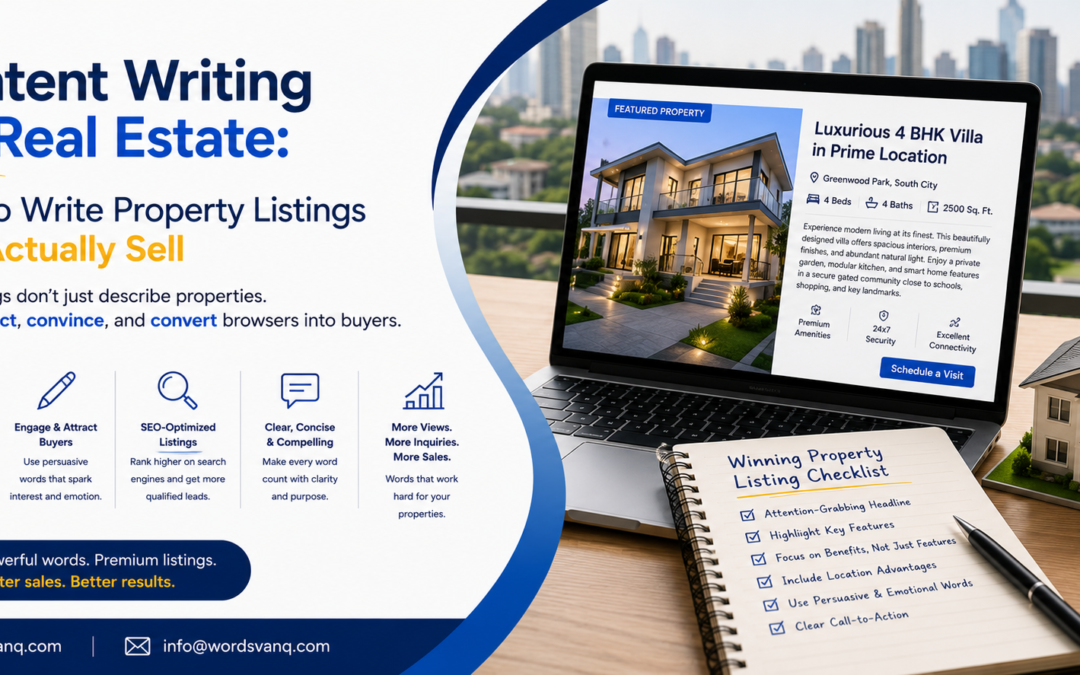
95% of Indian property buyers research online before site visits.
Listings with compelling descriptions get 3x more inquiries on average.
Real estate SEO blogs drive 60% lower cost per lead than paid ads.
India’s real estate market will hit $1 trillion by 2030; content wins.
KEY TAKEAWAYS
- 95% of Indian property buyers research online before their first site visit; your content is their first impression.
- Generic listings with vague descriptions generate a fraction of the inquiries that specific, buyer-focused listings produce.
- Great property listings lead with lifestyle and aspiration, then support with facts and specifications.
- Locality guides and neighborhood content are among the most powerful SEO assets a real estate business can build.
- Real estate SEO blogs targeting location-specific keywords drive consistent organic leads at significantly lower cost than paid advertising.
- Every property listing needs a compelling headline, a strong opening paragraph, a benefit-led description, and a clear call to action.
- WordsVanq writes property listings, locality guides, and SEO blogs for real estate businesses across India.
Open any Indian real estate portal and read ten property listings. Chances are eight of them will say something like, ‘A spacious 3 BHK flat is available in a prime location. Modern amenities. Close to schools and hospitals. Ready to move in. Contact for best price.’
These listings are everywhere. They are forgettable, interchangeable, and completely useless for a buyer trying to understand whether this property is right for their family. And because they are indistinguishable from every other listing on the page, they generate a fraction of the inquiries that well-written listings produce.
Research consistently shows that property listings with compelling, specific, buyer-focused descriptions generate up to three times more inquiries than generic ones. In India’s fast-growing real estate market, where buyers research extensively online before visiting a single site, the quality of your written content can be the difference between a property that sells quickly and one that sits on the market for months.
This guide covers everything real estate developers, agents, and property marketers in India need to know about real estate content writing, from individual property listings to locality guides, SEO blogs, and full content strategies. And for those who need professional real estate content writing services handled by experts, WordsVanq is ready to help.
Why Real Estate Content Writing Is Different From Other Industries
Real estate content writing has unique characteristics that make it distinct from content in almost any other industry. Understanding these differences is essential before writing a single word of property content.
The Stakes Are Exceptionally High
For most Indian families, buying a home is the single largest financial decision of their lifetime. For investors, commercial property purchases involve crores of rupees and years of financial planning. These are not impulse purchases. They are deeply considered decisions that involve extensive research, multiple comparison points, and strong emotional components.
This means your content needs to work at two levels simultaneously: it must be factually accurate and comprehensive enough to satisfy rigorous rational analysis and emotionally compelling enough to help the buyer envision their life in the property. Most real estate listings in India do the first poorly and the second not at all.
Buyers Research Extensively Before Any Contact
A 2025 survey by 99acres found that 95% of Indian property buyers conduct extensive online research before visiting a property or contacting an agent. The average buyer visits 8 to 12 online sources during their research journey. Your listing, locality guide, and blog content are competing for attention across all of these touchpoints simultaneously.
This means that a buyer who eventually calls your sales team has already formed a strong impression of your project through your content. If your content were generic and uninspiring, they would arrive skeptical or unexcited. If your content were vivid, specific, and compelling, they would arrive engaged, informed, and significantly more likely to convert.
Location Is the Core Value Proposition
In real estate, location is everything, which means location-specific content is everything. A 3 BHK apartment in Wakad, Pune, and a 3 BHK apartment in Koregaon Park, Pune, are entirely different propositions for entirely different buyers. Generic content that does not deeply reflect the specific character, advantages, and community of the exact location is failing at the most fundamental level of real estate marketing.
The Anatomy of a Property Listing That Generates Enquiries
A great property listing is not just a description of a flat or house. It is a piece of persuasive writing that helps a specific buyer understand why this specific property in this specific location is the right choice for their life. Here is the structure that consistently generates more inquiries:
1. The Property Headline
Your headline is the most visible element of your listing on any portal or search result page. It needs to be specific, evocative, and immediately communicate the property’s primary selling point.
Headline examples:
xWeak: 3 BHK Flat for Sale in Pune
✓Strong: Sunlit 3 BHK with Clubhouse Views in Wakad – Walk to Metro, Schools, and IT Parks
xWeak: 2 BHK Apartment Available in Bangalore.
✓Strong: Spacious 2 BHK in Whitefield with Private Balcony – 10 Minutes from ITPL, Zero Maintenance First Year
2. The Opening Paragraph
Your opening paragraph should paint a picture of life in this property, not list its features. Lead with the lifestyle, the feeling, the aspiration. Use sensory language. Help the buyer imagine waking up there on a Sunday morning.
Opening paragraph examples:
xWeak: This 3 BHK apartment is located in Whitefield, Bangalore. It has 3 bedrooms, 2 bathrooms, and a living room. The flat is on the 8th floor with good ventilation and natural light.
✓Strong: Imagine starting your morning on a private balcony that catches the Bangalore breeze, with a view that stretches across the Whitefield skyline. By the time you step out, ITPL is ten minutes away, your children’s school is around the corner, and everything else you need is within a 2-kilometre radius. This is not just an apartment – it is a location that gives your family the best of Bangalore without any of the compromises.
3. The Property Highlights
After the opening, present the key features as scannable bullet points, but frame each one as a benefit, not just a fact. Buyers scan listings. Make every point immediately clear in its value.
- 1,450 sq ft of open-plan living space – room for a family to spread out without feeling cramped.
- 8th floor, east-facing – natural sunlight from morning through afternoon, no direct western heat
- Semi-modular kitchen – all appliance points fitted and ready, saving 3 to 4 weeks of setup time
- 2 covered car parking bays—rare in this micro-market, typically charged Rs 3 to 5 lakh separately.
- RERA registered (MH/01/12345) – fully compliant, buyer protection guaranteed
4. The Locality Paragraph
Every listing needs a paragraph specifically about the location, not just the address but also what the neighborhood actually offers to someone who lives there. This is where most Indian listings are completely absent.
Include the nearest IT parks or business districts (with distance), schools (with name and distance), hospitals, metro or transport links, shopping and lifestyle options, and any upcoming infrastructure that adds future value.
5. The Builder or Developer Trust Paragraph
For new developments, buyers need to feel confident about the developer. Include a brief paragraph on the developer’s track record, number of completed projects, years in the market, any notable awards or certifications, and RERA compliance history.
6. The Call to Action
End every listing with a specific, low-friction call to action. Tell the buyer exactly what to do and what they will get when they do it.
xWeak: For more information, please contact us.
✓Strong: Schedule a private site visit this weekend – our relationship manager will arrange personal transport from your nearest metro station and prepare a full cost breakdown before you arrive.
Lifestyle-First Writing: The Most Important Shift in Real Estate Content
The single most impactful change any real estate developer or agent can make to their content is shifting from specification-first to lifestyle-first writing. This is the difference between describing what a property is and helping the buyer feel what living there will be like.
“People do not buy properties. They buy the life they imagine living in that property. Your content needs to sell that life, not the square footage.”
How to Write Lifestyle-First Real Estate Content
Lifestyle-first writing starts with the buyer, not the property. Ask yourself: Who is the ideal buyer for this property? What does their daily life look like? What matters most to them? Then write content that speaks directly to that person’s life.
| Property Type | Likely Buyer Profile | Lifestyle Angle to Lead With |
| Affordable 2 BHK, Outer Ring, Pune | Young working couple, first home | Freedom of owning your own space, no more landlord decisions |
| Luxury villa, Golf Course Ext, Gurugram | Senior executive, family upgrade | Space, privacy, and status in Gurugram’s most prestigious address |
| Studio apartment, Koramangala | Single tech professional | Walking distance to everything: work, food, nightlife, gym |
| 3 BHK, Satellite area, Ahmedabad | Family with children, school priority | Safe, community-oriented neighbourhood with top schools nearby |
| Commercial shop, Linking Road, Mumbai | Business owner or investor | Maximum footfall, brand visibility in one of Mumbai’s busiest retail corridors |
| 2 BHK, Sector 62, Noida | NCR professional with Noida commute | Affordable quality living with metro access and Noida Expressway connectivity |
| 4 BHK penthouse, Jubilee Hills, Hyderabad | HNI buyer, status purchase | The pinnacle of Hyderabad living, panoramic city views, ultimate privacy |
Notice how each lifestyle angle is specific to the buyer’s life situation, not generic adjectives like ‘premium’ or ‘luxurious’. Specificity is what makes real estate content resonate. Any developer can call their project premium. Only you can honestly say ‘walk to work, walk to Koramangala’s best restaurants, and be back in your apartment by 8 PM’.
Locality Guides: The Most Powerful Real Estate SEO Asset
Beyond individual property listings, locality guides are the single most valuable content type for real estate businesses in India. A well-written locality guide for a neighborhood where you have projects or listings serves three powerful purposes simultaneously:
- SEO traffic: ‘Living in Wakad, Pune,’ ‘Whitefield, Bangalore property guide,’ and ‘Sector 62, Noida locality overview’ are high-volume, low-competition search terms that attract buyers at the very beginning of their property search journey.
- Trust building: A developer or agent who publishes genuinely useful information about a locality demonstrates local knowledge and transparency, both of which significantly increase buyer confidence.
- Lead capture: Buyers reading a locality guide are in early research mode, the perfect moment to offer a more detailed area report, a price guide download, or a site visit in exchange for their contact details.
What a Great Locality Guide Covers
A great locality guide reads like advice from a knowledgeable friend who lives in the area, not a marketing brochure. It covers:
- The neighborhood character: What kind of community lives here? Young professionals, families, retirees? What is the vibe – quiet and residential, or buzzing and commercial?
- Connectivity and commute: Exact distances and travel times to the nearest metro stations, major IT parks, commercial hubs, and the city center. Specific, not vague.
- Schools and education: Named schools within 2 to 5 kilometers, with brief descriptions. This is one of the most searched pieces of information for family buyers.
- Healthcare: Named hospitals and clinics within the locality, including any specialist facilities.
- Daily convenience: Grocery stores, markets, pharmacies, banks, ATMs. Buyers want to know if they can live comfortably without a car for daily needs.
- Lifestyle and leisure: Restaurants, cafes, gyms, parks, malls, and entertainment options.
- Property market overview: Current price range for different apartment types, price trend over the last 2 to 3 years, and rental yield for investors.
- Future development: Upcoming infrastructure projects (metro extensions, road widening, new commercial zones) that add long-term value to properties in the area.
■Publish locality guides for every area where you have current or upcoming projects. A guide targeting ‘living in Wakad, Pune’ that ranks on page one of Google will consistently deliver early-stage property buyers directly to your website, month after month, without any additional advertising spend.
SEO Content Strategy for Real Estate Businesses in India
Real estate is one of the most competitive SEO categories in India. Portals like 99acres, MagicBricks, Housing.com, and NoBroker have enormous domain authority and dominate broad search terms. Individual developers and agents cannot compete with them for terms like “apartments in Bangalore.” But they absolutely can compete for specific, long-tail local searches that portals do not serve well.
The Long-Tail Keyword Strategy for Real Estate SEO
The key insight for real estate SEO is this: the more specific the search query, the less competition you face and the more qualified the searcher is. A developer in Gurugram who targets ‘ready-to-move 3 BHK apartments near Cyber City, Gurugram, under 1.5 crore’ is competing against almost nobody while reaching exactly the buyer they want.
| Keyword Type | Example | Competition | Buyer Intent |
| Broad (avoid these) | ‘apartments in Mumbai’ | Extreme | Low – early research |
| Mid-tail (compete carefully) | ‘3 BHK apartments Andheri West Mumbai’ | High | Medium – comparing areas |
| Long-tail (target these) | ‘ready to move 3 BHK flat near metro Andheri West’ | Low | Very High – ready to enquire |
| Question-based | ‘is Wakad a good area to buy property in Pune?’ | Very Low | High – seeking reassurance |
| Comparison-based | ‘Whitefield vs Sarjapur for property investment’ | Low | High – comparing options |
| Price-based | ‘2 BHK flats under 60 lakh in Noida Sector 62’ | Low | Very High – budget-defined search |
Top Real Estate Blog Topics That Drive SEO Traffic
Here are the blog topic categories that consistently rank well and generate qualified real estate leads:
- Locality guides: ‘Complete Guide to Living in [Neighbourhood Name]’
- Buyer education: ‘How to Verify RERA Registration Before Buying a Flat in India’
- Market analysis: ‘Pune Property Market Report 2026: Where to Buy and What to Avoid’
- Comparison content: ‘Whitefield vs Sarjapur Road: Which Is Better for Property Investment?’
- Investment guides: ‘Best Areas to Buy Property in Hyderabad for Rental Yield in 2026’
- Process guides: ‘Step-by-Step Guide to Buying Your First Home in India’
- Financial guides: ‘How to Calculate Your Home Loan EMI and Total Cost of Ownership’
- Checklist content: ‘Site Visit Checklist: 20 Things to Verify Before Booking a Flat’
Each of these blog types targets a specific stage of the property buyer journey and a specific type of search query. Together, they create a content ecosystem that brings buyers to your website at every stage of their decision process, from early research through to final comparison and inquiry. WordsVang builds exactly these kinds of real estate content strategies for developers and agents across India.
Writing for Different Real Estate Segments
Real estate content is not one-size-fits-all. The tone, depth, vocabulary, and emphasis that works for a luxury villa buyer in Gurugram is completely different from what works for a first-time affordable housing buyer in Nagpur. Here is how to adapt your content for different segments:
| Segment | Tone | Key Content Focus | Words to Use | Words to Avoid |
| Affordable Housing | Reassuring, practical | Value for money, clear specifications, ROI | Affordable, value, EMI-friendly, practical | Luxury, premium, exclusive |
| Mid-Market | Aspirational but grounded | Lifestyle improvement, community, convenience | Modern, well-designed, connected, family-friendly | Cheap, basic, starter |
| Premium | Confident, aspirational | Address prestige, craftsmanship, exclusivity | Curated, thoughtfully designed, distinguished | Affordable, budget, EMI |
| Luxury | Understated elegance | Privacy, rarity, bespoke, heritage, world-class | Rare, handcrafted, private, exclusive, uncompromising | Good value, affordable, reasonable |
| Commercial | Data-driven, ROI-focused | ROI, footfall, connectivity, tenant profile | Yield, appreciation, connectivity, grade A | Cosy, charming, homely |
| Investment/NRI | Professional, numbers-first | Capital appreciation, rental yield, legal clarity | Returns, appreciation, FEMA-compliant, repatriation | Home, family, neighbourhood feel |
The vocabulary of luxury real estate should never appear in affordable housing content, and vice versa. A first-time buyer reading about ‘curated living spaces’ and ‘bespoke amenities’ for a flat under Rs 40 lakh will immediately sense the mismatch and lose trust. Segment-appropriate content is not just good marketing; it is basic respect for your buyer’s intelligence.
Common Real Estate Content Writing Mistakes
These are the most common and most damaging content mistakes across India’s real estate sector, and the ones that cost developers and agents the most inquiries.
■Using identical listing descriptions across multiple properties
Copying the same template description across all listings of the same type is one of the most common mistakes in Indian real estate marketing. ‘Spacious 3 BHK in prime location’ appears in tens of thousands of listings simultaneously. It tells the buyer nothing specific and gives Google no reason to rank any individual listing over the others. Every property is different. Every listing description must be unique.
■Omitting the locality and connectivity information buyers actually need
The most-searched information in Indian property research is connectivity. How long does it take to get to work, to school, or to the airport? Listings that mention ‘close to schools and hospitals’ without naming those schools and hospitals, or that say ‘excellent connectivity’ without specifying metro distances, frustrate buyers and drive them to competitor listings that provide the detail they need.
■Writing only for Google and forgetting the human reader
Keyword stuffing, cramming search terms like ‘buy flat Pune’ or ‘property investment Bangalore’ unnaturally into listing descriptions, is immediately obvious to human readers and increasingly penalised by Google’s algorithms. Real estate content must read naturally to the human buyer first. SEO follows from genuine quality.
■No content beyond individual property listings
Developers who only publish individual property listings miss the enormous SEO opportunity of locality guides, market analysis blogs, buyer education content, and investment guides. These content types drive buyers to your website at the beginning of their research journey before they have even chosen a location and build your brand as the most knowledgeable, trustworthy voice in your market.
■Ignoring the NRI buyer segment
Non-Resident Indians represent one of the most valuable segments in Indian real estate, with consistently high purchasing power and strong motivation to invest in Indian property. Yet very few Indian real estate companies publish content specifically addressing NRI concerns—FEMA regulations, repatriation of funds, power of attorney for property transactions, and NRI home loan options. This is a significant missed opportunity.
■Weak or missing calls to action
Many real estate listings and blogs end with no clear call to action or a generic ‘Contact us for more information.’ The best real estate CTAs are specific and reduce friction: ‘Book a complimentary site visit this Saturday,’ ‘Download our floor plan and price list,’ or ‘Speak to a relationship manager today – available 7 days a week, 9 AM to 8 PM.’
How WordsVang Helps Real Estate Businesses With Content
At WordsVang, we have extensive experience writing content for real estate developers, agents, and property marketers across India. We understand the Indian property buyer’s mindset, the competitive SEO landscape for real estate search terms, and the specific content types that generate qualified inquiries.
| What WordsVanq Offers | How It Helps Your Real Estate Business |
| Property Listing Writing | Unique, lifestyle-led, SEO-optimized descriptions for every unit type, never templates |
| Locality Guide Writing | Comprehensive, buyer-focused neighbourhood guides that rank for local property searches |
| Real Estate SEO Blog Writing | Keyword-researched blogs targeting long-tail property search queries that drive organic traffic |
| Developer and Agency Website Copy | Clear, compelling copy for project pages, about pages, and contact pages that converts visitors |
| Investment and NRI Content | Specifically crafted content addressing NRI buyer concerns and investment-focused search queries |
| Market Reports and Analysis | Data-informed market reports that position your brand as the most knowledgeable voice in your market |
| Email Campaign Content | Property launch announcements, follow-up sequences, and newsletter content for your buyer database |
| 100% Human-Written, SEO-Optimized | Every piece written by a trained writer with real estate knowledge, never AI-generated filler content |
| Scalable for Large Inventories | From 10 listings to 500 – maintains quality and uniqueness across large property portfolios |
Conclusion
India’s real estate market is entering a period of unprecedented growth. As digital channels become the primary battleground for buyer attention, the quality of your written content will increasingly determine whether serious buyers find and choose your properties over competitors.
The developers and agents who invest in genuinely excellent content, lifestyle-led property listings, comprehensive locality guides, and well-researched SEO blogs will build a sustainable competitive advantage that compounds over time. Those who continue publishing generic, copy-paste listings will find themselves increasingly invisible to a buyer who has more choices and more information than ever before.
If your real estate business is ready to invest in content that generates serious inquiries, builds market authority, and drives consistent organic traffic, WordsVang is ready to help. We write the content. You close the deals.
Want property listings and SEO content that actually generate inquiries? Talk to WordsVanq.
Call: +91 9555844324 | Email: info@wordsvanq.com
Frequently Asked Questions
Q: Why do property listings need professionally written descriptions?
A: Most Indian property listings are generic, vague, and interchangeable, which means they generate a fraction of the inquiries that specific, buyer-focused descriptions produce. Professional real estate content writers understand how to lead with lifestyle and aspiration, include the specific locality detail buyers actually need, and structure listings for both human readers and Google’s search algorithms. The result is listings that attract more qualified inquiries and sell properties faster.
Q: What is a locality guide, and why does every real estate business need one?
A locality guide is a comprehensive, informative piece of content about a specific neighborhood, covering connectivity, schools, hospitals, lifestyle options, property prices, and future development potential. Locality guides rank well on Google for searches like ‘Is Wakad a good area to buy property?’ or ‘Living in Whitefield, Bangalore,’ driving early-stage property buyers to your website before they have even started comparing specific projects. They are one of the highest-ROI content investments a real estate business can make.
Q: How long should a property listing description be?
A: For residential properties, listing descriptions between 150 and 300 words perform best – long enough to cover lifestyle appeal, key features, locality highlights, and developer credibility, but short enough to read quickly on mobile. For luxury properties and commercial real estate, 300 to 500 words is appropriate given the complexity of the decision and the depth of information buyers need.
Q: Can WordsVanq write property listings for multiple cities?
A: Yes, WordsVanq writes real estate content for developers and agents across India, including Mumbai, Pune, Bangalore, Hyderabad, Gurugram, Noida, Delhi, Jaipur, Ahmedabad, and all other major property markets. We adapt our content to the specific character, buyer demographics, and competitive landscape of each city and micro-market.
Q: How does real estate content writing help with Google rankings?
A: Real estate content writing improves Google rankings through multiple mechanisms: unique, keyword-optimized listing descriptions give individual pages better ranking potential than duplicate copy; locality guides target long-tail local search queries with low competition; SEO blogs on buyer education topics rank for informational searches and drive early-stage buyers to your website. Together, a consistent real estate content strategy builds domain authority that makes every new property page rank faster and better.