
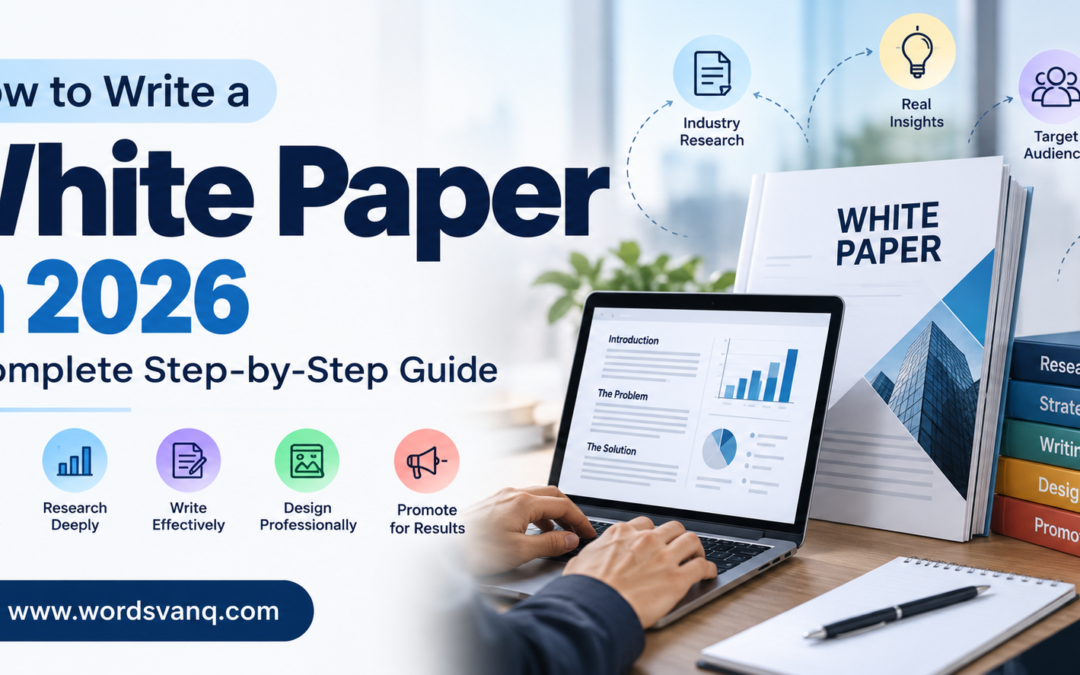
In business-to-business (B2B) marketing, building trust with potential customers takes more than publishing blog posts or promoting your products. Decision-makers want reliable information, evidence-backed recommendations, and a clear understanding of how your business can solve their problems.
This is where a well-written white paper can make a difference.
A white paper allows your business to explore a specific industry challenge, explain its causes, and present a practical solution backed by research. When you develop it around your audience’s needs, it can establish your expertise, support complex buying decisions, and attract potential customers who are actively researching solutions.
However, writing an effective white paper requires more than collecting information and putting it into a PDF. You need a focused topic, credible research, a logical structure, clear explanations, and a distribution strategy that reaches the right audience.
In this guide, you will learn how to write a white paper step by step, from selecting a topic and conducting research to editing, designing, publishing, and promoting the finished document. You will also discover common mistakes to avoid, practical formatting tips, and ways to measure the results of your white paper.
What Is a White Paper?
A white paper is a detailed, research-based document that explains a particular problem, examines possible solutions, and helps readers make informed decisions. Businesses commonly use white papers to explain complex subjects, demonstrate industry knowledge, and support their B2B marketing and sales activities.
White papers are especially useful in industries where customers need substantial information before making a purchase. These include technology, software as a service (SaaS), healthcare, finance, cybersecurity, manufacturing, and professional services.
For example, a cybersecurity company could publish a white paper on how small businesses can reduce the risks of ransomware attacks. Rather than simply promoting its security software, the company would explain common attack methods, examine business risks, compare prevention strategies, and offer recommendations.
A strong white paper typically includes:
- A clear title that communicates the subject or benefit.
- An executive summary outlining the main findings.
- An explanation of the problem and its business impact.
- Research, statistics, expert insights, or case studies.
- A detailed discussion of possible solutions.
- Practical recommendations and a conclusion.
- References for the supporting evidence.
- A relevant call to action (CTA), where appropriate.
Unlike a promotional brochure, a white paper should prioritize useful information and credible analysis over direct selling.
White Paper vs. Ebook vs. Blog Post: What Is the Difference?
White papers, ebooks, and blog posts all support content marketing, but each format serves a different purpose. Understanding these differences helps you choose the right format for your business goals.
| Feature | White Paper | Ebook | Blog Post |
|---|---|---|---|
| Primary purpose | Explain a problem and evaluate solutions. | Educate readers on a broader topic. | Answer a specific question or explore a topic. |
| Research depth | Usually high | Varies by subject | Varies by article |
| Writing style | Analytical, professional, evidence-based | Educational and often conversational | Accessible, informative, engaging |
| Typical format | PDF or detailed web document | Designed PDF or digital publication | Website article |
| Marketing use | Lead generation, thought leadership, sales enablement | Education, awareness, and lead nurturing | Organic traffic, education, engagement |
These are general distinctions rather than strict rules. A white paper does not have to be a PDF, and an ebook can contain substantial research. The right format depends on the complexity of the topic, the audience’s needs, and the outcome you want to achieve.
For example, a blog post might introduce the benefits of cloud cost management, while an ebook explores a broader cost optimization strategy. A white paper could go further by examining the causes of cloud overspending, comparing optimization approaches, and presenting a research-backed framework for reducing waste.
If you want to develop a consistent content strategy around these formats, explore WordsVang’s content solutions for content designed to educate audiences and support business objectives.
Why Should Your Business Create a White Paper ?
White papers require research, writing, editing, and design. Before investing in one, it is important to understand how it can contribute to your wider marketing and sales objectives.
1. Generate Qualified B2B Leads
White papers can attract prospects who are actively researching a problem or evaluating possible solutions. For example, a business looking for ways to improve its cybersecurity may download a detailed guide about managing security risks. If the document addresses a challenge that your company helps solve, that reader could become a relevant sales prospect.
Many businesses offer white papers through landing pages that request basic contact information. This approach is known as gated content. However, a download does not automatically represent a qualified lead. Assess whether the reader matches your target audience and has a genuine need for your solution.
2. Establish Thought Leadership
Publishing a well-researched white paper allows your business to demonstrate expertise in a specific area. Instead of making broad claims about your industry knowledge, you can explain a complex issue, interpret available evidence, and offer recommendations that readers can apply.
Original research, expert interviews, proprietary data, and detailed case studies can make your document more distinctive. The goal is to contribute something useful to the discussion rather than repeat information readers can find elsewhere.
3. Support Complex Sales Decisions
B2B purchases often involve several stakeholders, including business leaders, technical specialists, procurement teams, and finance departments. A detailed white paper can help explain technical considerations, financial implications, operational benefits, and potential risks.
Your sales team can share the document with prospects who need more information before moving to the next stage of the buying process.
4. Strengthen Your Content Marketing Strategy
A white paper can serve as a central resource for multiple marketing activities. You can repurpose its findings into blog posts, LinkedIn updates, email newsletters, short videos, infographics, and sales presentations.
For more ideas, explore our guide to types of content that drive website traffic.
5. Create Opportunities for Backlinks and Industry Exposure
A white paper containing original findings, useful data, or a distinctive framework can become a reference for journalists, bloggers, researchers, and industry professionals. Other websites may link to your research when discussing the same subject. These editorial links can improve discoverability and support SEO, although backlinks are not guaranteed.
What Are the Main Types of White Papers?
1. Problem-Solution White Paper
A problem-solution white paper identifies a specific challenge, explains why it occurs, and presents a structured approach to solving it. This format works well when your audience understands that a problem exists but needs help evaluating available solutions.
Example: How Mid-Sized SaaS Companies Can Reduce Cloud Infrastructure Costs. The document could examine common sources of cloud waste, explain cost monitoring methods, compare optimization strategies, and outline a practical implementation framework.
2. Technical or Product Background
A technical white paper explains how a technology, system, process, or product works. It may cover architecture, implementation requirements, integrations, security considerations, or technical performance. This format is useful for software companies, IT service providers, engineering businesses, and technology vendors.
Example: A Technical Guide to Implementing Zero-Trust Security Across Enterprise Networks. Explain the underlying technology clearly and objectively. If the document discusses your product, distinguish verifiable capabilities from marketing claims.
3. Research-Based or Data-Driven White Paper
A research-based white paper uses surveys, interviews, internal business data, industry benchmarks, or published research to examine a particular issue. Explain where the data came from, when it was collected, how the sample was selected, and what limitations readers should consider.
Example: The State of AI Automation in Mid-Market Businesses: Adoption Trends, Challenges, and Opportunities.
How to Write a White Paper: 9 Essential Steps
Writing a white paper becomes more manageable when you divide the process into clear stages. Follow these nine steps to develop a document that is informative, credible, and aligned with your business objectives.
Step 1: Define Your Target Audience and Objective
Before selecting a title, determine who will read the document and what you want them to learn or do. A white paper written for a chief technology officer will differ from one written for a marketing manager.
• Who is the reader? Identify the job role, industry, level of expertise, and responsibilities of your target audience.
• What problem are they facing? Consider their operational challenges, business risks, and unanswered questions.
• What do they already know? Decide whether you need to explain basic concepts or focus on advanced analysis.
• What should they learn? Define the key insight or practical takeaway.
• What business outcome do you want? Choose a primary goal, such as lead generation, thought leadership, sales enablement, or industry education.
For example, a company offering managed IT services might target operations directors at growing businesses. Its white paper could explain how to assess IT infrastructure risks before expanding into new markets. A clearly defined audience also makes keyword research and content planning easier.
Step 2: Choose a Specific and Relevant Topic
Select a topic that addresses a meaningful problem. Broad topics often make weak white papers because they encourage superficial coverage. A focused subject allows you to explore causes, examine evidence, and offer practical recommendations.
Too broad: The Future of Artificial Intelligence.
More focused: How B2B Marketing Teams Can Use AI Automation Without Compromising Content Quality.
• Review customer questions: Examine sales calls, support queries, feedback forms, and frequently asked questions.
• Analyze industry discussions: Explore industry publications, professional communities, research reports, and competitor resources.
• Conduct keyword research: Identify search terms, related questions, and gaps in existing content. Search Volume should not be your only criterion.
• Connect the topic to your expertise: Choose an area where your business has credible experience, useful data, or a distinctive perspective.
Your final topic should matter to your audience, support your expertise, and be possible to research thoroughly.
Step 3: Conduct Thorough and Credible Research
Research is the foundation of a reliable white paper. Readers expect its arguments and recommendations to rest on credible evidence rather than unsupported claims.
Primary research
Primary research involves collecting information directly. Examples include interviewing subject matter experts, surveying customers or industry professionals, analysing company data, reviewing anonymised customer outcomes, and conducting structured assessments.
How to evaluate your sources
• Who published the information?
• What evidence supports the claim?
• When was the information published or collected?
• Does the research method suit the question?
• Does the finding apply to your target audience?
• Can you locate the original source?
Record the source, publication date, relevant finding, and intended use of each important reference. If you use AI tools to support research, verify information against original sources. AI-generated citations, statistics, and quotations may be inaccurate or fabricated.
Step 4: Create a Detailed White Paper Outline
A structured outline keeps your white paper focused and helps you organise complex information logically. A typical B2B white paper includes:
• Title page: A clear title, company name, publication date, and relevant branding.
• Executive summary: A concise overview of the problem, findings, and recommendations.
• Introduction: Why the topic matters, who it affects, and what the document covers.
• Problem statement: Causes, consequences, and limitations of existing approaches.
• Research and analysis: Data, expert insights, examples, and supporting evidence.
• Proposed solution: Recommendations, implementation considerations, and trade-offs.
• Case studies or practical examples: Demonstrations of how recommendations apply.
• Conclusion: Main findings and recommended next steps.
• References and appendices: Sources and supporting information.
Example outline: For a white paper titled “How B2B Companies Can Improve Lead Quality Through Marketing Automation,” sections could cover why lead quality matters, common targeting gaps, relevant evidence, a lead-scoring framework, implementation considerations, and recommended next steps.
Step 5: Write the First Draft
With your research and outline ready, begin writing. Focus first on explaining your argument clearly; refine the language and presentation during editing.
• Lead with the problem. Explain why the subject matters before introducing recommendations.
• Use simple language. Define technical terms and acronyms and provide examples for difficult concepts.
• Support claims with evidence. Place citations close to the statements they support.
• Build a logical argument. Make each section contribute to the central question.
• Stay objective. Explain evidence, acknowledge limitations, and distinguish findings from opinions.
• Include practical examples. Use scenarios, implementation steps, and substantiated case studies.
• Control promotional language. Present analysis first and introduce your solution where it naturally fits.
Use short paragraphs, descriptive headings, numbered steps, and bullet points where they improve comprehension. Vary sentence structure while keeping the language direct.
Step 6: Edit, Fact-Check, and Refine the Content
The first draft is rarely ready for publication. Review it in several passes:
- Structural editing: Check the order of sections and whether the document fulfills its purpose.
- Content editing: Remove repetition, unsupported conclusions, and irrelevant information.
- Line editing: Improve sentence clarity, word choice, transitions, and paragraph flow.
- Proofreading: Correct spelling, punctuation, grammar, and formatting inconsistencies.
- Fact-checking: Verify names, dates, statistics, quotations, technical details, and references.
Ask a subject matter expert to review technical or industry-specific claims. For regulated topics such as healthcare, finance, or cybersecurity, arrange any additional specialist or compliance review required before publication.
Step 7: Design and Format the White Paper
Effective design helps readers navigate the document and understand complicated information. Combine readable typography, consistent branding, clear section hierarchy, and useful visual elements.
• Consistent visual identity: Apply brand colours, fonts, logos, and layout conventions consistently.
• Clear heading hierarchy: Make section headings and body text visually distinct.
• Readable typography: Ensure the document works on desktop and mobile screens.
• White space: Break up long sections with lists, tables, and callout boxes.
• Useful data visuals: Use charts and diagrams to explain important relationships.
• Descriptive captions: Explain visuals and cite sources where necessary.
• Navigation: Add page numbers and a table of contents for longer documents.
• Accessibility: Use sufficient colour contrast, readable text, and meaningful link labels.
Before publishing, inspect the final PDF on different screen sizes. Check that links work, charts remain legible, The text does not overflow, and page layouts display correctly.
Step 8: Optimise the White Paper for SEO and Lead Generation
A well-written white paper needs a distribution path. Start with a dedicated landing page that explains what the document covers and who should read it.
Create a useful landing page.
• A descriptive headline that communicates the white paper’s value.
• A short summary of the problem it addresses.
• Three to five specific takeaways.
• Information about the intended audience.
• A clear download button or call to action.
• A simple lead capture form, if appropriate.
If the white paper is gated, ask only for information you genuinely need. A long form may discourage downloads, so balance lead qualification with a straightforward user experience.
Optimise the landing page for search
Use your target keyword naturally in the page title, main heading, introduction, and relevant subheadings. Write a unique meta description and use a clear URL. Add descriptive links to related resources on your website. Ensure the landing page provides useful information rather than relying entirely on a download form.
For additional guidance, consult Google’s SEO Starter Guide.
Decide whether to gate the white paper
| Approach | Best suited for | Main consideration |
|---|---|---|
| Gated | Lead generation and prospect qualification | Forms can reduce the number of readers who access the content |
| Ungated | Reach, accessibility, and organic discovery | You may collect fewer direct leads from downloads |
| Hybrid | Balancing discovery with lead generation | Distinguish free content from optional conversion opportunities |
There is no universal answer. If organic search visibility is a priority, consider publishing a substantial HTML summary or article that covers the topic in its own right, with the full white paper available as an additional resource.
Step 9: Publish, Promote, and Measure Results
Publishing your white paper is the beginning of its distribution process, not the end. Develop a promotion plan that reaches your target audience through relevant channels.
• Email marketing: Announce the white paper to subscribers likely to find the subject useful.
• LinkedIn marketing: Share key findings, short insights, charts, and expert commentary.
• Blog content: Publish related articles and link naturally to the main resource.
• Sales enablement: Give your sales team a summary and guidance on when to share the document.
• Industry outreach: Contact relevant publications and experts when the research offers a useful contribution.
• Content repurposing: Turn the white paper into social posts, email updates, presentations, infographics, or short videos.
Measure performance against your original goal
| Objective | Useful metrics |
|---|---|
| Lead generation | Form submissions, qualified leads, conversion rate |
| Audience reach | Landing page visits, referral traffic, document views |
| Sales support | Sales team usage, prospect engagement, assisted conversions |
| Content visibility | Organic clicks, relevant backlinks, referral visits |
| Lead nurturing | Email engagement, repeat visits, progression to conversion |
Review results after publication and use the findings to improve future content. For example, many downloads but few qualified leads may indicate that the topic attracts the wrong audience or that the landing page sets unclear expectations
What Is the Ideal Length of a White Paper?
There is no fixed word count for a white paper. The appropriate length depends on the complexity of the subject, the amount of evidence required, and the needs of your audience. As a practical starting point, many marketing white papers contain approximately 2,500 to 5,000 words. More technical or research-intensive documents may require additional space, while focused guides can be shorter.
| White paper type | Suggested length | Best suited for |
|---|---|---|
| Focused problem-solution guide | 1,500–2,500 words | A specific challenge and practical recommendations |
| Standard B2B white paper | 2,500–5,000 words | Detailed analysis supported by research |
| Technical or research-intensive report | 5,000+ words | Complex subjects, original research, detailed evidence |
These ranges are planning estimates, not industry-wide requirements. A shorter white paper can be more effective than a longer one if it explains the issue thoroughly and answers the reader’s questions. Page count also depends on typography, charts, tables, and layout.
Common White Paper Writing Mistakes to Avoid
1. Making the Content Too Promotional
A white paper should educate readers and help them evaluate a problem or solution. If every section promotes your product, the document may feel like a sales brochure. Present the problem, supporting evidence, and possible solutions before discussing your offering.
2. Choosing a Topic That Is Too Broad
A broad topic makes it difficult to explore any one issue in sufficient depth. Narrow the subject by audience, problem, industry, or business outcome. Define the central question before writing the outline.
3. Using Statistics Without Verifying Them
Unsupported or outdated statistics can undermine credibility. Verify important claims against original sources, record publication dates, and explain the context behind the numbers. Never invent research findings or present estimates as established facts.
4. Overloading the Reader With Jargon
Technical language can be necessary, but unexplained acronyms and complicated sentences make content difficult to follow. Define specialist terms, use straightforward explanations, and include examples when a concept is difficult to understand.
5. Ignoring the Document’s Design
Dense paragraphs, inconsistent headings, and unreadable charts can make valuable research difficult to use. Plan the visual structure alongside the content and use a consistent heading hierarchy, white space, readable fonts, and useful visuals.
6. Publishing Without a Promotion Strategy
A white paper will not automatically attract readers simply because it is available on your website. Prepare a distribution plan and identify email, social media, search, industry outreach, and sales channels.
7. Failing to Define Success
A document may attract many downloads but generate few relevant leads. Define the primary objective before writing and select suitable performance metrics. Evaluate the quality of results, not just volume.
White Paper Writing Checklist
Use this checklist before publishing your white paper.
• Defined the target audience and business objective.
• Selected a specific topic that addresses a relevant problem.
• Conducted research using credible and verifiable sources.
• Created a logical outline with clear section headings.
• Written the executive summary, main content, and conclusion.
• Checked facts, statistics, quotations, and references.
• Edited the document for clarity, consistency, and readability.
• Reviewed technical claims with a subject matter expert where necessary.
• Applied consistent branding and professional formatting.
• Tested PDF links, page layouts, and accessibility.
• Prepared an SEO-friendly landing page and relevant calls to action.
• Planned distribution and defined performance metrics.
White Paper Writing Services in India: How to Choose the Right Partner
Developing a professional white paper requires more than good writing. Businesses need accurate research, subject expertise, a logical content structure, and a clear understanding of their target audience. When internal teams lack the time or specialist knowledge to manage the entire process, working with a professional writing partner can help.
If you are comparing white paper writing services in India, look for a provider that understands your industry, can work with subject matter experts, and knows how to turn complex business or technical information into clear, credible, and useful content.
The right white paper writing company in India should understand your industry, follow a structured research process, and align the document with your marketing objectives. Whether you need a technical report, a B2B thought leadership paper, or a research-backed business document, the quality of the process matters as much as the final word count.
What Do Professional White Paper Writing Services Include?
White paper writing services can cover several stages of content development, depending on the project’s requirements
.
• Topic research and planning: Identifying the right subject, target audience, research questions, and central argument.
• Research and source verification: Reviewing industry reports, credible publications, technical documentation, and other relevant evidence.
• White paper writing: Developing a structured document with an introduction, problem analysis, supporting evidence, recommendations, and conclusion.
• Technical and industry-specific writing: Explaining complex information in a way that suits the intended audience.
• Editing and proofreading: Improving clarity, consistency, grammar, readability, and logical flow.
• White paper design and formatting: Preparing the content for publication as a designed PDF or digital document, which is included in the scope.
• Supporting marketing content: Developing landing page copy, related blog posts, email announcements, and promotional material.
Before hiring a provider, confirm which deliverables are included in the quote. Some providers focus on writing and editing, while others may offer research, design, and distribution support as separate services.
How to Choose a White Paper Writing Company in India
1. Research quality
Ask how the writer verifies statistics, evaluates sources, and handles references. Research-backed white papers should distinguish evidence from opinion and make important claims verifiable.
2. Industry expertise
A white paper about cybersecurity, healthcare, financial technology, or manufacturing may require specialist knowledge. Choose a writer who can work with your subject matter experts and understand the terminology relevant to your industry.
3. Writing samples
Review samples to assess how well the provider explains complex subjects, structures arguments, and maintains a professional tone. Check whether the writing offers meaningful insights rather than simply summarizing information available elsewhere.
4. Editing and quality assurance
Confirm whether the service includes structural editing, proofreading, source verification, and subject matter expert review where required. Establish who will review technical claims and approve the final document.
5. Clearly defined project scope
Discuss the expected length, research depth, interview requirements, design responsibilities, delivery schedule, and revision process before work begins.
6. Understanding of B2B marketing
A good B2B white paper should address a genuine audience problem and support a defined business objective. The writer should understand whether the document needs to educate potential customers, demonstrate expertise, support sales conversations, or generate leads.
What Types of White Paper Solutions Can Businesses Use?
White paper solutions should reflect the complexity of the subject and the outcome your business wants to achieve.
• B2B white paper writing: In-depth documents that help decision-makers understand industry challenges, compare approaches, and evaluate potential solutions.
• Technical white paper writing: Content that explains technologies, processes, system architecture, implementation requirements, and other specialist subjects.
• Corporate white paper development: Research-backed documents that communicate business insights, industry perspectives, strategic recommendations, or organizational expertise.
• Research-based white paper content: Evidence-led content built from verified industry data, expert interviews, surveys, and published research.
• White paper content development for lead generation: A document and supporting landing page structured around a relevant audience problem and a suitable call to action.
These services can support different industries and business objectives. The scope should be defined according to the document’s purpose rather than using the same template for every project.
How Much Do White Paper Writing Services Cost in India?
The cost of professional white paper writing services in India depends on the amount of research, technical complexity, document length, and level of editorial support required. A short white paper based on an existing brief may require considerably less work than a research-intensive report involving expert interviews, original data analysis, technical review, and custom design.
When requesting a quotation, provide the following details:
• Your industry and target audience.
• The topic and intended business outcome.
• The expected word count or document length.
• Available research, internal data, and reference materials.
• Whether expert interviews or original research are required.
• Whether editing, graphic design, and landing page content are needed.
• Your preferred delivery date.
Ask providers to clarify the deliverables, revision limits, and any additional costs. Comparing quotations against the same project brief will help you evaluate value more accurately than comparing prices alone.
Why Consider WordsVang for Your Content Requirements?
WordsVang is a content writing company in India that develops content for businesses across multiple industries. Our approach focuses on audience needs, clear communication, and content that supports wider marketing objectives.
For businesses planning a white paper, related content may include research-based articles, technical documentation, case studies, and supporting SEO content. These assets can work together to explain complex subjects, demonstrate expertise, and help potential customers evaluate a business’s capabilities.
Explore WordsVang’s content writing solutions to learn more about the company’s content services. You can also explore our education content services for an example of industry-specific content development.
If you are evaluating white paper writing services in India, prepare a brief outlining your topic, audience, research requirements, and intended outcome before discussing the project with a provider. Contact WordsVanq to discuss your content requirements and determine the right approach for your business.
How WordsVanq Can Help With White Paper Writing
Creating a useful white paper requires a combination of research, structured writing, industry understanding, and careful editing. Each element contributes to the final document’s credibility and usefulness.
At WordsVanq, we help businesses develop content that explains complex subjects clearly and supports their marketing objectives. Whether you need research-backed B2B content, technical explanations, or supporting
SEO articles, the focus remains on delivering useful information for the intended audience.
Explore WordsVanq’s content solutions to learn more about our approach to business content.
If you are planning a white paper, start by defining the audience, topic, and intended outcome. A clear brief provides a stronger starting point for the research and writing process.
Conclusion
Learning how to write a white paper involves more than producing a long document. You need to understand your audience, choose a relevant problem, research the subject carefully, organise your findings, and present your recommendations in a clear and credible way.
Start by defining your objective and selecting a focused topic. Use reliable sources to support your arguments, structure the document around the reader’s questions, and edit the draft thoroughly before moving to design and publication.
Once your white paper is ready, build a distribution plan that includes relevant landing pages, email marketing, social media, related blog content, and sales enablement. Track performance against your original objectives and use the results to improve future content.
Most importantly, prioritise value over length. A well-researched, clearly written white paper that answers a genuine business question can do more for your brand than a lengthy document filled with generic information.
Need help developing research-backed content for your business? Visit WordsVanq to explore content solutions for your next project.
Frequently Asked Questions About White Paper Writing
1. How do you write a white paper step by step?
Start by defining your target audience and objective. Choose a focused topic, conduct credible research, and create a detailed outline. Write the first draft, edit and fact-check it, design the document, and prepare a distribution strategy. Finally, measure its performance against your business goals.
2. How long should a white paper be?
A typical B2B white paper may contain approximately 2,500 to 5,000 words, although shorter and longer documents can work well. The ideal length depends on the topic’s complexity, the depth of research, and the information your audience needs.
3. What is the standard format of a white paper?
A common white paper format includes a title page, executive summary, introduction, problem statement, research and analysis, proposed solution, supporting examples, conclusion, and references. Adjust this structure to suit your subject and intended audience.
4. What is the difference between a white paper and a research paper?
A white paper generally addresses a practical problem and helps readers understand a solution or make a business decision. A research paper typically investigates a research question and contributes to an academic or scholarly discussion. Their methods and formats can overlap, particularly in technical fields.
5. Can a white paper help with B2B lead generation?
Yes. Businesses can offer white papers through landing pages that collect contact information from interested readers. The document can attract prospects who are researching a relevant problem. Lead quality depends on the topic, audience targeting, form design, and follow-up process.
6. Should a white paper be gated or ungated?
Choose a gated white paper when collecting prospect information is a primary objective. An ungated document is useful when accessibility, reach, and direct sharing matter more. A hybrid approach can combine a useful, publicly accessible web article with an optional downloadable report.
7. How much research does a white paper require?
The research requirement depends on the topic and the claims you want to make. A focused guide may rely on credible published sources and expert interviews, while a data-driven report may require surveys, original analysis, or extensive technical research. Every factual claim should have appropriate support.
8. Can AI help write a white paper?
AI tools can assist with brainstorming, outlining, summarizing source material, and editing for readability. However, writers must verify facts and references, assess the quality of the research, and apply subject expertise. AI-generated content should not replace original analysis, expert review, or responsible fact-checking.
9. How long does it take to write a white paper?
A straightforward white paper may take a few weeks, while a complex technical or research-intensive project may take longer. The timeline depends on research requirements, expert availability, approval cycles, editing, and design. Agree on the scope and review schedule before starting the project.
10. Can a content writing agency create a white paper for my business?
Yes. A suitable content writing agency can help with topic development, research, interviews, outlining, drafting, editing, and related marketing content. Before hiring an agency, confirm its experience with your subject, its research process, and the deliverables included in the project.
11. What should I look for in white paper writing services in India?
Look for a provider with relevant industry experience, strong research capabilities, clear writing, source verification, and a defined editing process. Confirm the scope, delivery schedule, revision policy, and whether design and supporting marketing content are included.
12. How do I choose the right white paper writing company in India?
Review writing samples, research methods, subject expertise, and quality assurance procedures. Choose a provider that understands your audience and can align the document with your business objectives.
13. What are white paper solutions?
White paper solutions include the research, writing, editing, formatting, and related content development needed to create a professional white paper. The exact deliverables depend on the topic and whether the document supports technical education, thought leadership, or lead generation.
14. Do white paper writing agencies provide technical content?
Some agencies offer technical white paper writing for subjects such as software, cybersecurity, engineering, and IT infrastructure. Confirm that the provider can work with subject matter experts and verify technical claims before publication.
15. What is included in white paper development services?
Depending on the provider, white paper development services may include topic planning, research, outlining, writing, editing, fact-checking, design, and supporting promotional content. Confirm the exact deliverables before commissioning the project.