
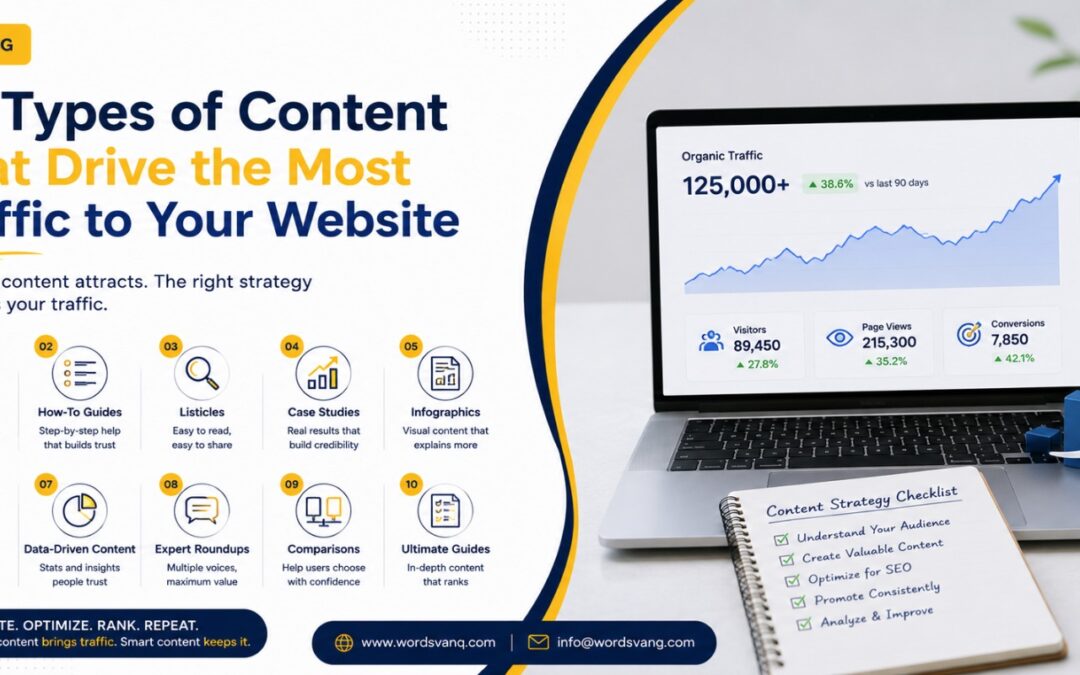
| # | Content Type | Best For | Traffic Potential |
| 1 | Long-Form Blog Posts | SEO + Authority | Very High |
| 2 | How-To Guides | Search Intent + AI Citation | Very High |
| 3 | Listicles | Shareability + Clicks | High |
| 4 | Case Studies | B2B Trust + Conversions | High |
| 5 | Pillar Pages | Topical Authority | Very High |
| 6 | FAQ Pages | Featured Snippets + AI | High |
| 7 | Comparison Content | Buying-Intent Traffic | Very High |
| 8 | Original Research | Backlinks + Citations | Very High |
| 9 | Localised Content | Local SEO Traffic | High |
| 10 | Evergreen Content | Long-Term Compounding Traffic | Very High |
KEY TAKEAWAYS
- Long-form blog posts and pillar pages are the two highest-traffic content types for SEO in 2026.
- How-to guides and FAQ pages are especially powerful for AI search citations and featured snippets.
- Comparison content and original research earn the most backlinks amplifying traffic over time.
- Localized content targeting specific Indian cities and regions is the fastest way to win local search traffic.
- Evergreen content compounds over time – a well-written piece from two years ago can still drive traffic today.
- A mix of all 10 content types gives your website the best coverage across different search intents and audience stages.
Most businesses create content. But very few businesses create the right content. There is a significant difference between publishing something and publishing something that actually brings people to your website.
The truth is, not all content types are equal when it comes to driving traffic. According to HubSpot’s 2026 State of Marketing Report, companies that publish strategic, targeted content see 3.5 times more traffic than those that publish without a defined content strategy. The format, structure, and intent behind your content have as much impact on your traffic as the quality of your writing itself.
In this guide, we will walk you through the 10 types of content that consistently deliver the most website traffic, with specific guidance on how Indian businesses can use each one effectively. Whether you are working with a professional content writing agency or building your content in-house, this list gives you a clear blueprint for what to prioritize.
Before We Begin: What Makes Content Drive Traffic?
Traffic does not come from content that merely exists. It comes from content that does one or more of the following things extremely well:
- Matches search intent – It gives people exactly what they were looking for when they typed their query.
- Earns backlinks – Other websites link to it because it is genuinely useful or contains information they want to reference.
- Gets shared – People share it on social media, in WhatsApp groups, on LinkedIn, or via email.
- Gets cited by AI—ChatGPT, Perplexity, or Google AI Overviews references it when answering related questions.
- Ranks for multiple keywords – A single well-written piece can rank for dozens of related search queries simultaneously.
Keep these five traffic drivers in mind as you read through the 10 content types below. The best content types are those that tick multiple boxes at once.
01 Long-Form Blog Posts (1,500 to 3,000+ Words)
Best for: SEO rankings, topical authority, AI citations, backlinks
Long-form blog posts remain the single most powerful content type for driving organic search traffic in 2026. Not because length alone matters, but because well-researched, comprehensive blog posts consistently outperform short posts across every key SEO metric.
Backlinko’s analysis of over 11 million Google search results found that the average first-page result contains 1,447 words. But content between 1,500 and 3,000 words earns more backlinks, ranks for more long-tail keyword variations, and generates more social shares than shorter alternatives.
For Indian businesses, long-form blogs are especially effective because most competitors are still publishing short, thin content. A 2,500-word blog post that genuinely covers a topic from every angle immediately stands out in a market where 600-word articles are still the norm.
What Makes a Long-Form Blog Post Drive Traffic
- Covers a topic comprehensively enough to rank for dozens of related keyword variations, not just one.
- Structured with clear H2 and H3 headings that match the sub-questions your audience is asking.
- Includes original insights, data, examples, or perspectives that cannot be found in competitor articles.
- Updated regularly—search engines reward content that stays current and accurate.
Ideal publishing frequency: 2 to 4 long-form blog posts per month. Consistency matters as much as quality. Google rewards websites that publish regularly.
02 How-To Guides and Step-by-Step Tutorials
Best for: High-intent search traffic, featured snippets, AI citations, social sharing
How-to content is one of the most searched content formats on the internet. People constantly want to know how to do something—how to start a business, how to file GST returns, how to improve their website’s Google ranking, or how to write a product description. Every ‘how to’ question is a traffic opportunity.
How-to guides are also one of the content formats most likely to be cited by AI search platforms. Perplexity and Google AI Overviews specifically favor step-by-step, structured content that gives users a clear, actionable answer. HowTo schema markup further boosts the chances of Google displaying your steps directly in search results.
How to Write a How-To Guide That Drives Traffic
- Use a numbered step format—numbered steps are easy to scan, easy to follow, and highly extractable by AI systems.
- Answer the question in the first paragraph—give a brief overview of the process before going into detail.
- Include the outcome in the title—’How to Rank on Google in 6 Months’ is more compelling than ‘SEO Tips for Beginners.’
- Add HowTo schema markup—this tells Google your content is a step-by-step guide and makes it eligible for rich results.
- Include screenshots or diagrams where relevant—visual aids increase dwell time and reduce bounce rate.
How-to guides on evergreen topics, topics that remain relevant year after year, are especially valuable. A ‘How to Set Up Google My Business’ guide can drive traffic for years with just periodic updates.
03 Listicles (List-Based Articles)
Best for: High click-through rates, shareability, quick wins for new websites
Listicles – articles structured as numbered or bulleted lists – are not just a lazy content format. Done well, they are one of the most clicked and shared content types on the internet. The reason is psychological: lists are easy to scan, easy to consume on mobile, and give readers a clear expectation of what they will get from the article.
Titles with numbers consistently outperform generic titles in click-through rate studies. ’10 Ways to Improve Your Website Traffic’ gets clicked more than ‘How to Improve Your Website Traffic’ – even when the content is identical.
Listicle Best Practices for Maximum Traffic
- Use odd numbers in titles—research shows odd-numbered lists (7, 9, and 11) get higher click-through rates than even numbers.
- Make each item genuinely useful – a listicle with 10 weak points is worse than one with 5 strong ones. Quality over quantity.
- Add depth to each point – avoid one-line bullet points. Each item should have at least 2 to 3 sentences of explanation.
- Include an item list schema – this helps Google display your list items directly in search results as a rich result.
- Update listicles regularly – ’10 Best SEO Tools in 2026′ should be updated annually to maintain relevance and rankings.
Avoid thin listicles that simply list items without context. Google’s May 2026 Core Update specifically targeted listicle content with no depth. Every item needs genuine value and explanation.
04 Case Studies
Best for: B2B trust, conversion, backlinks from industry publications, sales support
Case studies are one of the most underused content types by Indian businesses, and one of the most effective for driving high-quality, high-intent traffic. A well-written case study does something no other content type can do as effectively: it proves your claims with real evidence.
For B2B businesses in particular, case studies are often the content type that closes deals. A potential client who reads how you helped a similar business achieve a specific result is far more likely to contact you than one who only reads about your services in general terms.
What a High-Traffic Case Study Looks Like
- Clear problem-solution-result structure—What was the client’s challenge? What did you do? What measurable result did they achieve?
- Specific, quantified outcomes —’Traffic increased by 210% in 4 months’ is infinitely more convincing than ‘We improved their traffic significantly.’
- Industry and location specificity—A case study about a healthcare clinic in Delhi is more persuasive to another Delhi healthcare business than a generic success story.
- Client quotes where possible—Direct quotes from real clients add credibility and make the case study feel authentic.
- The SEO-optimized title—’How We Helped a Pune E-commerce Brand Double Organic Traffic in 6 Months’—is both compelling and searchable.
Case studies also earn natural backlinks from industry blogs and publications that want to reference real results. A strong case study with verifiable data is link-bait in the best sense of the word.
05 Pillar Pages and Topic Clusters
Best for: Topical authority, ranking for broad competitive keywords, long-term SEO dominance
A pillar page is a comprehensive, long-form piece of content that covers a broad topic in depth, typically 3,000–5,000 words, and links out to a cluster of related, more specific blog posts and articles. Together, the pillar page and its cluster create what Google recognizes as topical authority.
Topical authority is now one of the most important ranking factors in Google’s algorithm. Semrush’s 2026 ranking factors study found that websites with dense internal linking networks covering a topic comprehensively consistently outrank websites with isolated pages, even when the isolated pages have more backlinks.
For a content writing agency like WordsVanq, a pillar page on ‘Content Writing Services’ would link to cluster articles on blog writing, website copy, SEO content, social media content, and city-specific service pages. Each piece strengthens the others, and the whole cluster performs better than any individual page would alone.
How to Build a Pillar Page That Dominates Traffic
- Choose a broad, high-volume topic—the pillar page targets a broad keyword while cluster pages target more specific, long-tail variations.
- Cover the topic comprehensively—address every major sub-topic with enough depth to satisfy a curious reader.
- Link to every cluster page from the pillar—and ensure that every cluster page links back to the pillar. This creates a dense internal linking network.
- Keep the pillar page updated—as you add new cluster content, update the pillar to include links and brief mentions of the new pages.
- Use a clear, logical heading structure—pillar pages work best with a table of contents at the top, allowing users to jump to the section they need.
06 FAQ Pages and FAQ Sections
Best for: Featured snippets, Google AI Overviews, voice search, low-competition traffic
FAQ content is one of the most reliable traffic-generating formats available, and it is also one of the most neglected by Indian businesses. Every FAQ answer is a potential featured snippet, an AI overview citation, and a voice search result. Each question is a long-tail keyword opportunity in its own right.
FAQ pages work especially well for businesses in complex or technical industries, healthcare, legal, finance, and real estate, where customers have many questions before making a decision. A comprehensive FAQ page on ‘How Does GST Work for E-commerce Businesses’ can rank for dozens of related queries simultaneously.
How to Build FAQ Content That Drives Traffic
- Research actual questions—use Google’s People Also Ask box, AnswerThePublic, or keyword tools to find the exact questions your audience types. Do not guess.
- Answer each question directly in the first sentence. – Google extracts the first clear answer for featured snippets. Do not bury the answer in context.
- Implement FAQPage schema markup—this is the most direct way to earn rich results and AI overview citations for your FAQ content.
- Group FAQs by topic—organize questions into logical categories with clear H2 headings. This makes the page easier to navigate and easier for AI systems to process.
- Keep answers concise but complete—50 to 150 words per answer is ideal. Long enough to be genuinely helpful; short enough to be extractable.
Add FAQ sections to existing service and blog pages, not just standalone FAQ pages. A blog post about ‘Content Writing Services in Mumbai’ with a 5-question FAQ section at the bottom significantly increases that page’s chances of earning featured snippets.
07 Comparison and Versus Content
Best for: Bottom-of-funnel buying intent traffic, high conversion rate, competitive keywords
Comparison content, ‘X vs Y,’ ‘Best X for Y,’ and ‘X alternatives’ target people who are actively in the decision-making phase of the buying journey. These are some of the highest-converting visitors your website can attract, because they are already researching and comparing options before making a purchase or choosing a service provider.
For Indian businesses, comparison content is a particularly powerful way to intercept potential customers who are evaluating your competitors. A well-written ‘WordsVanq vs. Freelance Content Writer: Which Is Right for Your Business?’ page can capture searchers who are actively considering both options and guide them toward your service.
Types of Comparison Content That Drive Traffic
- Direct competitor comparisons—’Agency X vs. Agency Y’: high commercial intent, often low competition because few businesses publish these.
- Category comparisons—’Content Writing Agency vs. Freelancer vs. In-House Writer’: targets broader decision-making queries.
- Tool and product comparisons—’Best SEO Tools for Indian Businesses in 2026′: high search volume and strong shareability.
- Approach comparisons—’AI Content vs. Human Content Writing: Which Performs Better?’: thought leadership that also drives traffic.
- Price and value comparisons—’How Much Does Content Writing Cost in India? A Complete Price Guide’: targets budget-research queries.
Be fair and accurate in comparison content. Misleading comparisons erode trust and can backfire. Present genuine strengths and weaknesses, readers trust balanced analysis more than one-sided promotion.
08 Original Research and Data Reports
Best for: Backlinks, press coverage, AI citations, brand authority, social sharing
Original research is the single content type most likely to earn high-quality backlinks, and backlinks remain one of the strongest ranking factors in Google’s algorithm. When you publish data that does not exist anywhere else, other websites have no choice but to link to you if they want to cite it.
According to Ahrefs’ link-building study, original research and data-driven content earn, on average, 5 times more backlinks than standard blog posts. For Indian businesses, original research on India-specific topics is especially powerful because there is a significant shortage of reliable, India-specific data online, and foreign publications will link to credible Indian sources.
Original Research Ideas for Indian Businesses
- Industry surveys—survey your customers, prospects, or industry peers and publish the aggregated results.
- Annual benchmark reports track a specific metric over time and publish yearly data. These become authoritative reference points.
- Regional market analysis—data about a specific Indian city or state market is rare and highly linkable.
- Original case studies with data—even a single detailed case study with real numbers qualifies as original research.
- Trend analysis from your own data—if your business has access to interesting data from your customers or operations, anonymized and aggregated insights make compelling content.
You do not need a large research budget to publish original data. A simple survey of 50 to 100 customers, analyzed and presented clearly, can generate significant backlinks and press coverage if the insights are genuinely interesting.
09 Localised and City-Specific Content
Best for: Local SEO traffic, Google Maps rankings, hyper-relevant leads, low competition
For Indian businesses that serve customers in specific cities or regions, localized content is one of the fastest and most reliable ways to drive targeted organic traffic. City-specific service pages, neighborhood guides, local market analysis, and location-targeted blog posts all compete in a far less crowded search landscape than generic national content.
The data is compelling. Google reports that near me searches have grown by over 500% in the last five years in India. Searches that include specific city names are growing even faster. And because most national businesses do not bother to create genuinely local content, they just insert a city name into a template, so there is significant opportunity for businesses that create authentic, locally relevant content.
How to Build Localised Content That Drives Traffic
- Create city-specific service pages – not templates with the city name swapped, but pages that genuinely address the local market, local references, and local needs.
- Write neighborhood-level content—’Best IT Companies in Cyber City, Gurgaon’ targets a far more specific audience than ‘Best IT Companies in India.’
- Publish local market analysis – ‘The State of Real Estate in Kanpur: 2026 Market Report’ is highly shareable and linkable in that local community.
- Cover local events and news – publishing timely content about local business developments builds local relevance signals that Google values.
- Optimize for local keywords explicitly—include the city name in your H1, first paragraph, meta title, and URL naturally.
10 Evergreen Content
Best for: Compounding long-term traffic, ROI over time, consistent lead generation
Evergreen content is content that remains relevant and continues to drive traffic long after it is published—because the topic does not become outdated. A blog post about ‘What Is SEO and How Does It Work’ written in 2023 can still rank and drive traffic in 2026 with minimal updates. A blog post about ‘Top SEO News This Week’ written in 2023 is completely worthless today.
Evergreen content is the foundation of a compounding content strategy. Each piece you publish adds to a library of assets that collectively drive traffic 24 hours a day, 7 days a week, without ongoing ad spend. The more evergreen content you have, the more organic traffic you generate, and the returns compound over time as each piece builds domain authority that helps all other pages rank better.
Examples of Evergreen Content for Indian Businesses
- What Is Content Marketing and Why Does Your Business Need It?
- How to Improve Your Website’s Google Ranking – A Beginner’s Guide
- The Complete Guide to GST for Small Businesses in India
- What Is E-E-A-T and How Does It Affect Your Google Rankings?
- How to Write a Business Proposal That Wins Clients
- The Difference Between SEO and SEM, Explained Simply
How to Keep Evergreen Content Fresh
- Review and update annually—check statistics, update examples, and add new sections as the topic evolves.
- Add the current year to the title where relevant—a ‘Complete Guide to Content Marketing in India (Updated 2026)’ signals to both readers and Google that the content is current.
- Expand with new subtopics—as related questions emerge over time, add new sections to existing evergreen pieces rather than publishing separate articles.
- Refresh internal links—as you publish new related content, update older evergreen pieces to link to the newer articles.
Evergreen content combined with regular updates is the most cost-effective long-term SEO strategy available. One well-maintained evergreen article can drive consistent traffic for 5 or more years.
Choosing the Right Content Type for Your Goals
Not every content type is right for every situation. Here is a quick guide to matching content types with your specific business goals.
| Your Goal | Best Content Types to Use |
| Rank for competitive keywords | Pillar pages, long-form blog posts, original research |
| Drive local traffic in Indian cities | Localized content, city-specific service pages, local case studies |
| Get cited by ChatGPT and Perplexity | How-to guides, FAQ pages, original research, structured listicles |
| Build B2B trust and close sales | Case studies, comparison content, whitepapers, original research |
| Drive quick wins for a new website | Listicles, FAQ pages, long-tail how-to guides |
| Generate leads consistently | Evergreen content, pillar pages, comparison content |
| Earn backlinks and press coverage | Original research, case studies, comparison content |
| Rank in featured snippets | FAQ pages, how-to guides, definition content with clear headings |
| Build long-term domain authority | Consistent mix of all 10 content types with regular updates |
How Often Should You Publish Each Content Type?
A common question we hear from Indian businesses is not just what to publish, but how often. Here is a practical publishing framework based on what drives the best results:
| Content Type | Recommended Frequency | Notes |
| Long-Form Blog Posts | 2 to 4 per month | Core of your content strategy. Consistency matters most. |
| How-To Guides | 1 to 2 per month | Target your most-searched ‘how to’ questions first. |
| Listicles | 1 to 2 per month M | Mix with deeper content types for balance. |
| Case Studies | 1 per month or quarter | Quality over frequency. One strong case study beats three weak ones. |
| Pillar Pages | 1 per major topic | Build once, update regularly. Not a recurring format. |
| FAQ Pages | As needed per service | Create one per core service or topic cluster. |
| Comparison Content | 1 to 2 per quarter | Focus on your most competitive decision-stage keywords. |
| Original Research | 1 to 2 per year | Resource-intensive but high-return. Plan well ahead. |
| Localised Content | 1 per city per quarter | Build a library of city pages over time. |
| Evergreen Content | Ongoing | Every piece you publish should aim to be evergreen where possible. |
How WordsVanq Helps You Create All 10 Content Types
At WordsVanq, we offer content writing services across all 10 of the content types covered in this guide. Whether you need a single blog post or a complete content strategy with pillar pages, localized content, and original research, our team of human writers, SEO specialists, and content strategists has you covered.
| Content Type | How WordsVanq Delivers It |
| Long-Form Blog Posts | Keyword-researched, structured, SEO-optimized blogs of 1,500 to 3,000+ words. Every post is ready to publish. |
| How-To Guides | Step-by-step guides with HowTo schema recommendations, clear headings, and AI-citation-ready structure. |
| Listicles | Well-researched, depth-filled listicles with item list schema and SEO-optimized titles. |
| Case Studies | Data-driven case studies with client outcome data, direct quotes, and persuasive narrative structure. |
| Pillar Pages | Comprehensive 3,000 to 5,000-word pillar pages with full content cluster planning and internal link mapping. |
| FAQ Pages | Research-based FAQ content with FAQPage schema recommendations and featured snippet optimization. |
| Comparison Content | Balanced, credible comparison pages targeting bottom-of-funnel buying keywords. |
| Original Research | Survey design, data analysis support, and compelling research report writing. |
| Localised Content | Genuine, locally knowledgeable content for cities across Delhi, Mumbai, Bangalore, Kanpur, Pune, and beyond. |
| Evergreen Content | Timeless, strategically structured content built to rank and compound traffic over years. |
Conclusion
Traffic does not come from publishing content randomly. It comes from publishing the right content types at the right frequency, targeting the right audience, with the right structure. The 10 content types in this guide are not a complete list of everything you can publish, but they are the formats that consistently deliver the most traffic across the widest range of business types and industries.
Start with the content types that match your most urgent goals. If you need local traffic, begin with localized content and FAQ pages. If you want long-term SEO authority, prioritize long-form blogs and pillar pages. If you want backlinks and press coverage, invest in original research. The key is to start and to be consistent.
If your business needs help creating any of these content types, from individual blog posts to a full 12-month content strategy, WordsVanq is ready to help. We write content that drives real traffic, builds real trust, and delivers real results for Indian businesses.
Ready to build a content strategy that drives real traffic?
Get a free quote today.
Call: +91 9555844324 | Email: info@wordsvanq.com
Frequently Asked Questions
Q: Which type of content drives the most website traffic?
A: Long-form blog posts and pillar pages consistently drive the most organic search traffic over time. How-to guides and FAQ pages are especially effective for featured snippets and AI search citations. Comparison content drives the highest-converting traffic because it targets buyers who are actively in the decision phase.
Q: How long should a blog post be to rank on Google?
A: The average first-page Google result contains around 1,400 to 1,500 words, but the most consistently high-ranking and traffic-generating content is between 1,800 and 3,000 words. Length alone does not determine ranking; depth, relevance, and quality matter more. But comprehensive coverage of a topic naturally produces longer content.
Q: How many blog posts do I need to see traffic results?
A: Most Indian businesses start seeing meaningful organic traffic growth after publishing 20 to 30 well-optimized blog posts consistently over 3 to 6 months. The timeline depends on your industry competitiveness, keyword difficulty, and how frequently you publish. Quality and consistency matter more than hitting a specific number.
Q: What is the difference between evergreen content and topical content?
A: Evergreen content covers topics that remain relevant indefinitely, like ‘What Is SEO’ or ‘How to Write a Business Plan.’ Topical content covers current events and trends, like ‘Google May 2026 Core Update.’ Both have their place: evergreen content builds compounding long-term traffic, while topical content can drive large spikes of traffic quickly when a trend is hot.
Q: Can WordsVanq help with all 10 of these content types?
A: Yes – WordsVanq offers professional writing services across all 10 content types covered in this guide. From individual blog posts to full content strategies with pillar pages, original research, and localized content for Indian cities, our team handles everything from strategy and keyword research through to final, publish-ready content.