
Featured snippets appear in 12.3% of all Google searches.
Position zero earns 35% more clicks than the #1 organic result.
40% of voice search answers come from featured snippets.
Pages in the top 10 win 99% of all featured snippets.
KEY TAKEAWAYS
✓Featured snippets appear above all organic results and earn up to 35% more clicks than the number one ranking page.
✓99% of featured snippets come from pages already ranking in the top 10, strong SEO is the foundation.
✓The three most common snippet types are paragraph, list, and table; each requires different formatting.
✓Answer the question directly in the first 40 to 60 words immediately after a question-format heading.
✓FAQ Page and HowTo schema markup significantly improve your chances of earning snippet and AI overview placements.
✓WordsVanq writes content specifically structured to earn featured snippets and AI citations for Indian businesses.
Imagine your content appearing above every other search result on Google, above the number one ranked page, above ads, and above everything else. That is what a featured snippet does. It is Google’s way of saying, “This page has the best, most direct answer to what this person is asking.”
Featured snippets appear in roughly 12% of all Google searches. Research by Advanced Web Ranking found that featured snippet results earn around 35% of clicks, more than the number one organic result below. For voice search, Google Assistant and Alexa answer approximately 40% of voice queries using featured snippet content.
The good news for Indian businesses is that featured snippets are winnable by any website that structures its content correctly and ranks within the top 10. This guide explains exactly how to write and structure content to earn featured snippets, with tactics that work for Indian businesses across every industry.
What Are Featured Snippets and Why Do They Matter?
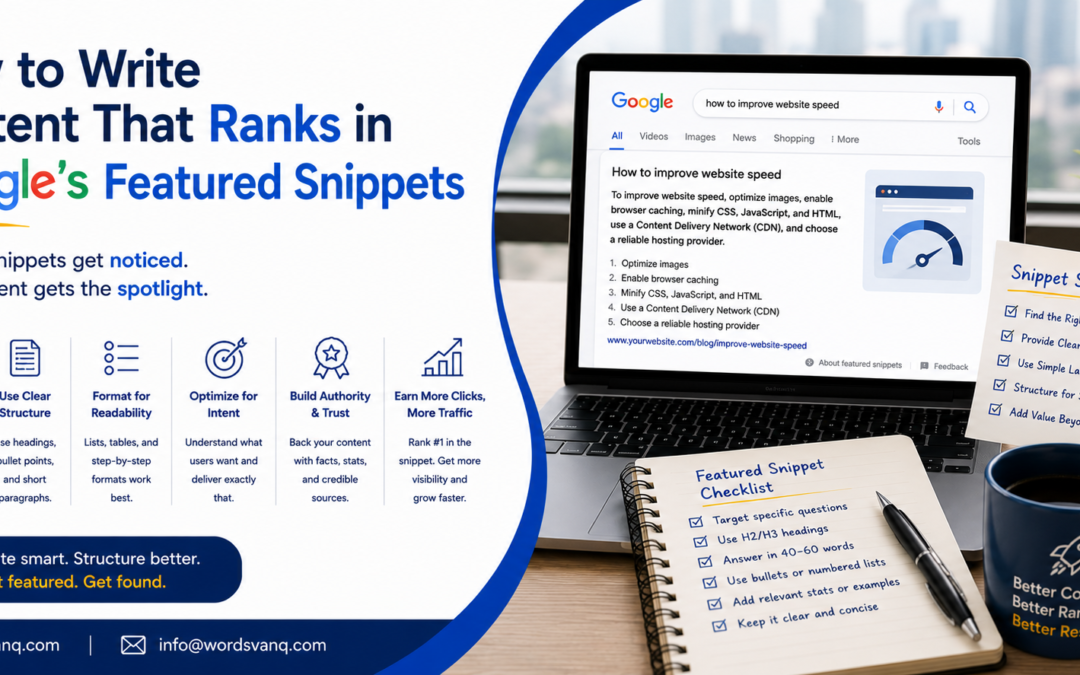
A featured snippet is a selected search result that Google displays in a special box at the top of the search results page above all organic results. Google extracts a portion of text, a list, or a table from a webpage and displays it directly in the results, with the page title and URL.
Despite answering the question on the results page itself, featured snippets consistently generate more traffic than the number one result below them because the source attribution is prominent and users trust the page Google has chosen to feature.
The Four Types of Featured Snippets
| Snippet Type | What It Looks Like | Best Content Format | % of Snippets |
| Paragraph | A block of 40-60 words directly answering a question | Direct answer paragraph after a question-format heading | 82% |
| List | A numbered or bulleted list of steps or items | Properly formatted HTML ordered or unordered list | 11% |
| Table | A table comparing items, prices, or data | Properly formatted HTML table with clear headers | 4% |
| Video | A YouTube clip showing a process | Well-titled, chaptered YouTube video | 3% |
Paragraph snippets are the most common and the most actionable. It is also important to note that content optimized for featured snippets is more likely to be cited in Google AI Overviews, because both systems reward the same signals: clear, direct, well-structured answers.
The Foundation: You Must Already Rank in the Top 10
Ahrefs analysis of 2 million featured snippets found that 99.58% come from pages that already rank on page one. Featured snippet optimization is not a shortcut for pages that don’t rank; it’s an upgrade for those that do.
This means the foundation of any featured snippet strategy is solid traditional SEO, quality content, relevant keywords, proper on-page optimization, and sufficient backlinks to earn a top 10 position.
“You cannot win position zero if you are not on page one. Featured snippets reward pages that are already trusted; they give them an additional promotion.”
How to Identify Your Featured Snippet Opportunities
• Google Search Console: Filter queries where your average position is between 2 and 10. These are your priority targets.
• Ahrefs or Semrush: Use the SERP features filter to find keywords where a featured snippet exists but is not owned by your domain.
• Manual Google search: Search your target queries and observe which ones show a featured snippet. If a snippet exists and is not yours, that is an immediate opportunity.
• People Also Ask boxes: Every question in the PAA section is a potential featured snippet target.
The Query Types That Trigger Featured Snippets
Not every query triggers a featured snippet. Google displays snippets most reliably for queries where there is a clear, specific answer that can be extracted and displayed concisely.
| Query Type | Examples | Snippet Likelihood | Best Format |
| Definition | ‘What is schema markup?’, ‘What is content marketing?’ | Very High | Paragraph definition |
| How-to | ‘How to write a meta description,’ ‘How to do keyword research’ | Very High | Numbered list / steps |
| Question | ‘Why is content marketing important?’, ‘What causes PCOS?’ | High | Direct paragraph answer |
| Comparison | ‘Blog post vs article,’ ‘SEO vs SEM’ | High | Table or paragraph |
| List | ‘Types of content marketing’ and ‘Best SEO tools India 2026’ | High | Bulleted or numbered list |
| Process | ‘How does GST work?’, ‘How does Google indexing work?’ | High | Numbered step list |
| Cost | ‘SEO cost in India,’ ‘content writing price India’ | Medium | Paragraph with ranges |
How to Structure Content to Win Paragraph Snippets
Paragraph snippets are the most common and the most actionable for content writers. Here is the exact structure that gives your content the best chance of being selected:
Rule 1: Use a Question-Format H2 or H3 Heading
The most reliable signal that tells Google your content is answering a specific question is a heading that phrases the question exactly as a user would search it.
Heading format examples:
H2: What Is a Featured Snippet? H2: How Long Should a Blog Post Be for SEO? H2: What Is the Difference Between SEO and SEM?
Rule 2: Answer the Question in the First 40 to 60 Words After the Heading
This is the content Google most commonly extracts. The answer paragraph immediately following your question-format heading should:
•Begin with a direct answer, not background context or an introduction.
•Be between 40 and 60 words long, long enough to be complete and short enough to display without truncation.
•Be self-contained and make complete sense without prior context
•Repeat the key term from the question naturally.
Example snippet: optimized heading and answer
H2: What Is a Featured Snippet? A featured snippet is a selected search result that Google displays in a special box at the top of the search results page, above all other organic results. Also called position zero, it shows a direct answer to the user’s query extracted from a webpage, along with the page title and URL. Featured snippets appear for approximately 12% of all Google searches.
Rule 3: Follow the Answer With Supporting Depth
After your 40 to 60-word answer, continue with a fuller explanation, examples, and detail. The snippet is the hook. The content that follows is why the reader stays and trusts your brand.
How to Structure Content to Win List and Table Snippets
Winning List Snippets
List snippets are triggered by content answering questions about steps, items, or a series of elements. To win list snippets:
•Use proper HTML list formatting, ordered lists for steps, and unordered lists for items. Google cannot reliably extract plain text dashes or asterisks.
•Keep list items concise, ideally 5 to 8 words each. Google truncates at around 8 items, so put the most important first.
•Use a question-format heading above the list.
•Add a brief introductory sentence before the list framing what it covers.
•Keep list items parallel in structure—all starting with a verb or all noun phrases.
List snippet example:
H2: What Are the Types of Featured Snippets? Google displays four main types of featured snippets: 1. Paragraph snippets – a block of 40 to 60 words answering a question 2. List snippets – a numbered or bulleted list of steps or items 3. Table snippets – a table comparing data, prices, or options 4. Video snippets – a YouTube video clip showing a process
Winning Table Snippets
•Use a proper HTML table with a clear header row (thead) and data rows (tbody).
•Keep the table focused; Google typically shows 3 to 5 columns and up to 6 to 8 rows.
•Use descriptive column headers that make the table’s purpose immediately clear.
•Target comparison queries, such as ‘X vs Y,’ ‘types of,’ and ‘comparison of,’ are most likely to trigger table snippets.
Schema Markup That Supports Featured Snippet Eligibility
While Google has stated that schema does not directly cause snippets, the right schema types significantly improve your content’s eligibility for snippets and AI Overview citations.
| Schema Type | When to Use It | How It Helps with Snippets |
| FAQ Page | Pages with a structured list of questions and answers | Enables FAQ accordion in results and signals Q&A structure for AI Overviews |
| How-to | Step-by-step guide content | Enables rich step results and helps Google extract individual steps for list snippets |
| Article | Blog posts and editorial content | Confirms content type and author, supporting E-E-A-T signals that influence snippet selection |
| DefinedTerm | Pages defining a specific term or concept | Explicitly tells Google this page defines a term, useful for definition query snippets |
■Add FAQPage schema to every blog post that includes a FAQ section. This is one of the fastest ways to improve both featured snippet eligibility and AI Overview citation chances simultaneously.
The Featured Snippet Optimisation Checklist
Use this checklist for every piece of content you want to optimize for featured snippets, both when creating new content and when updating existing content that already ranks in the top 10.
| Checklist Item | Done? |
|---|---|
| Target query identified: question, how-to, definition, or list type | [ ] |
| The page already ranks in top 10 for the target query (or being optimised to) | [ ] |
| H2 or H3 heading phrases the exact target query as a question | [ ] |
| A 40- to 60-word direct answer paragraph immediately follows the question heading | [ ] |
| The answer is self-contained and makes sense without prior context | [ ] |
| Key terms from the question repeated naturally in the answer paragraph | [ ] |
| Lists use proper HTML ordered/unordered list formatting (not dashes) | [ ] |
| Tables use proper HTML table formatting with header row | [ ] |
| FAQPage schema added if content includes FAQ section | [ ] |
| HowTo schema added if content includes step-by-step guide | [ ] |
| The page loads fast and is mobile-optimized. | [ ] |
| Content is comprehensive; Google prefers pages that cover a topic fully | [ ] |
Featured Snippet Mistakes That Cost You Position Zero
■Burying the answer instead of leading with it
The most common snippet mistake is providing extensive background before finally answering the question. Google extracts the passage that most directly answers the query. If your direct answer appears in paragraph 8 after seven paragraphs of introduction, Google will either not select it or will select a competitor’s more direct answer instead. Lead with the answer. Then provide context.
■Writing answer paragraphs that are too long or too short
Paragraph snippets under 30 words are often too incomplete to be selected. Paragraphs over 80 words are too long to display cleanly. The 40 to 60-word range is based on analysis of what Google consistently selects. Count your words and trim or expand to hit this range.
■Using question headings but not answering directly underneath
Some writers correctly use question-format headings but then start with context rather than a direct answer. ‘This is an important question because…’ or ‘To understand this, we first need to…”—these push your direct answer down and reduce snippet eligibility significantly.
■Targeting queries where you rank below position 10
Snippet optimization on pages that rank below position 10 has virtually no effect. Prioritise snippet optimisation for your top 10 pages, and focus on traditional SEOPrioritize that are optimization.
■Ignoring the People Also Ask section
Every question in Google’s People Also Ask section is a potential snippet target. If your content answers several PAA questions using proper snippet structure, you can earn multiple snippet placements from a single well-optimized page.
How WordsVanq Writes Content Optimized for Featured Snippets
At WordsVanqu, featured snippet optimization is built into our content writing process, not added as an afterthought. Every blog post, FAQ page, and how-to guide we produce is structured to maximize its eligibility for position zero placements and AI search citations.
| What WordsVanq Does | How It Maximises Featured Snippet Potential |
|---|---|
| Query and Snippet Research | We identify which target queries trigger featured snippets and which of your pages are closest to earning them |
| Question-Format Heading Strategy | Every piece is planned with a hierarchy of question-format H2 and H3 headings matching exactly how target queries are phrased |
| 40 to 60-Word Answer Paragraphs | We write and count direct-answer paragraphs to hit the optimal snippet length for every question targeted |
| Proper List and Table Formatting | All lists and tables are formatted correctly in HTML to maximise list and table snippet eligibility |
| Schema Markup Guidance | We advise on FAQPage, HowTo, and Article schema markup to support snippet and AI Overview eligibility |
| People Also Ask Coverage | We research and answer the most relevant PAA questions for every target topic, maximising snippet opportunities from a single page |
| AI Search Alignment | Our snippet-optimised structure is identical to what ChatGPT, Perplexity, and Google AI Overviews reward |
| Ongoing Optimisation Support | We help existing pages that rank in positions 2 to 10 get restructured for snippet eligibility. |
Conclusion
Featured snippets represent one of the most significant and underutilized opportunities in Indian SEO. For businesses that already rank in the top 10 for valuable queries, the investment required to earn position zero is relatively modest, primarily restructuring existing content to answer questions more directly and format lists and tables correctly.
As Google AI Overviews continue to expand, the same content structures that earn featured snippets also earn AI citations, making snippet optimization one of the highest-leverage content investments available to Indian businesses in 2026.
If your business is ready to invest in content structured to earn featured snippets and AI citations, WordsVang is here to help. We write the content. Google features it.
Want content structured to earn Google’s featured snippets? Talk to WordsVanq today.
Call: +91 9555844324 | Email: info@wordsvanq.com
Frequently Asked Questions
Q: What is a featured snippet?
A: A featured snippet is a selected search result that Google displays in a special highlighted box at the top of the search results page, above all organic results. Also called position zero, it shows a direct answer to the user’s query extracted from a webpage, along with the page title and URL. Featured snippets appear for approximately 12% of all Google searches and earn significantly more clicks than standard first-position results.
Q: How do I check if my content has a featured snippet?
A: Google Search Console shows which queries your pages appear for. To check featured snippet status, manually search your key target queries in Google and look for your domain in the snippet box. SEO tools like Ahrefs and Semrush also have SERP feature filters that show which keywords trigger snippets and who currently owns them.
Q: Do featured snippets reduce website traffic?
A: Research shows mixed results depending on query type. For simple factual queries, users may get the answer without clicking. For complex queries, the snippet acts as a preview that encourages click-through. Overall, featured snippet pages consistently see higher total click-through rates than non-snippet pages for the same queries.
Q: How long does it take to win a featured snippet?
A: After restructuring content for snippet eligibility, most pages that already rank in the top 10 see snippet results within 2 to 8 weeks, the time it takes for Google to re-crawl and re-evaluate the page.
Q: Can WordsVanq optimize my existing content for featured snippets?
A: Yes, WordsVanq offers content optimization services that restructure existing pages’ rankings in positions 2 to 10 for better featured snippet eligibility. We identify the highest-priority opportunities, restructure headings and answer paragraphs, add schema markup guidance, and ensure correct formatting for both paragraph and list snippets.