
ChatGPT has 200M+ weekly active users globally in 2026.
Perplexity sends 1B+ referral visits to websites per month.
Only 11% of websites have an LLM-friendly content structure.
LLM-cited pages get 47% more qualified traffic on average.
KEY TAKEAWAYS
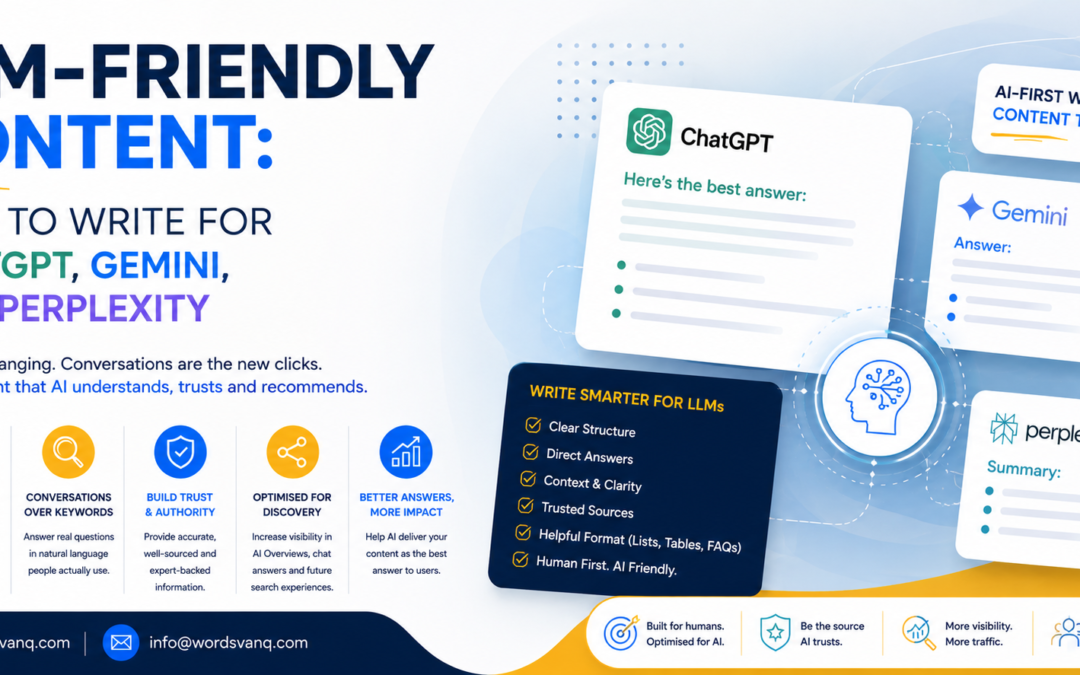
✓ LLMs evaluate content differently from traditional search engines; they prioritize clarity, directness, accuracy, and verifiability over keyword density.
✓ Each major LLM platform has different retrieval mechanisms: ChatGPT uses training data, Perplexity uses real-time web search, and Gemini uses a hybrid approach.
✓ The five pillars of LLM-friendly content are answer-first structure, entity clarity, source credibility, technical accessibility, and topical depth.
✓ LLMs extract and cite individual passages, not whole pages every paragraph should be independently valuable and self-contained.
✓ Structured data (schema markup), outbound citations, and named author credentials all significantly improve LLM citation rates.
✓ WordsVanq writes LLM-friendly content that earns citations across ChatGPT, Gemini, and Perplexity for Indian businesses.
There is a new audience for your content. It does not read the way humans do. It does not scroll, skim, or click. It processes language at machine speed, extracts the most relevant passages, and synthesises them into answers that millions of people receive every day.
That audience is Large Language Models, the AI systems powering ChatGPT, Google’s Gemini, Perplexity, Anthropic’s Claude, and Microsoft Copilot. These platforms collectively process billions of queries every month, and when they answer a question about your industry, your services, or your expertise, they are drawing from content they have retrieved and evaluated from across the web.
The businesses whose content gets cited become the trusted sources in their field, not just on traditional Google searches but across the AI platforms that are rapidly becoming how a growing number of people find information and make decisions. This guide shows how to create content that AI systems can easily understand, trust, and reference and offers a practical way to write content that works well on ChatGPT, Gemini, and Perplexity at the same time. For Indian businesses looking to build AI search visibility, this is one of the most valuable content strategies available right now.
What Does LLM-Friendly Content Actually Mean?
LLM-friendly content is content that is structured, written, and technically configured in a way that makes it easy for large language models to retrieve, parse, extract, and cite. It is not a separate style of content from good, human-readable content—it is an enhanced version of it, with specific structural and technical characteristics that AI systems reward.
Understanding what LLM-friendly means requires understanding how LLMs actually process content. When a user asks ChatGPT “what is the best SEO strategy for an Indian business in 2026,” the model does not read a single webpage from top to bottom. It either draws from its training data (for ChatGPT’s base model) or retrieves several pages, extracts relevant passages, and synthesises them into an answer (for ChatGPT Search, Perplexity, and Gemini).
This passage-level extraction is the key insight. LLMs do not cite whole articles; they cite specific paragraphs, specific answers, and specific data points. Content that is structured to make those individual passages maximally clear, accurate, and self-contained is the content that gets cited.
“Think of your content as a library of answers. Each paragraph should be a complete, self-contained answer to a specific question. LLMs are looking for exactly that.”
How ChatGPT, Gemini, and Perplexity Retrieve Content Differently
Writing LLM-friendly content requires understanding that ChatGPT, Gemini, and Perplexity work very differently from each other. A strategy that optimizes for one but ignores the others leaves significant citation opportunities on the table.
ChatGPT: Training Data and Brand Recognition
OpenAI’s ChatGPT primarily draws from its training data for most responses, a massive dataset of text from across the internet collected up to its knowledge cutoff. This means that for ChatGPT to cite or recommend your brand, your content needs to have appeared widely across the web in sources that ChatGPT’s training data includes: major publications, Wikipedia, industry blogs, review platforms, and widely shared social content.
ChatGPT Search (the web-search-enabled version) does perform real-time web retrieval, and here the signals shift toward recency, authority, and structured content. But for most ChatGPT responses where users are not explicitly asking for recent information, training data presence and brand recognition across multiple external sources are the dominant factors.
Primary optimization strategy for ChatGPT: Build brand presence across multiple authoritative external sources. Get published in industry publications. Earn backlinks from credible domains. Maintain consistent, recognizable brand positioning across all platforms.
Perplexity: Real-Time Retrieval and Content Freshness
Perplexity AI performs a real-time web search for every query. It retrieves several web pages, reads them in full, and synthesises an answer with inline citations to the sources it used. This makes Perplexity the most immediately actionable LLM platform for content optimization because a blog post published today can be cited by Perplexity within hours.
Perplexity’s citation algorithm heavily favors freshness, speed (fast-loading pages get read more reliably), clear, structured answers, and pages with verifiable outbound citations to credible sources. Analysis of Perplexity citations consistently shows that pages published within the last 30 days are cited at a dramatically higher rate than older content on the same topic.
Primary optimization strategy for Perplexity: Publish consistently and frequently. Structure content with question-format headings and direct answer paragraphs. Include visible date stamps. Ensure fast page loading. Add outbound citations to credible sources.
Gemini: Google Index Plus Real-Time Retrieval
Google’s Gemini uses a hybrid approach combining Google’s massive search index with real-time retrieval capabilities. This means Gemini’s citation behavior is strongly correlated with traditional Google Search rankings: pages that rank well in Google Search are more likely to be cited by Gemini.
However, Gemini also applies its own quality evaluation layer on top of Google’s organic ranking. It is not simply a list of the top 10 search results; it synthesizes from sources that are both highly ranked and structured for AI extraction. Structured data, clear headings, E-E-A-T signals, and FAQPage schema all improve Gemini citation rates above and beyond their Google ranking value.
Primary optimization strategy for Gemini: Focus on traditional SEO to achieve strong Google rankings. Add FAQPage and Article schema. Build E-E-A-T signals with named author credentials. Structure content with question-format headings and direct answers.
The Five Pillars of LLM-Friendly Content
Based on the mechanics of how major LLMs retrieve and evaluate content, five core pillars determine whether any piece of content earns AI citations. Every page you publish should be evaluated against all five.
Pillar 1: Answer-First Structure
LLMs extract passages, not pages. The most cited passage on any page is typically the first clear answer to a question, the text that immediately follows a question-format heading. Structure every section of your content to lead with the answer, then provide supporting depth.
The optimal format is the Question-Answer-Depth pattern:
Pattern: H2: [Question as users would ask it] [40-60 word direct answer- self-contained, factual, clear] [Supporting paragraphs with examples, data, and context]
📌 Apply this pattern to every major section of every piece of content you publish. Each section should open with a question heading and immediately follow with a direct answer before adding any context or elaboration.
Pillar 2: Entity Clarity
LLMs understand content through named entities, specific people, places, organizations, products, concepts, and events. Content that uses specific, named entities consistently helps LLMs understand exactly what your content is about and in what context.
Vague content that uses generic pronouns and unspecified references is significantly harder for LLMs to extract confidently. Compare these two versions:
Vague (hard for LLMs to extract): “The company has been growing fast, and their services are used by many businesses.” Entity-clear (LLM-friendly): “WordsVanq, a content writing agency based in India, has served over 500 businesses across sectors including IT, real estate, healthcare, and e-commerce since 2018.”
The entity-clear version gives the LLM specific, verifiable information: company name, industry, location, client count, sectors, and founding period. Every one of these entities helps the LLM understand and confidently cite the content.
Pillar 3: Source Credibility
LLMs are trained to be skeptical of uncorroborated claims. Content that makes assertions without supporting evidence is less likely to be cited than content that backs every significant claim with a verifiable source. Research from Princeton’s GEO study found that adding citations to content independently improved LLM visibility scores, even when controlling for all other content quality factors.
For every significant statistic, research finding, or factual claim in your content:
- Link to the original source (peer-reviewed research, government data, recognized industry reports)
- Name the source explicitly in the text: “According to NASSCOM’s 2026 report…” rather than just linking it.
- Prefer primary sources over secondary aggregators; LLMs evaluate source authority recursively.
- Ensure all cited sources are current; outdated citations reduce LLM confidence in your content’s accuracy.
Pillar 4: Technical Accessibility
LLMs cannot cite content they cannot access. Technical barriers that prevent AI crawlers from reading your content are the single most common and most fixable cause of poor LLM visibility.
The key technical requirements:
| Technical Element | What to Do | Why It Matters for LLMs |
|---|---|---|
| robots.txt | Allow GPTBot, OAI-SearchBot, PerplexityBot, ClaudeBot, anthropic-ai, Google-Extended, Bingbot | Each blocked crawler makes you invisible to its corresponding AI platform |
| Page Speed | Achieve an under-2.5-second LCP on mobile and desktop | Perplexity reads pages in real-time; slow pages are deprioritized or skipped |
| Schema Markup | Implement FAQPage, HowTo, Article, and DefinedTerm schemas where appropriate | Structured data helps LLMs understand content type and extract passages accurately |
| Clean HTML | Use semantic HTML elements: h1, h2, h3, p, ul, ol, table properly | LLMs parse HTML structure to understand content hierarchy and identify key sections |
| Canonical Tags | Ensure canonical tags are correctly configured | Prevents LLMs from indexing and splitting authority across duplicate content |
Pillar 5: Topical Depth
LLMs evaluate not just individual pages but domains; they are more likely to cite a website that covers a topic comprehensively across multiple pieces of content than one that has a single isolated article on the subject. This is topical authority, and it matters as much for LLM citations as it does for traditional Google rankings.
A website with 20 interconnected pieces of content about content writing, covering SEO content, healthcare content, real estate content, AEO, LLM optimization, case studies, and more, sends a much stronger topical authority signal to LLMs than a website with one or two general articles on the same subject.
The LLM Content Writing Framework: Step by Step
Here is a practical, step-by-step framework for writing content that is LLM-friendly from the first word to the final paragraph. Apply this framework to every new piece of content you publish.
Step 1: Research What LLMs Are Already Saying About Your Topic
Before writing, ask ChatGPT, Perplexity, and Gemini the questions your content will answer. Note what they say, which sources they cite, how they structure their answers, and where the gaps in their responses are. Writing content that fills those gaps, providing more specific, more current, or more locally relevant information than what LLMs currently have access to, gives you the strongest chance of being cited as an improved source.
Step 2: Identify the Specific Questions Your Content Will Answer
LLM-friendly content starts with a list of specific questions, not a topic. “Content marketing” is a topic. “How does content marketing help Indian SMBs rank on Google?” is a question that a user would actually ask an LLM. Map out every question your target piece of content will answer before writing a single word. These questions become your section headings.
Step 3: Write a One-Sentence Definition or Answer for Each Section
For each question you have identified, write a single sentence that directly answers it. This is your anchor; the 40-60 word answer paragraph will expand this into a complete, citable passage. If you cannot write a single-sentence answer, the question may be too vague or too broad.
Step 4: Expand Each Answer to 40-60 Words
Expand your one-sentence answer into a 40-60 word paragraph that is completely self-contained. The test: if this paragraph appeared in isolation, without any surrounding context, would it fully and accurately answer the question? If yes, it is LLM-ready. If not, revise until it is.
Step 5: Add Supporting Depth With Specific Examples and Data
After each direct answer paragraph, add supporting paragraphs that provide examples, data, context, and elaboration. This is where you demonstrate genuine topical depth, the signal that distinguishes an authoritative source from a superficial one. Include at least one specific, sourced data point per major section.
Step 6: Name Your Entities Explicitly throughout the review,
Every paragraph has vague references. Replace “the company” with the company name. Replace “a recent study” with “a 2026 study by NASSCOM.” Replace “some cities” with “Delhi, Mumbai, and Bangalore.” Specificity is what allows LLMs to extract and cite your content with confidence.
Step 7: Add FAQPage Schema to Every Q&A Section.
Implement FAQPage schema markup on every page with a question-and-answer structure. This directly signals to Google Gemini and Google AI Overviews that your content is structured as Q&A, making it eligible for AI Overview extraction. Most WordPress SEO plugins (Rank Math, Yoast Premium) support FAQPage schema natively.
LLM-Friendly Content Examples: Before and After
The fastest way to understand LLM-friendly writing is to see the difference between content that LLMs struggle to extract and content that they cite readily. Here are three before-and-after examples.
Example 1: Service Page Introduction
BEFORE (LLM-unfriendly): At WordsVanq, we pride ourselves on delivering exceptional content writing services that help businesses achieve their goals. Our team of experienced writers works tirelessly to create compelling content that resonates with audiences and drives meaningful engagement.
AFTER (LLM-friendly): H2: What content writing services does WordsVanq offer? WordsVanq is an Indian content writing agency that provides SEO-optimized blog writing, website copywriting, case studies, and social media content for businesses across India and internationally. Founded to serve SMBs and enterprises, WordsVanq has delivered content for clients in IT, real estate, healthcare, and e-commerce since 2018.
Example 2: Blog Section on a Technical Topic
BEFORE: Keyword research is really important for SEO. There are many tools you can use. Some are free and some are paid. You should look for keywords that people are searching for and try to use them in your content.
AFTER: H2: How do you do keyword research for SEO? Keyword research for SEO involves identifying the specific words and phrases your target audience types into search engines. Use tools like Google Keyword Planner (free), Ahrefs, or SEMrush to find keywords with high monthly search volume and low competition. Target long-tail keywords (3-5 word phrases) for faster rankings as a new or small website.
Example 3: Data and Statistics
BEFORE: Studies show that content marketing generates more leads than traditional marketing. Many businesses have seen great results from investing in content.
AFTER: According to the Content Marketing Institute’s 2025 B2B Report, content marketing generates approximately 3x more leads per dollar spent than traditional outbound marketing while costing 62% less per lead. For Indian SMBs, HubSpot’s 2025 State of Marketing report found that businesses publishing 4+ blog posts per month see 4.5x more website traffic than those publishing once per month.
In every case, the latter version is more specific, more entity-rich, more sourced, and more directly answerable to a specific question. It takes no more words, often fewer, to write LLM-friendly content. It simply requires a more intentional approach to structure and specificity.
Building LLM Authority: The Off-Page Strategy
On-page LLM-friendly writing covers the content structure side. But for ChatGPT specifically, which draws heavily on training data and cross-platform brand recognition, off-page signals are equally important.
The Brand Mention Strategy
Research from Profound shows that AI platforms look for corroboration across multiple independent sources before confidently recommending a brand. If ChatGPT sees your brand mentioned in your own content but nowhere else, it treats that as a low-confidence signal. If it sees your brand mentioned in YourStory, Inc42, LinkedIn articles by industry figures, Quora answers, and Google reviews, it develops a high-confidence understanding of who you are and what you offer.
Build your brand mention profile by:
- Getting featured or quoted in Indian business publications (Economic Times, YourStory, Inc42, Entrepreneur India)
- Writing genuine, expert answers on Quora for questions in your field
- Publishing thought leadership on LinkedIn that gets shared and commented on
- Being listed and reviewed on B2B platforms like Clutch, G2, and GoodFirms
- Appearing in podcast interviews, webinars, or industry events that generate online content mentioning your brand
Named Author Attribution
LLMs, particularly for YMYL (Your Money or Your Life) content categories like finance, healthcare, and legal, significantly prefer content with named, credentialed authors over anonymous content. Every piece of content you publish should carry a byline with the author’s name and relevant credentials.
For an Indian content writing agency, this means content signed by a named content strategist or SEO specialist with their experience and credentials stated. For a healthcare clinic, content signed by a named doctor with their qualifications is essential. For a fintech company, content is reviewed by a named finance professional. The named author is one of the strongest trust signals available to LLMs.
LLM Content Strategy for Indian Businesses: The Specific Opportunity
For Indian businesses, LLM-friendly content represents one of the highest-return content investments available right now. Here is why the Indian opportunity is particularly strong:
| Opportunity | Why It Exists for Indian Businesses | How to Capture It |
|---|---|---|
| Low competition for LLM visibility | Fewer than 11% of Indian websites have LLM-friendly content structure. Most Indian content is still written for traditional SEO only | Start now. The first-mover advantage in LLM visibility is significant and hard to replicate later |
| India-specific knowledge gap | LLMs often have limited or outdated information about Indian market specifics city-level data, India-specific regulations, and local business context | Create content with specific Indian data, named Indian cities, rupee-denominated pricing, and local case studies |
| Vernacular opportunity | LLMs are expanding Hindi and regional language coverage. Very little quality Hindi-language content is LLM-friendly | Publish key content in Hindi with the same LLM-friendly structure used for English content |
| B2B decision-maker research | Indian B2B buyers increasingly use ChatGPT and Perplexity to research vendors and solutions before making purchase decisions | Create LLM-friendly content that directly answers the questions Indian buyers are asking AI platforms |
| AI Overview expansion | Google AI Overviews are expanding their coverage of Indian searches rapidly, creating new citation opportunities | Structure existing top-10-ranking pages with question headings and FAQPage schema |
The combination of low current competition, fast-growing AI adoption among Indian users, and a significant India-specific knowledge gap in existing LLM training data makes this an extraordinary window of opportunity. Indian businesses that build LLM-friendly content libraries in 2026 will hold AI citation positions that are very difficult for later competitors to dislodge.
Measuring Your LLM Content Performance
You cannot optimize what you cannot measure. Here is how to track whether your LLM-friendly content is working:
Manual Query Testing
Regularly search your target queries in ChatGPT, Perplexity, and Gemini. Note whether your brand or content is cited, how it is described, and which competitors appear when you do not. Test 10 to 15 priority queries weekly and track changes over time.
AI Referral Traffic in GA4
Set up a custom channel group in Google Analytics 4 to track referral traffic from AI platforms. Add sources: chatgpt.com, perplexity.ai, claude.ai, gemini.google.com, copilot.microsoft.com, and bing.com (for Copilot). This shows you how much traffic AI platforms are already sending.
LLM Tracking Tools
LLMrefs.com monitors brand mentions across ChatGPT, Perplexity, Claude, and Gemini for specific queries. Track your citation rate, the context of mentions, and competitor citation patterns. These tools are relatively new but rapidly improving.
Google Search Console for AI Overviews
Filter your Search Console data for queries where you rank in positions 1-5 but see unusually low click-through rates. This pattern often indicates an AI overview is appearing for the query and absorbing clicks that would otherwise come to your page. These are your highest-priority AEO optimization targets.
How WordsVanq Creates LLM-Friendly Content
At WordsVanq, LLM-friendly content writing is now a standard part of every content project. As AI platforms become an increasingly important visibility and traffic channel for Indian businesses, the content we create is built to perform across ChatGPT, Gemini, and Perplexity, not just on traditional Google Search.
| What WordsVanq Does | How It Improves LLM Visibility |
|---|---|
| LLM Question Mapping | We identify the specific questions your target audience is asking AI platforms and structure content to answer them directly |
| Question-Format Heading Strategy | Every piece is structured with question-format H2 and H3 headings that match LLM query patterns |
| 40-60 Word Direct Answer Paragraphs | We write and count direct answer paragraphs for every question heading, the most commonly cited content format |
| Entity-Rich Writing | We name specific companies, cities, products, and people throughout giving LLMs the specificity they need to cite confidently |
| Verifiable Source Integration | We research and include credible, linked sources for every significant claim, a key LLM trust signal |
| FAQ Page and How-To Schema Guidance | We advise on and support schema implementation that directly improves LLM extraction eligibility |
| AI Crawler Technical Review | We check and advise on robots.txt configuration to ensure your content is accessible to all major AI crawlers |
| Topical Depth Planning | We build content plans that create the topical authority clusters that LLMs recognise as genuine expertise |
Conclusion
Writing for LLMs is not a radically different skill from writing great content. It is the same craft applied with greater intentionality, more direct answers, more specific entities, more verifiable sources, and more deliberate structure. The result is content that serves both human readers and AI systems more effectively.
For Indian businesses, the window to build LLM content authority is open right now, and it will not stay this wide forever. The businesses that invest in LLM-friendly content libraries in 2026 will hold AI citation positions that deliver branded visibility, qualified traffic, and competitive advantage for years to come.
If your business is ready to build content that performs in both traditional search and AI search, WordsVanq is ready to help. We create LLM-friendly content that earns citations, builds authority, and drives traffic across every search surface available in 2026 and beyond.
Want LLM-friendly content that gets cited by ChatGPT, Gemini, and Perplexity? Talk to WordsVanq.
Visit: wordsvanq.com/contact-us | Call: +91 9555844324 | Email: info@wordsvanq.com
Frequently Asked Questions
Q: What is LLM-friendly content?
A: LLM-friendly content is content that is structured and written to make it easy for large language models like ChatGPT, Gemini, and Perplexity to retrieve, extract, and cite specific passages. Key characteristics include question-format headings followed by direct 40-60 word answers, entity-specific language, verifiable sourced claims, FAQPage schema markup, and technical accessibility for AI crawlers.
Q: Does the same content work for ChatGPT, Gemini, and Perplexity?
A: There is significant overlap in what works across all three platforms; direct answers, credible sourcing, structured headings, and named entities help with all three. However, each platform has different primary signals: ChatGPT weights training data presence and brand mentions across external platforms. Perplexity weights content freshness and speed; Gemini weights Google organic rankings and structured data. A comprehensive LLM strategy addresses all three.
Q: How is LLM-friendly content different from SEO content?
A: LLM-friendly content builds on SEO content rather than replacing it. Traditional SEO focuses on keyword placement, backlinks, and ranking in Google’s list of results. LLM-friendly content adds specific structural elements, question-format headings, direct-answer paragraphs, entity clarity, and schema markup—that make content extractable and citable by AI systems. Good LLM content is always also good SEO content.
Q: How quickly will LLM-optimized content show results?
A: Perplexity can cite new content within hours of it being published, making it the fastest-responding LLM platform. Google AI Overviews typically update within 2-4 weeks of content being published or restructured, provided the page already ranks in the top 20 organically. ChatGPT’s base model cites training data, so results depend on when OpenAI next updates its training corpus, though ChatGPT Search (web-enabled) responds to new content much faster.
Q: Can WordsVanq help with LLM content optimization for existing content?
A: Yes — WordsVanq offers content restructuring services that audit existing pages for LLM-friendliness and update them with question-format headings, direct answer paragraphs, entity clarity improvements, source citations, and schema guidance. This is particularly valuable for pages that already rank in the top 10 on Google and are therefore the closest to earning AI Overview citations.