
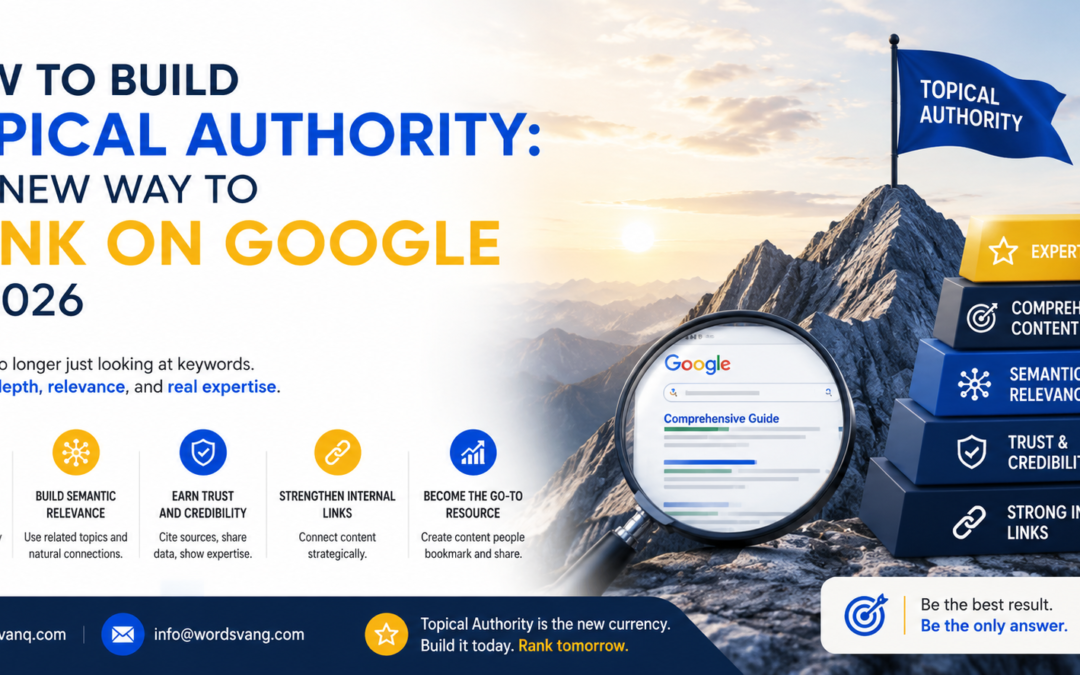
Websites with topical authority rank 3x faster for new content.
Google’s Beneficial Content Update penalized over 40% of thin-topic websites.
Topic cluster sites get 78% more organic traffic on average.
Only 9% of Indian business sites have a topical authority strategy.
Key Takeaways
- Topical authority is Google’s assessment of how comprehensively and authoritatively your website covers a given subject area, not just individual pages.
- Websites with topical authority rank new content 3x faster and hold rankings more durably than those without it.
- Building topical authority requires a topic cluster strategy: one comprehensive pillar page surrounded by deeply linked supporting content.
- Internal linking is the mechanism that communicates your topical depth to Google; without it, even excellent content does not build authority.
- Topical authority also significantly improves AI search visibility on ChatGPT, Perplexity, and Google AI Overviews.
- WordsVanq builds topical authority content strategies and content libraries for Indian businesses across every industry.
For years, the conventional SEO wisdom was simple: find a keyword with decent search volume, write a blog post targeting that keyword, build some backlinks, and wait to rank. This approach worked well enough through most of the 2010s. But in 2026, it is no longer sufficient, and for many Indian businesses, it is the reason their content efforts are producing traffic but no real search authority.
Google’s algorithm has fundamentally evolved. Where it once evaluated individual pages primarily on keyword relevance and backlink count, it now evaluates entire websites on topical depth, how comprehensively and authoritatively a website covers a given subject area. This is what topical authority means: Google’s assessment of whether your website is a genuinely trusted, comprehensive resource on the topics it covers.
A website with strong topical authority ranks new content faster, holds rankings more durably, and earns AI citations more reliably than one without it. Building topical authority is not just the new SEO strategy; it is the foundational SEO strategy that makes everything else work better. This guide explains exactly what topical authority is, why it matters for Indian businesses in 2026, and precisely how to build it step by step.
What Is Topical Authority, and Why Does Google Care About It?
Topical authority is the degree to which Google considers your website a trusted, comprehensive, expert resource on a given subject. It is not about individual pages or individual keywords; it is about the cumulative signal that your entire website sends about your depth of knowledge in a particular area.
Think of it this way. If you want to know about SEO for Indian businesses, would you rather consult a website that has one blog post about SEO keywords or one that has 40 interconnected pieces covering every aspect of SEO, from keyword research and on-page optimization to technical SEO, link building, local SEO, and AI search? The second website has topical authority. The first has a keyword-targeted blog post.
Why Google Shifted to Topical Authority
Google’s shift toward topical authority as a primary ranking signal accelerated significantly with the Helpful Content Update and subsequent core updates. Google’s stated goal is to surface content from the most credible, comprehensive sources available, and comprehensiveness across a topic is one of the strongest credibility signals available.
The practical result: websites that have built dense, interconnected content ecosystems around specific topics are outranking websites with more backlinks but shallower topical coverage. For Indian businesses that cannot compete with global competitors on link-building budgets, topical authority represents one of the most achievable paths to sustainable Google rankings.
“A single brilliant blog post is a moment of visibility. A topical authority content library is a permanent competitive moat.”
Topical Authority vs. Keyword Targeting: Understanding the Shift
The shift from keyword targeting to topical authority represents a fundamental change in how SEO content strategy should be approached. Understanding the difference is essential before building your own strategy.
| Dimension | Keyword Targeting (Old Model) | Topical Authority (New Model) |
|---|---|---|
| Unit of strategy | Individual keyword or page | Topic clusters and content ecosystems |
| Success measure | Single-page ranking for one keyword | Domain authority across all keywords in a topic area |
| Content approach | Write the best post for this keyword. | Build the most comprehensive resource on this subject. |
| Internal linking | Optional, often overlooked | Essential, the mechanism that communicates topical depth |
| Result | Isolated rankings that fluctuate frequently | Durable rankings that improve over time as content compounds |
| AI search impact | Minimal, individual pages rarely cited | High, comprehensive topic coverage earns consistent AI citations. |
| Time to results | Can be fast for low-competition keywords | Slower to build, but far more durable once established |
| Best for | Quick wins on specific queries | Long-term organic traffic leadership in a category |
The most effective 2026 SEO strategy combines both: keyword targeting to identify what to write and topical authority content architecture to structure how it all fits together. But the strategic foundation must be topical authority, because keyword-targeted content that exists within a topical authority framework performs dramatically better than the same content existing in isolation.
The Topic Cluster Model: The Architecture of Topical Authority
The most practical framework for building topical authority is the topic cluster model, first popularized by HubSpot and now widely adopted as the standard content architecture for authority-building SEO.
A topic cluster consists of three elements:
- The Pillar Page: A comprehensive, long-form page (typically 3,000 to 5,000 words) that covers a broad topic in sufficient depth to serve as the definitive resource on that subject. It links out to all related cluster pages.
- Cluster Pages (Supporting Content): Individual blog posts or landing pages that cover specific sub-topics within the broader pillar topic in greater depth. Each cluster page links back to the pillar page.
- Internal Links: The connective tissue that ties the cluster together. Every cluster page links to the pillar page, and the pillar page links to all cluster pages. This dense internal link structure communicates to Google the relationship and depth of your topical coverage.
A Real Topic Cluster Example: Content Writing for Indian Businesses
Here is what a topic cluster looks like for a content writing agency targeting Indian businesses:
| Type | Page | How It Links |
|---|---|---|
| Pillar Page | The Complete Guide to Content Writing for Indian Businesses (4,000 words) | Links to all cluster pages below |
| Cluster Page | What Is SEO Content Writing, and Why Does It Matter? | Links back to pillar |
| Cluster Page | How to Build Topical Authority for Your Indian Business Website | Links back to pillar |
| Cluster Page | Content Writing Services in Mumbai Local SEO Guide | Links back to pillar |
| Cluster Page | Healthcare Content Writing: Why Medical Content Needs a Different Approach | Links back to pillar |
| Cluster Page | How to Write Product Descriptions That Rank and Convert | Links back to pillar |
| Cluster Page | The Complete Guide to Schema Markup for Indian Websites | Links back to pillar |
| Cluster Page | Answer Engine Optimization (AEO): What Indian Businesses Need to Know | Links back to pillar |
| Cluster Page | White Label Content Writing: What It Is and Why Agencies Use It | Links back to pillar |
Notice that the pillar page covers “content writing for Indian businesses” broadly, and each cluster page dives deep into a specific sub-topic. This is exactly the structure that signals topical authority to Google: not just one excellent page, but an entire ecosystem of deeply related, interlinked content that comprehensively covers the subject from every relevant angle.
How to Build Topical Authority: A Step-by-Step Strategy
Building topical authority is a systematic process, not a random collection of blog posts. Here is the exact step-by-step strategy to follow:
Step 1: Choose Your Core Topics Strategically
The first decision is which topics to build authority around. This choice should be driven by three criteria:
- Relevance to your business: The topic must be directly related to what your business does. A content writing agency building topical authority about car insurance is wasting resources; every page should relate to content, SEO, and digital marketing.
- Search demand: The topic must have meaningful search volume. Use keyword research tools to confirm that the topic cluster you are planning captures genuine search demand across the keyword spectrum.
- Achievable competition: Choose topics where you can realistically compete within 12 to 18 months. Broad topics like “SEO” are too competitive for most Indian SMBs to build authority around. ” Content writing for Indian healthcare businesses” is far more achievable.
■ Start with one topic cluster, not five. Build genuine authority in one area before expanding. A website with deep authority on one topic outperforms one with shallow coverage across five topics.
Step 2: Map the Full Keyword Universe for Your Topic
For each core topic, map every keyword in the semantic universe around it. Tools like Ahrefs, Semrush, or Google Keyword Planner allow you to enter a seed keyword and generate hundreds of related questions, sub-topics, and long-tail variations. These become your cluster page topics.
Organize your keyword universe into groups:
- Informational: “What is topical authority?” and “How does topical authority work?”
- How-to: “How to build topical authority,” “how to create topic clusters”
- Comparison: “Topical authority vs. keyword targeting” and “topic clusters vs. pillar pages”
- Commercial: “Best content writing agency for topical authority,” “topical authority services India”
Each keyword group represents a cluster page opportunity. The breadth of your keyword universe shows you the full scope of content you need to build genuine topical authority.
Step 3: Build Your Pillar Page First
Your pillar page is the anchor of your entire topic cluster. It should:
- Cover the core topic comprehensively; aim for 3,000 to 5,000 words that genuinely address the topic from every important angle
- Include clear sections for each major subtopic that your cluster pages will cover in depth.
- Link to each cluster page as soon as those pages are published
- Target a broad, high-volume head keyword for the overall topic
- Be updated and expanded as new cluster pages are added and new subtopics emerge.
Step 4: Publish Cluster Pages Systematically
Publish cluster pages in a systematic sequence that builds topical coverage progressively. Do not try to publish all cluster pages at once; a steady cadence of two to four cluster pages per month allows Google to process and index each piece before the next arrives, building cumulative authority signals over time.
Priority for cluster page publishing order:
- Highest search volume subtopics first—these deliver early traffic while authority builds
- Subtopics with the least existing competition and faster rankings build confidence and momentum.
- Sub-topics that support your commercial pages: content that drives business inquiries takes priority over purely informational pieces.
Step 5: Build a Dense Internal Linking Architecture
Internal linking is the mechanism that turns a collection of related blog posts into a topical authority ecosystem. Every cluster page must link back to the pillar page using the pillar’s target keyword as anchor text. The pillar page must link to every cluster page. Related cluster pages should also link to each other where the connection is natural.
This internal link structure does three things: it tells Google that these pages are related and part of a coherent content ecosystem; it distributes page authority across all cluster pages; and it keeps visitors on your site longer by naturally guiding them from one related piece of content to the next.
Step 6: Measure Topical Authority Growth
Track your topical authority progress through three key metrics:
- Keyword ranking breadth: Are you ranking for an increasing number of keywords within your topic area? Track the total number of keywords your domain ranks for within your chosen topic; this should grow steadily as your cluster expands.
- New content ranking speed: Is new content on your topic area ranking faster over time? A website building topical authority sees new pieces rank for their target keywords progressively faster as domain authority within the topic grows.
- AI citation frequency: Are ChatGPT, Perplexity, or Google AI Overviews citing your content when answering questions about your topic? This is one of the strongest indicators of genuine topical authority.
Common Topical Authority Mistakes to Avoid
Building topical authority is a significant content investment. These are the mistakes that waste that investment:
■ Spreading content across too many unrelated topics
A website that publishes content about real estate, fitness tips, stock trading, and content writing is not building topical authority in any of these areas; it is signalling to Google that it has no particular expertise in anything. Every piece of content you publish should either be within your core topic cluster or directly adjacent to it. Content that is not topically relevant to your business is not just wasted effort; it may actively dilute your topical authority signals.
■ Building clusters without a pillar page
A collection of loosely related blog posts is not a topic cluster. Without a comprehensive pillar page that anchors the cluster and links to all the supporting pages, Google cannot identify the central topic that your content cluster is about. The pillar page is not optional it is the architectural requirement that gives your cluster coherence.
■ Publishing cluster pages without internal linking
The most common topical authority failure is producing all the right content but not linking it together. Cluster pages that exist in isolation, with no links to the pillar and no links from the pillar, do not build topical authority regardless of their quality. After publishing every cluster page, update both the new page and the pillar page to include the appropriate internal links.
■ Stopping content production before authority is established
Topical authority takes time to build, typically 6 to 18 months of consistent content production, depending on competition and starting point. The most common reason Indian businesses fail to build topical authority is that they stop publishing consistently before the compounding effect kicks in. The first 6 months of content production often show modest results. The acceleration happens between months 9 and 18.
■ Targeting too broad a topic for your current domain authority
A new website cannot build topical authority around “digital marketing” and compete with HubSpot or Semrush. Choose a topic scope that matches your current domain authority and competitive strength. A niche topic cluster that you can own comprehensively is far more valuable than a broad topic cluster where you can only ever cover a fraction of the keyword universe.
Topical Authority and AI Search: The 2026 Connection
One of the most significant benefits of topical authority in 2026 is its direct correlation with AI search visibility. When ChatGPT, Perplexity, or Google AI Overviews answer a question about your topic area, they are drawing from sources they have assessed as authoritative on that subject.
A website with genuine topical authority, comprehensive coverage, dense internal linking, strong E-E-A-T signals, and consistent publishing is exactly the kind of source that AI systems prioritize as citations. When your website covers a topic from 30 different angles across 30 interconnected pieces of content, AI systems have multiple passage-level extraction opportunities from multiple pages, dramatically increasing your chances of appearing in AI-generated answers.
The Topical Authority – AI Visibility Flywheel
The relationship between topical authority and AI search creates a positive flywheel:
| Stage | What Happens | Result |
|---|---|---|
| Build Topic Cluster | Publish comprehensive, interconnected content on your core topic. | Google indexes a dense content ecosystem. |
| Earn Topical Authority | Google begins ranking all your topic cluster pages higher. | More pages rank for more keywords, and breadth of coverage grows. |
| Get Cited by AI | AI systems recognize your website as authoritative on the topic and cite it in AI answers. | Brand visibility increases across ChatGPT, Perplexity, and AI Overviews. |
| Earn More Backlinks | AI citations and higher rankings generate backlinks from other publishers. | Domain authority increases, further boosting topical authority signals |
| Rank New Content Faster | Every new piece published on your topic ranks faster because of established authority. | Content output compounds, the more you publish, the faster it works |
Topical Authority for Indian Businesses: Practical Topic Ideas
Every Indian business, regardless of industry, has the potential to build topical authority in its specific area. Here are example topic cluster ideas across major Indian industries:
| Industry | Core Topic for Pillar Page | Example Cluster Page Topics |
|---|---|---|
| Content Writing Agency | Content writing and SEO for Indian businesses | Healthcare content, SaaS content, real estate content, AEO, topical authority |
| Real Estate Agency | Property investment and buying in [City] | Area guides, market reports, RERA guides, home loan content, and NRI buying guides |
| IT Services | Software development for Indian enterprises | Web development, mobile development, cloud migration, digital transformation |
| Healthcare | [Specialty] treatment and patient care in India | Condition guides, treatment options, procedure FAQs, specialist profiles, patient care guides |
| Fintech / NBFC | Personal finance and lending in India | GST loans, working capital, MSME financing, credit score guide, EMI calculators |
| EdTech | Career guidance and skill development in India | Course comparisons, career path guides, certification reviews, job market trends |
| Legal Services | Business law and compliance in India | Company formation, GST compliance, IP law, employment law, contract guides |
The key principle is specificity: the more narrowly you define your core topic while ensuring it has sufficient search demand, the faster you will build genuine topical authority. A real estate agency that owns “property investment in Pune” is better positioned than one trying to compete for “real estate India”.
How WordsVanq Builds Topical Authority Content
At WordsVanq, topical authority content strategy is the framework we use to plan and execute content programs for Indian businesses. We do not publish random blog posts; we build content ecosystems.
| What Words Vanq Does | How It Builds Your Topical Authority |
|---|---|
| Topic Cluster Planning | We map your entire keyword universe and design a pillar-cluster content architecture before writing begins. |
| Pillar Page Creation | We write comprehensive, 3,000–5,000-word pillar pages that anchor your topic cluster and link to every cluster page |
| Systematic Cluster Page Production | We publish cluster pages in a strategic sequence that builds topical coverage progressively and consistently. |
| Internal Linking Architecture | We build the internal link structure that communicates your topical depth to Google and update it as new pages go live |
| Content Gap Identification | We identify which sub-topics your competitors are covering that you are not, and fill those gaps |
| Topical Authority Tracking | We monitor ranking breadth across your topic area and track how new content is performing. |
| AI Optimization Integration | All topical authority content is built with LLM-friendly structure for simultaneous AI search visibility. |
| Consistent Publishing Cadence | We maintain the consistent publishing schedule that topical authority building requires: 2 to 4 cluster pages per month |
Conclusion
Topical authority is not a new SEO tactic to add to your existing strategy. It is the strategic foundation that makes every other SEO effort more effective. A website with topical authority ranks new content faster, holds rankings more durably, earns AI citations more reliably, and compounds in value over time in a way that keyword-targeted individual blog posts never can.
For Indian businesses competing in crowded digital markets, topical authority represents one of the most achievable paths to genuine search leadership. The investment is consistent content production over 12 to 18 months, but the return is a compound asset that generates organic traffic, AI visibility, and brand authority for years.
If your business is ready to build topical authority with a structured, expert-driven content strategy, WordsVanq is ready to help. We design the architecture, write the content, and build the internal linking that turns your website into a trusted authority in your field.
Ready to build topical authority and dominate your niche on Google? Talk to WordsVanq.
Visit: wordsvanq.com/contact-us | Call: +91 9555844324 | Email: info@wordsvanq.com
Frequently Asked Questions
Q: What is topical authority in SEO?
A: Topical authority is Google’s assessment of how comprehensively and authoritatively a website covers a given subject area. A website with high topical authority on content writing has published extensive, interconnected content covering every major aspect of the subject, from SEO content and healthcare content to AEO and white label services. Google rewards topical authority with faster rankings, more durable positions, and broader keyword coverage.
Q: How long does it take to build topical authority?
A: Building genuine topical authority typically takes 9 to 18 months of consistent content production, depending on your starting point, the competitiveness of your topic area, and the quality and volume of content you publish. The first 6 months often show modest results as Google processes and indexes your content ecosystem. The acceleration typically kicks in between months 9 and 18 as topical authority signals compound.
Q: What is a topic cluster?
A: A topic cluster is a content architecture consisting of one comprehensive pillar page covering a broad topic and multiple supporting cluster pages that cover specific sub-topics in depth. All cluster pages link back to the pillar page, and the pillar page links to all cluster pages. This dense internal link structure communicates to Google the breadth and depth of your topical coverage, building topical authority across the entire keyword universe associated with your core topic.
Q: How many cluster pages do I need to build topical authority?
A: There is no fixed number. Topical authority is built by covering a topic comprehensively, not by hitting a specific page count. A topic with a broad keyword universe might require 30 to 50 cluster pages for comprehensive coverage. A narrower niche topic might achieve authority with 15 to 20 well-written, densely interlinked cluster pages. Quality and comprehensiveness matter more than quantity.
Q: Can WordsVanq design and build a topical authority content strategy for my business?
A: Yes, topical authority content strategy and execution are one of WordsVanq’s core service offerings. We map your keyword universe, design your pillar-cluster content architecture, write the pillar page and all cluster pages, build the internal linking structure, and maintain the publishing cadence required to build genuine topical authority over time.