
The white label content market is growing at a 14% CAGR globally.
65% of digital agencies outsource at least some content production.
Indian white label agencies save clients 60-70% on costs.
Content agencies using white label partners grow 2.3x faster.
KEY TAKEAWAYS
✓ White label content writing is content produced by a specialist agency that another business resells under its own brand; the end client never knows the original producer.
✓ It is used by digital agencies, SEO firms, PR companies, web studios, and businesses that need high-quality content at scale without building an in-house writing team.
✓ The white label model saves 60 to 70% compared to hiring in-house writers while maintaining quality and allowing rapid scaling.
✓ A reputable white label content partner operates under strict confidentiality, matches client brand voice, and delivers reliably at the agreed quality standard.
✓ WordsVanq provides white label content writing services for agencies and businesses in India and internationally, with full NDA coverage and brand voice matching.
✓ The three things to look for in a white label content partner are quality consistency, confidentiality reliability, and scalability.
Your client needs 20 blog posts per month. Your SEO agency has three writers who are already stretched across eight accounts. You could hire more writers, but recruitment, training, quality control, and salary costs would wipe out your margin. You could turn down the business, but this is a good client and a significant contract. Or you could do what thousands of digital agencies, marketing firms, and businesses around the world do every day: use a white label content writing partner.
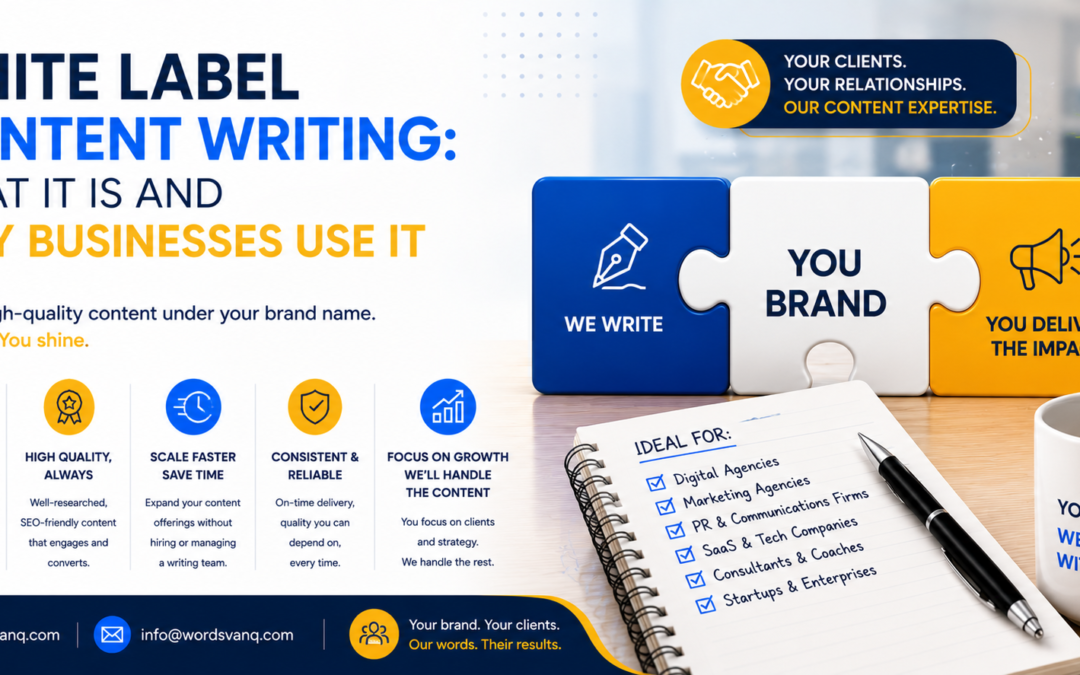
White label content writing is one of the most commercially logical models in the digital services industry. A business or agency outsources content production to a specialist content provider, receives the finished content under a confidentiality agreement, and delivers it to its own clients under its own brand, as if it were produced in-house. The end client sees only the agency’s name. The white label partner works invisibly in the background.
This model is used by thousands of digital marketing agencies, SEO firms, PR companies, web development studios, and businesses worldwide. It allows them to offer content services they could not economically produce in-house, scale their content output without scaling their headcount, and maintain the quality standards their clients expect. In this guide, we explain exactly how white label content writing works, who uses it, what to look for in a white label content partner, and why WordsVanq is the trusted white label content choice for agencies across India and internationally.
What Is White Label Content Writing?
White label content writing is a content production arrangement in which a specialist content agency creates content that another business presents to its clients as its own work. The content producer, the white label agency, operates without attribution. The reselling business, the agency or company purchasing the white label content, delivers it under their own brand.
The term “white label” comes from the retail industry, where manufacturers produce generic products that retailers package under their own brand labels. The same principle applies to content: WordsVanq produces a blog post, an SEO agency delivers it to their client as the agency’s own work, and the end client never has reason to know anyone else was involved.
How White Label Content Writing Works in Practice
| Step | Who Is Involved | What Happens |
|---|---|---|
| 1. Brief | Reselling agency and WordsVanq | The agency shares the client’s content requirements, brand guidelines, target keywords, and tone |
| 2. Production | WordsVanq | WordsVanq’s writers research and produce the content to the agreed specification and brand voice |
| 3. Delivery | WordsVanq to agency | Finished content is delivered to the agency under an NDA. No WordsVanq branding appears anywhere |
| 4. Review | Agency (optional: end client) | The agency reviews the content, may request revisions, and prepares it for delivery to their end client |
| 5. Final Delivery | Agency to end client | The agency delivers the content to their client under the agency’s own brand. The end client has no visibility into WordsVanq’s involvement |
| 6. Ongoing | All parties | The cycle repeats on the agreed publishing schedule. WordsVanq functions as an invisible extension of the agency’s team |
This arrangement is entirely standard, legal, and widely practiced across the digital services industry. There is nothing hidden or deceptive about it; agencies routinely use specialist partners for services including content writing, graphic design, web development, and paid advertising. “White labeling” simply means the specialist partner’s involvement is not disclosed to the end client.
Who Uses White Label Content Writing Services?
White label content writing is used by a wide range of businesses across the digital services ecosystem. Understanding who uses it helps clarify whether it is the right model for your specific situation.
| Business Type | Why They Use White Label Content | What They Typically Need |
|---|---|---|
| Digital Marketing Agencies | Core content capability without a full in-house writing team. Allows content to be offered as a service line | SEO blogs, website copy, social media content, email newsletters |
| SEO Agencies | Content is inseparable from SEO, but many SEO agencies are strong on technical SEO and weak on writing | Keyword-optimized blog posts, landing pages, on-page copy at scale |
| PR and Communications Firms | Clients need owned media content to complement earned media. White label allows PR firms to offer content services | Press releases, thought leadership articles, company blogs, LinkedIn content |
| Web Development and Design Studios | Clients need websites populated with content after the build. Studios rarely have in-house copywriters | Website homepage copy, about pages, service pages, product descriptions |
| Business Consultancies | Strategy clients need content implementation support that consultancies cannot economically staff in-house | Content strategies executed, blog programmes set up and maintained |
| Freelance Content Consultants | Individual content strategists who manage client content programmes but outsource production volume | Bulk blog production, content calendar execution, specialist content |
| Businesses Scaling Rapidly | Fast-growing companies that need to scale content output faster than they can hire | Increasing blog frequency, new content channels, new market content |
The common thread across all these user types is the same: they need content production capacity that exceeds what they can economically produce in-house, delivered to a quality standard that their clients expect. White label content writing solves this problem elegantly.
The Business Case for White Label Content Writing
For digital agencies and businesses considering the white label model, the commercial logic is straightforward. Here is how the economics typically work:
The Cost Comparison: In-House vs. White Label
| Cost Factor | In-House Writer (India) | White Label (WordsVanq) | Saving |
|---|---|---|---|
| Salary (Senior Writer) | Rs 60,000 to 90,000/month | None | Full saving |
| Benefits and PF | Rs 8,000 to 15,000/month | None | Full saving |
| Recruitment Cost (one-time) | Rs 50,000 to 150,000 | None | Full saving |
| Training and Onboarding | 2 to 4 weeks of lost productivity | None | Full saving |
| Management Overhead | 15 to 20% of manager’s time | Minimal – account management only | Significant saving |
| Sick Leave and Attrition Risk | High – individual writer dependency | None – team production model | Full saving |
| Scalability | Slow, each new hire takes months | Immediate scale-up with one request | Full flexibility gain |
| Per-Article Cost (1,500 words) | Rs 3,000 to 6,000 (fully loaded) | Significantly lower | 60 to 70% |
“For a digital agency billing clients for content at market rates and buying white label content from WordsVanq at our rates, the margin on content services is typically 40 to 60%. That is a content revenue stream that requires almost no overhead investment.”
Beyond cost savings, white label content provides a strategic benefit that the cost comparison alone does not capture: the ability to say yes to content opportunities that would otherwise be declined. An SEO agency that can offer high-quality blog writing, social media content, and email newsletter services, all delivered through WordsVanq as a white label partner, can win larger retainers and serve more clients without adding headcount.
What to Look for in a White Label Content Partner
Not all white label content providers are equal. Choosing the wrong partner can result in inconsistent quality, missed deadlines, confidentiality breaches, and damage to your reputation with the clients whose trust you are responsible for. Here is what to evaluate when selecting a white label content writing partner:
1. Quality Consistency Across Writers and Topics
The biggest risk with any white label content partnership is quality inconsistency—receiving excellent content one month and mediocre content the next. This happens when the provider lacks proper editorial processes, assigns writers randomly to projects, or relies on AI tools without human quality control.
A reliable white label content partner has a structured editorial process: dedicated writer assignment based on industry expertise, editorial review of every piece before delivery, and a revision policy that ensures every piece meets the agreed standard before it leaves their system. Ask for samples across multiple topics before committing.
2. Confidentiality Reliability
White label content only works if the provider operates with complete confidentiality. A provider who mentions client names in case studies without permission, uses client content in their own portfolio, or allows writers to discuss projects publicly is a liability risk.
WordsVanq operates under Non-Disclosure Agreements (NDAs) for all white-label partnerships. All content produced for white label clients is delivered exclusively to that client, never used in WordsVanq’s own marketing, and never discussed or referenced without explicit written permission.
3. Scalability Without Quality Loss
Your content needs will fluctuate. A client campaign might require 30 pieces in one month and 8 the next. A white label partner that can only maintain quality at consistent, predictable volumes is a constraint rather than a solution.
WordsVanq’s team-based production model, with multiple specialist writers across every industry category, allows us to scale output up or down with very short notice, without the quality degradation that happens when individual freelancers are overloaded.
4. Brand Voice Matching
Different clients have different voices: formal and authoritative, casual and conversational, technical and precise. A white label content partner that writes everything in the same generic style will produce content that sounds nothing like your client’s established brand.
WordsVanq invests time in understanding each client’s brand voice from samples, guidelines, and briefing conversations before producing the first piece. We maintain voice consistency across all content for that client, regardless of which writer is assigned.
5. Turnaround Reliability
Missed deadlines in a white label arrangement cascade directly to your clients. If your content partner delivers late, you deliver late, and you bear the client relationship consequences.
WordsVanq commits to and consistently meets 48 to 72-hour turnaround for standard content pieces. For high-volume accounts, we establish dedicated capacity slots that protect delivery timelines even during busy periods.
6. Clear and Transparent Pricing
White label content partnerships work best when pricing is clear, consistent, and scalable. Avoid providers with complex pricing matrices, hidden fees for revisions, or pricing that changes without notice.
WordsVanq provides transparent, volume-based pricing for white label partners with clear rates for different content types, lengths, and complexity levels. Volume discounts apply at agreed monthly thresholds, making the partnership increasingly economical as client accounts grow.
White Label Content Writing vs. Other Content Outsourcing Models
White label content writing is one of several content outsourcing models available to agencies and businesses. Understanding how it compares to alternatives helps clarify when it is the right choice.
| Model | How It Works | Best For | Main Limitation |
|---|---|---|---|
| White Label Agency | A specialist agency produces content, reselling business delivers under own brand | Agencies and businesses needing consistent volume with brand confidentiality | Requires trust in partner’s quality and confidentiality |
| Freelance Marketplace | Businesses hire individual freelancers per project through platforms | One-off projects or occasional content needs | Inconsistent quality, management overhead, no guarantees |
| Content Mill | High-volume, low-cost content factories, often template-based or AI-assisted | Bulk low-quality content at minimum cost | Quality too low for most professional client accounts |
| In-House Team | Employ writers directly on salary or contract | Businesses with stable, high-volume, single-brand content needs | High fixed cost, slow to scale, attrition risk |
| Hybrid (White Label + In-House) | Core in-house team for strategy and key accounts, white label for volume and specialist content | Mid-to-large agencies wanting quality control with scalability | Coordination complexity between internal and external teams |
For digital agencies and marketing firms serving multiple clients simultaneously, the white label agency model consistently outperforms the alternatives on the combination of quality, reliability, cost, and scalability. The freelance marketplace model introduces management overhead and quality inconsistency. The content mill model compromises quality. The in-house model introduces cost and inflexibility. White label eliminates all these problems simultaneously.
White Label Content Writing for Indian Agencies: The Specific Opportunity
India’s digital marketing agency landscape is one of the fastest-growing in the world. Hundreds of new digital agencies, SEO firms, and marketing consultancies are launched in India every year, many of them serving both domestic Indian clients and international clients in the US, UK, UAE, and other markets.
The Indian Agency Content Problem
Indian digital agencies face a particularly acute version of the content production challenge. They need to produce high-quality content across multiple industries, often for international clients with specific English language standards, at a price point that maintains competitive margins in a price-sensitive market.
Hiring in-house writers in India capable of producing consistent, high-quality English content for international markets is more expensive than most agency principals expect. Good English-language content writers in Bangalore, Mumbai, or Delhi command salaries that, when fully loaded with benefits and overhead, make per-article production costs only marginally cheaper than outsourcing.
How Indian Agencies Use WordsVanq as a White-Label Partner
- SEO agencies use WordsVanq to produce the blog content their clients need at the frequency and quality that drives Google rankings, at margins that make their content service line genuinely profitable.
- Digital marketing agencies use WordsVanq to expand their service offering to include content marketing, email newsletters, and social media content without hiring specialist writers.
- Web development studios use WordsVanq to deliver website copy alongside their builds, turning a pure tech sale into a fuller retainer.
- PR agencies use WordsVanq to produce the thought leadership and owned media content their clients need to complement earned media campaigns.
- Marketing consultants use WordsVanq to execute the content strategies they develop for clients, providing strategy and using WordsVanq for delivery.
■ WordsVanq white label partnerships are structured to be invisible to end clients. All content is delivered without any WordsVanq branding, attribution, or reference. Our writers sign confidentiality agreements, and agency partner details are never shared or referenced in our own marketing materials.
Setting Up a White Label Content Partnership With WordsVanq
Setting up a white label partnership with WordsVanq is straightforward. Here is the process from initial enquiry to first content delivery:
Step 1 – Initial Conversation and Fit Assessment
We start with a conversation about your agency’s content needs, your client base, the industries you serve, the content types you require, and your typical monthly volumes. This helps us assess whether we are the right fit and design the right partnership structure for your specific situation.
Step 2 – NDA Execution
Before any client details or content briefs are shared, we execute a non-disclosure agreement that protects your client relationships and business information. Our NDA covers complete confidentiality of client identities, project details, and content produced.
Step 3 – Onboarding and Sample Production
We onboard your team and produce two to three sample pieces across your most common content types and industries. This allows you to evaluate quality, provide feedback, and calibrate our understanding of your standards before the partnership goes live.
Step 4 – Briefing Process Alignment
We agree on a briefing template and process that makes content requests efficient for your team. Good briefs produce better content, we help you develop a brief format that captures all the information our writers need to produce on-brand, on-target content without excessive back-and-forth.
Step 5 – Pricing and Volume Agreement
We agree on pricing based on your expected monthly volumes across different content types. Volume-based pricing tiers reward consistent partnership with lower per-unit rates as monthly volumes grow.
Step 6 – Go Live and Ongoing Partnership
The partnership goes live with a structured review at the end of the first month to assess quality, turnaround, and process fit. Most white label partners are fully comfortable with the process within the first two to three months and run the partnership largely on autopilot from there.
8. Common White Label Content Questions Answered
These are the questions agencies and businesses most commonly ask before entering a white label content partnership:
Q: Can our clients ever find out WordsVanq produced the content?
A: Not through our actions. We operate under NDA, produce all content without attribution to WordsVanq, and never reference client relationships in our own marketing. The only way a client could discover the arrangement is if the agency itself disclosed it, which is entirely the agency’s choice to make.
Q: What happens if the quality is not what we expected?
A: Every piece delivered under our white label arrangements includes a revision round at no additional cost. If content does not meet the agreed standard, we revise until it does. If there is a persistent quality issue, our account management team investigates the root cause, a writer mismatch, briefing quality, or process gap, and resolves it.
Q: Can you match different brand voices for different clients?
A: Yes. We maintain separate brand voice profiles for every client account within a white label partnership. A brief for Client A is assigned to a writer familiar with Client A’s voice, and a brief for Client B goes to a writer calibrated to Client B’s completely different tone. Voice consistency is one of our most important quality commitments.
Q: Do you produce content for international clients in American or British English?
A: Yes. WordsVanq produces content for Indian clients and for international clients in American English, British English, Australian English, and Canadian English. All international English content goes through an appropriate English variant review before delivery.
Q: Is there a minimum volume commitment?
A: We work with white label partners from startup agencies needing 4 to 8 pieces per month through to large agencies needing 100 or more pieces per month. There is no punitive minimum volume, but consistent monthly partnerships receive better pricing than one-off requests.
Why WordsVanq Is India’s Trusted White Label Content Partner
At WordsVanq, white label content partnerships are a core part of our business, not an afterthought. We have structured our operations, our quality processes, and our account management specifically to serve agencies and businesses that need reliable, scalable, confidential content production.
| What WordsVanq Offers | What It Means for Your White Label Partnership |
|---|---|
| Full NDA Coverage | All white-label partnerships operate under non-disclosure agreements. Client identities and projects stay confidential |
| 100% Human-Written Content | No AI-generated content. Every piece produced by a trained human writer with relevant expertise |
| Industry-Specific Writer Matching | We match every client account to writers with genuine expertise in the relevant sector – not generalists |
| Brand Voice Profiles | Separate brand voice documentation maintained for every client account. Consistent tone across all deliverables |
| Multi-Language English Support | American, British, Australian, and Canadian English available for international client accounts |
| 48-72 Hour Standard Turnaround | Reliable delivery within agreed timelines. Dedicated capacity for high-volume partners |
| Volume-Based Pricing | Transparent per-piece pricing with volume discounts at agreed monthly thresholds |
| Dedicated Account Management | A single point of contact for your partnership. Brief submission, delivery coordination, and quality control |
| Unlimited Revisions Policy | Every piece includes revisions until it meets the agreed standard. No revision fees |
| Scalable from Day One | Scale from 4 to 200+ pieces per month without process changes or quality degradation |
Conclusion
White label content writing is one of the most commercially logical decisions a digital agency or marketing business can make. It turns content, which every client needs but most agencies struggle to produce economically, into a profitable, scalable service line without the headcount, management overhead, and attrition risk of building an in-house writing team.
The key is choosing the right white label content partner. A partner that operates with genuine confidentiality; produces consistently high-quality content across multiple industries and English variants; matches brand voices reliably; and delivers on time, every time.
If your agency or business is ready to explore a white label content writing partnership with WordsVanq, get in touch today. We will start with a no-commitment conversation about your needs, execute an NDA, and produce sample content so you can evaluate quality before making any commitment. That is how confident we are in what we deliver.
Ready to start a white label content partnership? Get in touch with WordsVanq today.
Visit: wordsvanq.com/contact-us | Call: +91 9555844324 | Email: info@wordsvanq.com
Frequently Asked Questions
Q: What is white label content writing?
A: White label content writing is a content production arrangement in which a specialist content agency creates content that another business resells to its own clients under its own brand. The end client never knows the original content producer was involved. This model is widely used by digital marketing agencies, SEO firms, PR companies, and web development studios to offer content services at scale without building in-house writing teams.
Q: Is white label content writing ethical and legal?
A: Yes, completely. White labeling is a standard commercial practice across industries from manufacturing to professional services. Digital agencies routinely white label services, including web development, graphic design, PPC management, and content writing. There is nothing deceptive about it—the end client is contracting with the agency for a deliverable, and the agency’s choice of production partners is a business decision. WordsVanq operates under NDA for all white label partnerships.
Q: How is white label content different from ghostwriting?
A: “Ghostwriting” refers to content written in the voice of a specific named individual—a CEO’s LinkedIn article, a founder’s blog post. White label content writing refers to content produced for a business (not a specific person) that the purchasing agency delivers to its own end client. Both involve content produced without attribution to the original writer, but the scale, commercial structure, and use case are different.
Q: What industries does WordsVanq cover for white label content?
A: WordsVanq covers all major industries for white-label content partners—including technology and SaaS, finance and fintech, healthcare, real estate, legal services, e-commerce, education, construction, and hospitality. We also produce content for international markets in American, British, Australian, and Canadian English for agencies serving global clients.
Q: How do we get started with a WordsVanq white label partnership?
A: Contact WordsVanq to start a conversation about your agency’s content needs. We will assess fit, execute an NDA, agree on briefing processes and pricing, and produce sample content before going live. Most partnerships are fully operational within 5 to 7 business days of initial contact.