
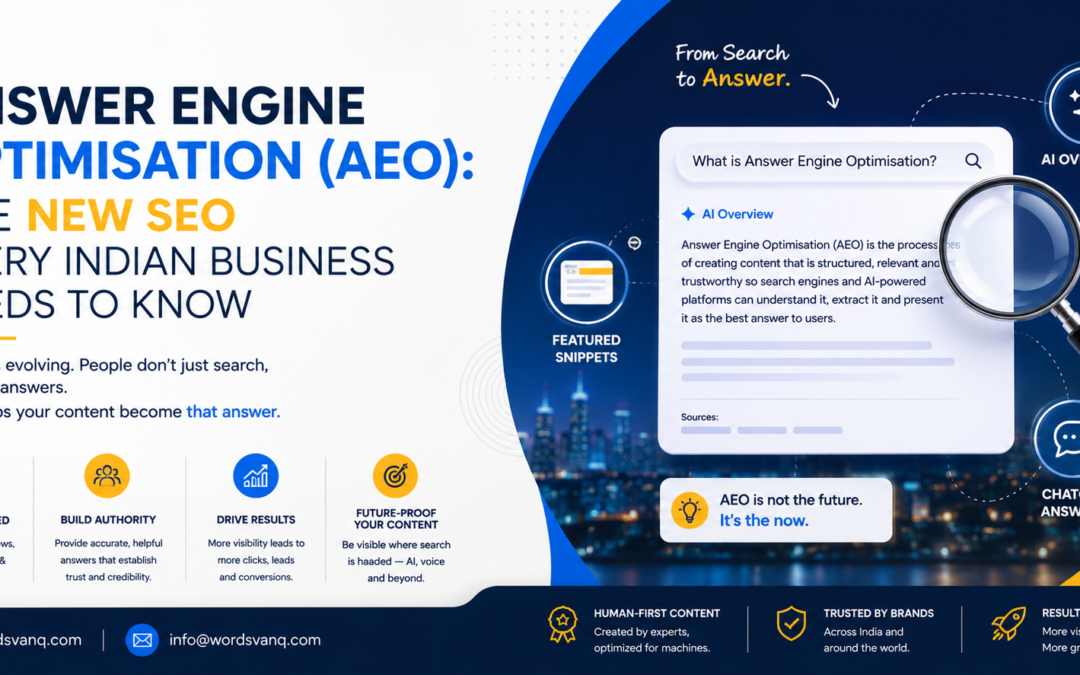
AI search platforms process 1B+ queries per month in 2026.
60% of searches now end without a website click.
Pages optimized for AEO get 3x more AI citations than unoptimized pages.
Only 8% of Indian businesses have an AEO strategy today.
KEY TAKEAWAYS
✓ AEO (Answer Engine Optimization) is the practice of structuring content to be cited by AI answer engines like ChatGPT, Perplexity, Google AI Overviews, and Gemini.
✓ AEO and SEO are complementary, not competing; AEO builds on good SEO and adds specific content structure and trust signals.
✓ The three pillars of AEO are: direct answers (content structure), authority (trust signals and credentials), and accessibility (technical access for AI crawlers).
✓ Question-format headings followed by 40-60 word direct answers are the most reliable AEO content structure.
✓ Only 8% of Indian businesses currently have an AEO strategy, making this a massive first-mover opportunity.
✓ WordsVanq creates AEO-optimized content that helps Indian businesses get cited by ChatGPT, Perplexity, and Google AI.
Something fundamental has changed about how people find information. For thirty years, the process was the same: type a query into Google, receive a list of links, click one, read the answer. The website owner got the traffic. The user got the information.
That process is breaking down. When someone asks ChatGPT, “What is the best content writing agency in India?” they get a direct answer, a synthesized response that names specific agencies, explains what they offer, and recommends a choice. No list of links. No clicking through to websites. The answer engine answered the question.
This is the shift that Answer Engine Optimization (AEO) addresses. Where SEO was about ranking in search results so users would click through to your website, AEO is about becoming the source that AI answer engines cite when they respond to questions about your industry, your services, or your expertise. In 2026, both matter, but AEO is the faster-growing opportunity, and almost no Indian businesses have a strategy for it yet. This guide explains what AEO is, how it works, how it differs from traditional SEO, and exactly what Indian businesses need to do to build an AEO content strategy that works.
What Is Answer Engine Optimization (AEO)?
Answer engine optimization is the practice of creating and structuring content so that AI-powered answer engines, including ChatGPT, Perplexity, Google AI Overviews, Gemini, and Claude, select your content as a source when generating responses to user queries.
Where traditional SEO aims to rank your page in a list of search results so users click through to your website, AEO aims to have your content cited directly within an AI-generated answer. The user receives the answer from the AI, but the AI’s answer is built from your content, and the source attribution gives your brand visibility and authority.
Why AEO Has Become Essential in 2026
The numbers explain the urgency. According to SparkToro and Datos research published in 2024, approximately 60% of Google searches now end without a click to any website. Users are getting their answers from Google’s own AI features, AI Overviews, featured snippets, and knowledge panels without ever visiting a third-party site. For AI search platforms like ChatGPT and Perplexity, the zero-click rate is even higher.
For Indian businesses, this creates a stark choice. Either optimize content to be the source AI engines cite, in which case your brand appears in AI answers even without a click, or remain invisible to the growing proportion of users who get their answers from AI rather than traditional search results.
AEO vs SEO vs GEO: Understanding the Differences
The marketing world in 2026 is full of new acronyms. AEO, GEO, LLM optimization, and AI search optimization can be confusing. Here is a clear breakdown of what each term means and how they relate to each other.
| Term | Full Name | What It Optimises For | Primary Platforms |
|---|---|---|---|
| SEO | Search Engine Optimisation | Ranking in traditional search result pages so users click to your website | Google, Bing |
| AEO | Answer Engine Optimisation | Being cited as a source in AI-generated direct answers to questions | ChatGPT, Perplexity, Google AI Overviews, Gemini[, Claude] |
| GEO | Generative Engine Optimisation | Broader term covering optimisation for all AI-generated content, includes AEO | ChatGPT, Perplexity, Google AI, all LLM-powered search platforms |
| LLMO | Large Language Model Optimisation | Ensuring brand and content appears in LLM training data and retrieval systems | ChatGPT (training data), Gemini, Claude |
| VSO | Voice Search Optimisation | Ranking for voice queries answered by smart speakers and voice assistants | Google Assistant, Siri, Alexa, Cortana |
“AEO is not a replacement for SEO. It is the next layer of the same strategy. You still need to rank to be cited. But ranking alone is no longer enough.”
The most important thing to understand is that AEO and SEO are not competing strategies. AEO builds on top of SEO. You cannot be cited in AI Overviews if you do not rank in the top 10 organic results. But ranking in the top 10 is no longer sufficient on its own. You also need to structure your content in a way that makes it easy for AI systems to extract, trust, and cite.
How Answer Engines Work to Decide What to Cite
To optimize for AEO, you need to understand how AI answer engines actually decide which sources to cite. The mechanics differ somewhat between platforms, but the core signals are consistent.
The Three Core AEO Signals
Signal 1: Direct Answers (Content Structure)
AI answer engines are fundamentally extraction systems. They retrieve content from the web, extract relevant passages, and synthesize them into an answer. Content that is structured to make extraction easy, with clear question-format headings, direct-answer paragraphs, and well-formatted lists, is cited far more frequently than content that buries answers in narrative prose.
Research published by Superlines found that 44% of AI citations come from the first 30% of content on a page and from the first paragraph immediately following a question-format heading. This is the most actionable structural insight in AEO: lead with your answer, then provide depth.
Signal 2: Authority (Trust and Credibility Signals)
AI systems, particularly ChatGPT, which draws heavily on training data rather than real-time web retrieval, weigh sources by their perceived authority. A website that appears consistently across multiple credible external sources, has named authors with verifiable credentials, and has earned backlinks from authoritative domains is significantly more likely to be cited than a website that only exists on its own domain.
This is why AEO is not just a content strategy; it is a brand authority strategy. Getting mentioned in industry publications, earning backlinks, maintaining a consistent and credible presence across platforms, and having named experts associated with your content all contribute to the authority signals that AI systems use to evaluate sources.
Signal 3: Accessibility (Technical AI Crawler Access)
AI answer engines cannot cite content they cannot read. Each major AI platform uses specific web crawlers to access and index content, and many websites have inadvertently blocked these crawlers through their robots.txt settings.
The key AI crawlers you must allow in your robots.txt file:
- GPTBot and OAI-SearchBot—OpenAI (ChatGPT and ChatGPT Search)
- PerplexityBot — Perplexity AI
- ClaudeBot and Anthropic-AI—Anthropic (Claude)
- Google-Extended — Google AI Overviews and Gemini training
- Bingbot—Microsoft Copilot and ChatGPT search integration
■ Check your robots.txt immediately. Many Indian business websites updated their robots.txt in 2023–24 to block AI crawlers, making them completely invisible to every major AI answer engine. Go to yourdomain.com/robots.txt and verify none of these crawlers are blocked.
How Each AI Platform Works: A Guide for Indian Businesses
| AI Platform | How It Sources Answers | Key AEO Signal | Growing in India? |
|---|---|---|---|
| ChatGPT | Primarily training data (knowledge cutoff). Web search activated for recent queries. Favours high-authority [sources] | Brand mentions across multiple external platforms. Wikipedia presence. | Very rapidly, 200M+ global weekly users |
| Perplexity AI | Real-time web search for every query. Retrieves and reads current pages. Heavily favors fresh content. | Content freshness (published recently). Fast page speed. Direct answers | Growing fast among Indian researcher[s and students] |
| Google AI Overviews | Pulls from Google’s organic search index. 97% of cited sources rank in the top 20 organically. | Existing organic rankings. E-E-A-T signals. FAQ Page and HowTo Schema | Expanding across India, now visible for most search queries. |
| Gemini | Hybrid of Google index and real-time retrieval. Closely tied to Google Search signals. | Google organic ranking. Brand authority. Structured data. Official page sources | Integrated into Google Workspace—rapidly growing in India |
| Claude (Anthropic) | Real-time web retrieval when web search is enabled. Favors accurate, well-sourced content. | Content accuracy. Source citation within content. Clear, factual writing style | Growing among Indian developers and [tech professionals] |
For most Indian businesses, the highest-priority platforms to optimize for are Google AI Overviews (because they appear within existing Google searches), Perplexity (because it sends significant referral traffic), and ChatGPT (because of its massive user base and brand recognition effect). A good AEO content strategy covers all three simultaneously.
The AEO Content Framework: How to Structure Every Page
The most impactful change you can make to improve your AEO performance is changing how you structure your content. Here is the framework that produces the most consistent AEO results:
Step 1: Identify AEO Target Questions
Every piece of AEO-optimized content should target a specific question that your audience is asking AI engines. Use Google’s People Also Ask section, AnswerThePublic, keyword research tools, and your own customer service and sales conversation records to identify the most-asked questions in your space.
For an Indian content writing agency, AEO target questions might include “What is the best content writing agency in India?” , “How much does content writing cost in India?” “What is SEO content writing?”, “How do I rank my Indian business website on Google?”
Step 2: Use Question-Format Headings
Structure your content with H2 and H3 headings that phrase the exact target question as users would ask it. This signals to AI extraction systems that this section of content directly answers a specific question.
Heading format:
H2: What Is Answer Engine Optimization? H2: How Does AEO Differ from SEO? H2: How Can Indian Businesses Rank in AI Search?
Step 3: Answer Directly in 40-60 Words
Immediately after your question-format heading, provide a direct, complete, self-contained answer in 40 to 60 words. This is the passage AI systems most commonly extract as a citation. It must make complete sense on its own, without requiring any surrounding context.
Example AEO-optimized answer:
H2: What Is Answer Engine Optimization (AEO)? Answer Engine Optimization (AEO) is the practice of structuring website content so that AI-powered platforms like ChatGPT, Perplexity, and Google AI Overviews cite your content when generating direct answers to user questions. AEO builds on traditional SEO by adding specific content structures, trust signals, and technical access that AI systems require to extract, evaluate, and recommend content as a credible source.
Step 4: Support With Depth
After the 40-60 word direct answer, continue with comprehensive supporting content, examples, data, additional context, and related questions. This depth signals to AI systems that your page is genuinely authoritative on the topic, not just superficially covering it.
Step 5: Add Verifiable Statistics With Source Links
AI systems gain confidence in a source when its claims are backed by verifiable statistics with links to credible external sources. Include data points from reliable research, industry reports, or authoritative publications, and link to them. This single change can significantly improve your AEO citation rate.
Step 6: Implement FAQPage Schema
Add FAQPage schema markup to every page that contains a question-and-answer structure. The FAQPage schema is one of the most direct signals to Google AI Overviews that your content contains structured Q&A content suitable for extraction. It also improves your eligibility for featured snippets simultaneously.
Building AEO Authority: The Off-Page Strategy
On-page content structure is only half of AEO. The other half is building the external authority signals that AI systems — particularly ChatGPT — use to decide whether to trust and cite a source.
The Consensus Signal: Why AI Needs Multiple Confirmations
Research from Profound and SEMrush shows that AI platforms look for agreement across multiple independent sources before confidently recommending a brand or citing a piece of content. If your business appears consistently across your own website, industry publications, review platforms, and professional communities, all with similar positioning, AI systems gain the confidence to recommend you.
For Indian businesses, building this consensus signal requires a deliberate off-page strategy:
- Get published in Indian industry publications—The Economic Times, YourStory, Inc42, Entrepreneur India, and sector-specific publications all contribute to the consensus signal.
- Build Quora and Reddit presence — These are heavily indexed platforms that both ChatGPT’s training data and Perplexity’s real-time retrieval draw from. Genuine, helpful answers on industry topics build AEO authority.
- Collect and respond to reviews — Google Business Profile reviews, G2 reviews, and Clutch listings are all crawled by AI systems as trust validation.
- Get cited by other websites — Traditional backlinks remain important for AEO because they create the web of external validation that AI systems look for.
- Maintain consistent brand positioning — If your website says you are “India’s leading content writing agency” but your external mentions say something different, AI systems lose confidence in your positioning.
AEO for Indian Businesses: The Specific Opportunity
India represents a particularly significant AEO opportunity for two reasons: the speed of AI search adoption among Indian users and the almost complete absence of AEO strategy among Indian businesses.
Indian AI Search Adoption Is Accelerating
India has one of the world’s fastest-growing ChatGPT and AI tool user bases. Indian students, professionals, and entrepreneurs are adopting AI search platforms at a remarkable rate, driven by affordable smartphones, low data costs, and a young, tech-forward population. The Indian AI user base is projected to be one of the largest in the world by 2027.
This means that the proportion of Indian searches happening on AI platforms rather than traditional Google search is growing rapidly. Businesses that build AEO content libraries now will have a significant head start over competitors who wait.
The Indian AEO Gap: A First-Mover Opportunity
Despite this growing demand, fewer than 8% of Indian businesses currently have any AEO strategy. Most Indian content, even from established agencies, is still written for traditional Google SEO only, with no consideration for how AI systems extract and evaluate content.
This gap creates an extraordinary opportunity. An Indian business that builds a structured AEO content library right now, with question-format headings, direct answer paragraphs, FAQPage schema, and external authority signals, will occupy AI answer positions for its key topics before competitors even know AEO exists.
Local and Regional AEO: An Untapped Indian Opportunity
As AI platforms expand their coverage of Indian languages and local queries, local AEO is becoming increasingly important. When someone asks Perplexity “best content writing agency in Delhi” or asks Google AI Overviews “top SEO services in Bangalore,” the cited sources will be businesses with locally targeted, AEO-structured content. This is an opportunity that is almost completely untapped by Indian SMBs right now.
AEO Content Audit: Is Your Existing Content AEO-Ready?
Before building new AEO content, audit your existing pages to identify which ones are closest to AEO-ready and can be improved with targeted restructuring.
| AEO Audit Question | If Yes | If No, action required. |
|---|---|---|
| Does the page already rank in the top 20 for its target query? | Proceed with AEO optimization; this page is eligible for AI Overview citation | Focus on SEO first to reach page one before adding AEO structure. |
| Does the page have question-format H2 or H3 headings? | Good, ensure direct answers follow each heading | Restructure headings to phrase target queries as questions |
| Is there a 40-60 word direct answer paragraph after each question heading? | Strong AEO structure — check word count and self-containedness | Add direct answer paragraphs immediately below each [question heading] |
| Are there outbound links to credible sources for all statistics? | Good, AI systems value verifiable sourcing | Add source links to all statistical claims and external references. |
| Is FAQPage schema implemented on pages with Q&A content? | Excellent, this directly improves AI Overview eligibility | Add FAQPage schema; this is one of the highest-impact A[EO changes] |
| Are all major AI crawlers allowed in robots? Text? | Good, your content is accessible to AI systems | Update robots.txt immediately to allow GPTBot, PerplexityBot, ClaudeBot, and others. |
■ Run this audit on your top 10 most important pages first, your homepage, key service pages, and your most-visited blog posts. These are the pages most likely to already rank and most likely to earn AI citations with targeted optimization.
How WordsVanq Builds AEO-Optimized Content
At WordsVanq, AEO optimization is integrated into our content writing process for every client. As AI search becomes an increasingly important traffic and visibility channel, the content we create is built to perform in both traditional search and AI answer engines simultaneously.
| What WordsVanq Does | How It Supports AEO Performance |
|---|---|
| AEO Question Research | We identify the exact questions your audience is asking AI engines and structure content to answer them directly. |
| Question-Format Heading Strategy | Every piece is structured with a hierarchy of question-format H2 and H3 headings that match [target queries] |
| 40-60 Word Direct Answer Paragraphs | We write and verify direct answer paragraphs for every question heading, the most common [cited content format by AI systems] |
| Verifiable Source Citation | We include credible outbound source links for all statistical claims — a key AI trust signal. |
| FAQ Page Schema Guidance | We recommend and support FAQPage schema implementation on every piece with Q&A structure. |
| AI Crawler Access Review | We advise clients on robots.txt configuration to ensure all major AI crawlers can access their [content] |
| Local AEO for Indian Searches | We structure location-specific content for AEO visibility in local Indian AI search queries. |
| Authority Signal Strategy | We advise on off-page strategies to build the consensus signals that ChatGPT and other AI systems look for. |
Conclusion
Answer: Engine optimization is not a future concern. It is a present-day competitive advantage that is available right now to the small minority of Indian businesses aware enough to pursue it. As AI search platforms continue to grow their Indian user base and as Google AI Overviews expand their coverage of Indian search queries, the gap between AEO-optimized businesses and those that are not will widen rapidly.
The good news is that the content strategies that win in AEO are the same strategies that make content genuinely excellent: clear answers, credible sourcing, real expertise, and proper structure. AEO does not require a different kind of content; it requires a better version of the content you should already be creating.
If your Indian business is ready to build a content strategy that performs in both traditional search and the growing AI search landscape, WordsVanq is ready to help. We build AEO-optimized content that earns citations, builds authority, and drives traffic from every search surface, now and as the search landscape continues to evolve.
Want content optimized for AI search and traditional SEO? Talk to WordsVanq today.
Visit: wordsvanq.com/contact-us | Call: +91 9555844324 | Email: info@wordsvanq.com
Frequently Asked Questions
Q: What is Answer Engine Optimization (AEO)?
A: Answer Engine Optimization (AEO) is the practice of structuring website content so that AI-powered platforms like ChatGPT, Perplexity, and Google AI Overviews cite your content when generating direct answers to user questions. AEO builds on traditional SEO by adding specific content structures, authority signals, and technical access that AI systems require to extract, evaluate, and recommend content as a credible source.
Q: How is AEO different from SEO?
A: Traditional SEO aims to rank your page in a list of search results so users click through to your website. AEO aims to have your content cited directly within an AI-generated answer, providing brand visibility even when users do not click through to your site. AEO builds on top of SEO: you generally need to rank in the top 10 organically before AI systems will cite your content, but ranking alone is no longer sufficient in an AI search environment.
Q: Which AI platforms are most important to optimize for in India?
A: For Indian businesses in 2026, the highest-priority AEO platforms are Google AI Overviews (because they appear within existing Google searches), Perplexity (because it sends measurable referral traffic), and ChatGPT (because of its massive and rapidly growing Indian user base). A good AEO content strategy covers all three simultaneously through the same content structure and authority-building practices.
Q: How do I check if AI crawlers can access my website?
A: Go to yourdomain.com/robots.txt and look for “Disallow” rules that mention GPTBot, OAI-SearchBot, PerplexityBot, ClaudeBot, anthropic-ai, Google-Extended, or Bingbot. If any of these are blocked, update your robots.txt to allow them. This is the single fastest technical change that can improve your AEO performance.
Q: Can WordsVanq help me build an AEO content strategy?
A: Yes—WordsVanq integrates AEO optimization into every content project. We structure content for direct AI extraction, implement question-format headings, write 40-60 word answer paragraphs, add source citations, and advise on FAQPage schema and robots.txt configuration. Contact us to discuss an AEO-optimized content strategy for your Indian business.